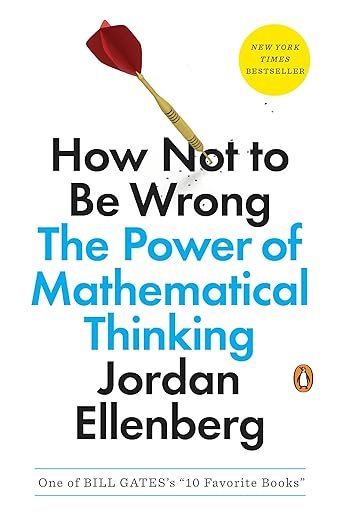

Book "How Not to Be Wrong": The Power of Mathematical Thinking
Author: Jordan Ellenberg
The Idea in Numbers
Zero (0)! This was the most important number when analyzing military aircraft returning from battles in World War II. The military noticed that returning aircraft were full of bullet holes in the wings and tail, so they decided to reinforce those areas. But mathematician "Abraham Wald" intervened and said: "We should reinforce the engine, because although there are zero holes in it, that means aircraft hit in the engine didn't come back!". This zero represents what's known as "survivorship bias", and proves that numbers we don't see are just as important as numbers we do see.
The Big Idea
Mathematics is not just complex equations taught in classrooms, but "an extension of common sense by other means". This book shows how simple mathematical thinking can be a shield protecting us from logical fallacies, statistical manipulation by marketers and politicians, and helps us read the hidden structures that govern our daily world.
3 Life Lessons from This Book
- Survivorship Bias (Survivorship Bias): We always tend to focus on the successful (entrepreneurs, companies, winners) and extract lessons from their numbers, ignoring the "silent graveyard" of millions of failures who followed the same steps. To make your analysis accurate, always search for missing data and people who didn't complete the journey.
- Linear Thinking Trap (Non-linear Thinking): Many believe that an upward trend will continue to go up forever. If increasing work hours increases productivity, this doesn't mean working 24 hours will achieve legendary productivity (it will cause collapse). Mathematical thinking teaches us that most phenomena in life are not straight-line, but take the form of curves that change over time and circumstances.
- The Art of Methodical Doubt (The Value of Uncertainty): Numbers don't always give you absolute certainty at 100%. Real mathematics doesn't teach us how to be sure, but teaches us how to be "unsure in a precise and studied way" by understanding probabilities and margins of error.
Unforgettable Quotes
"Mathematics is common sense after we strip away the confusion and dress it in the garb of precision."
"Being wrong is inevitable; but mathematics helps you be wrong less often and less catastrophically."
Who Is This Book For?
For data analysts, decision-makers, and everyone who thinks they "hate mathematics"; they will discover that mathematical thinking is just a clearer and smarter way to understand life and make sound decisions based on numbers and probabilities.
 Ask Yamami
Comments (8)
No comments yet. Be the first to comment!