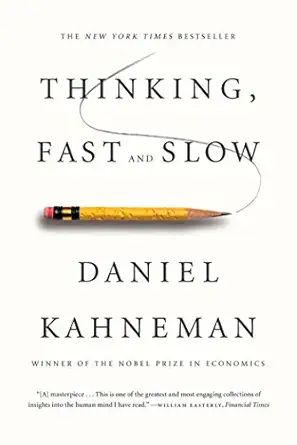

Book "Thinking, Fast and Slow": How Do We Fall Into Our Mind's Trap?
Author: Daniel Kahneman - Nobel Prize winner in Economics.
The Idea in Numbers
2 is the multiplier of the "pain" we feel when losing compared to the "pleasure" we feel when achieving a gain of the same value! Statistical data in this book has proven a phenomenon known as "Loss Aversion", where losing $100 bothers you psychologically twice as much as the happiness of winning $100. This simple number explains many of our financial decisions and irrational behavior in life.
The Big Idea
Our minds work according to two systems: "System 1" is fast, emotional, and automatic, but it hates numbers and easily falls into the trap of biases. "System 2" is slow, logical, and analytical, but it is very lazy by nature. The book shows that understanding life and interpreting data correctly requires us to force "System 2" to work hard, and not surrender to the quick jumps and conclusions that "System 1" tempts us with.
3 Life Lessons from This Book
- Anchoring Effect: Our minds are strongly affected by the first number we encounter. If you see a product priced at $1000 then reduced to $500, you'll feel it's a great deal, ignoring the product's true value. The first number works as an "anchor" that programs our subsequent expectations, and it's a tactic used heavily in pricing and negotiation.
- Illusion of Understanding: The human mind tends to make coherent stories from random or incomplete data to convince itself that it understands how the world works, which Kahneman calls "What You See Is All There Is" (WYSIATI). To read reality accurately, we must learn to search for missing data, not settle for only available data.
- Base Rate Neglect: When judging the likelihood of an event, people tend to focus on exciting descriptive details and ignore general statistics and true proportions (base rate). To not be deceived in your predictions, always return to historical overall statistics before diving into details.
Unforgettable Quotes
"The surest way to make people believe lies is through constant repetition; because the human mind does not easily distinguish between the familiar and the truth."
"We tend to overestimate how much we understand the world, and greatly underestimate the role of chance and randomness in events."
Who Is This Book For?
For investors, financial analysts, marketing managers, and anyone who wants to understand how they make daily decisions, and how to avoid the mental traps that distort their reading of reality and numbers.
 Ask Yamami
Comments (7)
No comments yet. Be the first to comment!