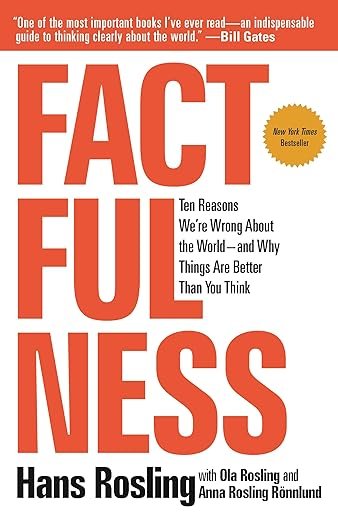

Factfulness: Why the World is Better Than You Think
Author: Hans Rosling
The Idea in Numbers
33% is the percentage of correct answers that humans (including politicians, scientists, and bankers) achieve when tested on basic global facts about poverty, education, and health. This means that chimpanzees – which choose answers randomly – outperform most educated individuals in understanding reality! The reason? Our brains are wired to consume drama, not to read numbers.
The Big Idea
Our view of the world is severely distorted by our psychological instincts and our bias towards negative news. This book presents a framework based on data and statistics to tame these instincts, proving that the world – despite challenges – is gradually improving, and that reading numbers objectively is the only tool to understand reality away from misleading pessimism.
3 Life Lessons from This Book
- Beware of the Gap Instinct: As humans, we tend to divide the world into two opposing categories (us and them, rich and poor, developed and developing countries). However, recent numbers show that the vast majority of the world's population (about 75%) now lives in the "middle," where income and living standards are average. The world is no longer split into two distant halves.
- Bad Can Be Improving: Many fall into the trap of confusing "state" with "trend." The current situation of a phenomenon can be "bad," but the overall trend in the numbers can be "improving." For example: extreme poverty still exists, but its rate is historically declining remarkably. Don't let the momentary negative picture blind you to the path of progress.
- Knowledge Has an Expiration Date: The information and statistics we learned 10 or 20 years ago are outdated. Numbers speak daily, and we must continuously update our data and beliefs just as we update our smartphones.
Unforgettable Quotes
"Forming your view of the world based on news headlines is like forming your opinion of me by only looking at a picture of my feet."
"You cannot understand the world without numbers, but you cannot understand it with numbers alone."
Who Is This Book For?
For every decision-maker, data analyst, and entrepreneur seeking an accurate understanding of behaviors and markets. And for anyone feeling overwhelmed by negative news and looking for a precise digital compass to read the world realistically.
 Ask Yamami
Comments (12)
No comments yet. Be the first to comment!