
Al Jouf Agricultural Development Company announced the signing of strategic supply agreements for "par-fried potato fries" with the companies operating the AlBaik restaurant chain (each operating company separately). This step comes as part of the company’s efforts to expand its customer base and strengthen its marketing channels, supporting efforts to localize Saudi food products in line with the objectives of Saudi Vision 2030.
Each agreement runs for one Gregorian year and is renewable, while the agreement values were not predetermined; quantities and prices will be set quarterly according to supply mechanisms and actual orders. The company expects the financial impact to begin contributing positively from the third quarter of 2026, depending on the development of agreed supply volumes and actual orders, without disclosing a specific financial value. It confirmed that the contracts were concluded on customary commercial terms and in accordance with applicable regulations and approved governance policies.
Al Yamamah University students discussed the implications of this announcement and its expected impact on the company’s financial performance and expansion strategy within the food services sector as follows:
Strengthening B2B market presence and pricing flexibility
Student "Mohammad Alghaihab" @Mohammad Alghaihabcommented on the investment and commercial dimensions, saying: "I believe the agreement represents a positive step for Al Jouf Agricultural, not only in terms of increasing revenue, but also because it takes the company deeper into the B2B market and links its agricultural production to a party with a high and sustained level of demand, such as AlBaik restaurants.
What stands out to me is that setting quantities and prices on a quarterly basis gives the company flexibility in dealing with changes in demand and production costs. At the same time, however, it means that the impact on revenue and profit margins will be tied to demand levels and changes in input costs.
From an investment perspective, the most important factor will be Al Jouf’s ability to turn this agreement from a supply contract into a sustainable business relationship, so that future increases in supply volumes translate into revenue growth and higher cash flows without coming at the expense of margins."
Operating efficiency and unit economics
From a purely operational perspective, student "Ghadah Alwallan" @Ghadah Alwallanoffered her assessment, saying: "The aspect of the agreement that caught my attention is its impact on the utilization of Al Jouf’s production capacity, rather than merely adding a new customer.
If demand from AlBaik helps increase production volumes without a corresponding increase in fixed costs, this could support operating efficiency and improve unit economics.
However, the actual impact will remain linked to the company’s ability to fulfill the required quantities efficiently, particularly given the quarterly demand-setting mechanism."
Production planning and reducing operational risks
Regarding risk management and supply chains, student "Rimas Almashali" @Rimas Almashaliadded: "In my view, one of the important aspects of the agreement is that it narrows the gap between local agricultural production and end demand from the restaurant sector. This could give Al Jouf a clearer view of demand levels and help it with production planning while reducing the risk of producing quantities that are not matched by sufficient demand.
However, the actual benefit will depend primarily on the extent of stability in AlBaik’s orders from one quarter to the next."
Supporting local content and improving profit margins
Regarding the strengthening of local content and the financial impact, colleague "Abeer Altuwaijri" @Abeer Altuwaijrishared her view, saying: "I believe Al Jouf Agricultural’s agreement with AlBaik is a positive step because it strengthens reliance on local products and provides the company with more stable demand for its products. Setting prices and quantities on a quarterly basis also gives it flexibility in dealing with changes in production costs. Financially, I expect this partnership to contribute to increased sales and revenue growth, and it may support profit margins alongside higher production volumes and improved operating efficiency."
A step toward localization and stronger profit margins
In an analytical assessment of the company’s performance, financial and economic analyst "Hamad Alsaeed" @Hamad Alsaeedexplains, saying: Al Jouf Agricultural’s agreements with AlBaik restaurants have a limited direct impact on GDP, but their significance lies in localizing production, which aligns with the Vision 2030 targets of increasing the private sector’s contribution to GDP from 40% to 65% and raising non-oil exports from 16% to 50%. Every riyal spent on imports is deducted from the GDP equation through net exports.
From the company’s operational perspective, Al Jouf expanded its factories in August 2024 with an additional SAR 87 million to increase productivity. This expansion saddled the company with significant fixed operating expenses. Accordingly, this contract will allow the company to spread these fixed costs over higher production volumes, reducing the unit cost; we may therefore see an improvement in the company’s profit margins in the future.
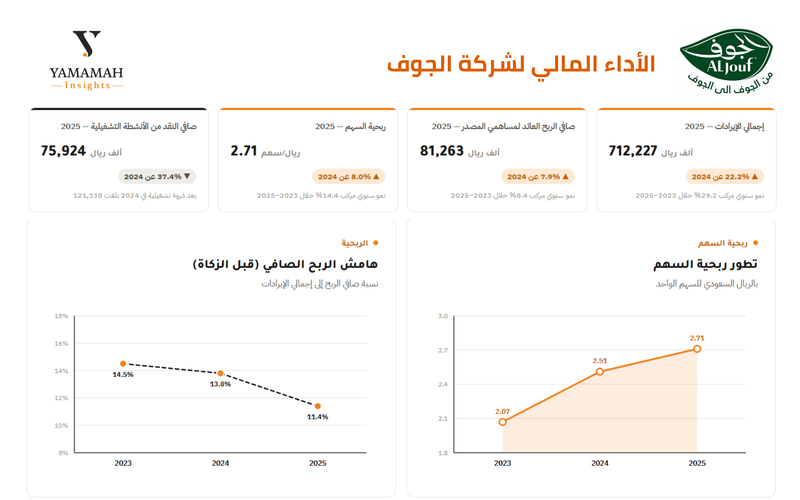
This is particularly important given the decline in the operating profit margin from 14.5% in 2024 to 12.7% in 2025, the decline in the net profit margin from 12.9% to 11.4%, and the 78% drop in profit to SAR 11.5 million in the first half of 2026. Management attributed this partly to lower sales of potato fries and import pressures—the very weakness that the AlBaik agreements may address.
Disclaimer: This material was prepared under the supervision of a “Yamamah Insights” editor with the assistance of artificial intelligence tools for financial education purposes. It does not constitute a recommendation to buy, sell, or hold any security, and expresses the views of its authors rather than those of the platform.


Comments (7)
No comments yet. Be the first to comment!