
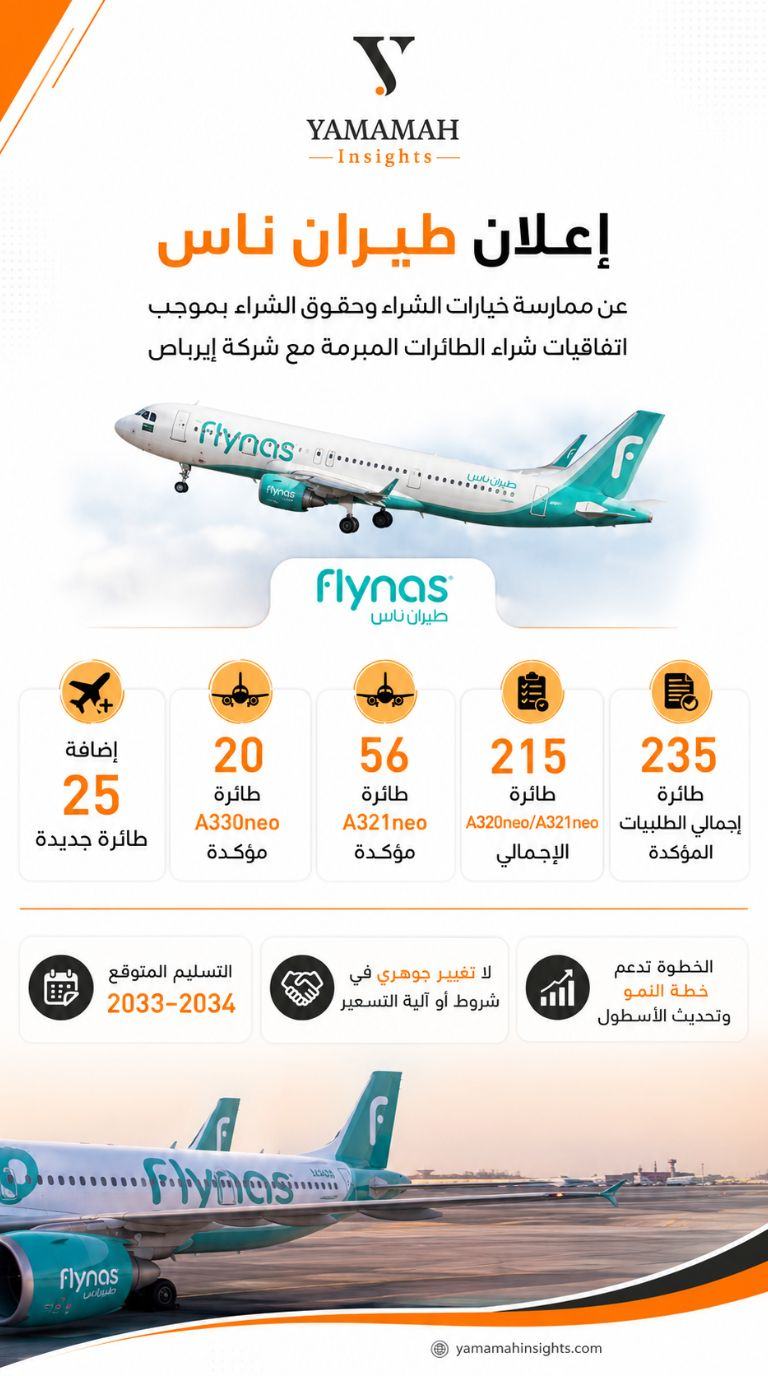
flynas announced that it had exercised its contractual rights under its agreements with Airbus S.A.S. to convert options and purchase rights into firm orders for 25 additional aircraft to join its fleet.
The company explained in its published statement that this step was based on the Aircraft Purchase Agreement dated December 31, 2016, and the A330neo Aircraft Purchase Agreement signed on November 7, 2024, both of which were disclosed in the prospectus. These options were formally exercised on July 22, 2026.
Operational details showed that the company exercised an option to purchase 5 aircraft of the A330neo model, bringing total firm orders for this model to 20 aircraft (with 10 options remaining available). It also exercised purchase rights for 20 aircraft of the A321neo model out of 55 available rights, bringing total firm orders for the A320neo and A321neo families to 215 aircraft. These additional aircraft are expected to be delivered between 2033 and 2034.
This move confirms the company's confidence in its long-term growth strategy and its continued commitment to expanding and modernizing its fleet in line with Saudi Vision 2030 and the National Aviation Strategy. The company noted that this was done without any material changes to its previous contractual obligations or pricing mechanism, which remains subject to prevailing economic conditions.
flynas noted that the financial impact of exercising these options and purchase rights will be reflected progressively in the company's financial statements when the aircraft deliveries begin according to the agreed schedule. It also confirmed that there are no related parties involved in these agreements.
The students of Al Yamamah University discussed the implications of this announcement, the updated assessment, and its impact on the company's financial statements as follows:
Benefiting from Growth and the Risks of Excess Capacity
Student @Shahad Al-Mohaysin explained that expanding flynas's fleet represents a strong opportunity to benefit from expected growth in the aviation and tourism sectors in the Kingdom, coinciding with the hosting of major events and higher passenger-number targets.
She noted that increasing seat capacity would enhance competition and provide better options and fares, emphasizing that the success of this step depends on the company's ability to raise aircraft load factors and maintain cost efficiency.
She also considered securing delivery slots for future years a strategic step to ensure the company's needs and reduce the risks of delays or price fluctuations, provided that this expansion is aligned with actual demand to prevent excess capacity from putting pressure on margins and profitability.
Competitiveness and Improving the Passenger Experience
Colleague "Abeer Al-Tuwaijri" @Abeer Altuwaijri shared her view, saying: "The benefits of expanding low-cost airlines will not be limited to lowering ticket prices; they will also raise the level of overall competition, prompting airlines to improve the passenger experience and expand their destination networks.
Ultimately, the greatest beneficiary is the passenger, thanks to the increased choice available among different airlines and destinations."
Forward-Looking Vision and Earnings Quality
Student Ghadah Al-Walan @Ghadah Alwallan added that the most significant aspect of flynas's announcement was not merely the addition of 25 aircraft, but the company's proactive step of reserving part of its operating capacity for deliveries extending through 2033–2034, giving it an advantage in benefiting from expected demand growth.
She emphasized that fleet growth requires deploying this capacity on profitable routes, enabling the company to convert growth in aircraft and passenger numbers into genuine growth in profits and cash flows, rather than focusing solely on increasing market share.
Balancing Fleet Size and Demand
Student "Rimas Al-Mashali" @Rimas Almashali commented: "flynas's expansion reflects strong confidence in the growth of demand for travel within the Kingdom. However, its actual success depends on carefully balancing the increase in fleet size with the level of actual demand, to ensure the preservation of operational efficiency and sustainable profitability."
Supply-Demand Dynamics and Hedging Against the Future
Student @Faisal Al-Qahtani explained that fleet expansion is a natural step to keep pace with passenger growth and upcoming projects. He noted that an increase in supply does not necessarily mean a sharp decline in prices, given the expected rise in demand during major-event seasons. He added that the expansion of low-cost aviation supports the tourism sector by increasing competitiveness.
He also regarded the early booking of delivery dates as a strategic decision that gives companies greater visibility into their plans and reduces the risk of delivery delays or higher aircraft costs in the future.
Keeping Pace with Demand and Price Stability
Student "Jumana Al-Shahri" @Jumana Alshehri shared her view, saying: "The expansion of the (flynas) fleet is a positive and important step, particularly in light of expected demand growth resulting from hosting major events and the targets of Saudi Vision 2030.
Increasing seat capacity and intensifying competition in the low-cost aviation sector could also contribute to price stability and stimulate the tourism sector. However, the success of this approach remains dependent on actual demand growing at a pace commensurate with the speed at which seats are added.
In addition, early reservation of delivery slots gives the company greater operational flexibility and effectively limits the risks of higher aircraft prices and future supply-chain delays."
The Supply-Demand Gap and Alignment with the Vision
In an analytical review of the company's performance, financial and economic analyst "Hamad Al-Saeed" @Hamad Alsaeed explains, saying: flynas's decision to convert 25 options into firm orders, bringing the total to 235 aircraft, goes beyond routine fleet renewal; it is a bet based on a precise reading of the accelerating demand curve in the Kingdom.
Operationally, we are facing a clear gap in which demand is outpacing the sector's infrastructure. With 140.9 million passengers recorded by the end of 2025, and Jeddah Airport exceeding its designed capacity by operating at 107%, these capital orders constitute an inevitable response to genuine operational pressure, rather than speculative expansion.
This step is fully aligned with the 2030 targets of reaching 330 million passengers and 250 destinations. More than doubling the current market, by 2.3 times, requires compound annual growth of 15% for a vital sector that contributes $53 billion and serves as a key lever for non-oil activities in Saudi Arabia's GDP.
Beyond the company's figures—reaching 15.8 million passengers and increasing its domestic share to 23%—the true investment value lies in the structure of the sector itself. Low-cost aviation accounts for only 39% of the Saudi market, compared with an average approaching 60% in comparable global markets. This structural gap represents the real growth opportunity, and these massive orders are nothing more than a proactive step to establish dominance and capture this untapped share before competition intensifies.
Disclaimer: This material was prepared under the supervision of a “Yamamah Insights” editor and with the assistance of artificial intelligence tools for financial education purposes. It does not constitute a recommendation to buy, sell, or hold any security, and it expresses the views of its authors rather than those of the platform.


Comments (8)
No comments yet. Be the first to comment!