
If you prefer strict and faithful adherence to the direct text alone, without external linking sentences, we can formulate the second paragraph based directly on the contract text as follows:
Al-Moammar Information Systems Company (MIS) signed a contract with the Saudi Data and Artificial Intelligence Authority (SADAYA), with a total value of SAR 64.6 million (including VAT), for a period of 36 months.
The contract aims to support and develop the infrastructure of a system hosted at the National Information Center by building a highly secure environment that ensures business continuity and enhances the efficiency of electronic services.
The direct financial impact of this contract is expected to be reflected in the company’s financial statements starting in the third quarter of fiscal year 2026, following completion of all procedures and final approval of the contract.
Students from Al Yamamah University discussed the contract’s strategic and financial implications for the telecommunications and information technology sector as follows:
Students from Al Yamamah University discussed the contract’s strategic and financial implications for the telecommunications and information technology sector as follows:
Converting revenue growth into actual profits through cost control
Student "Mohammad Alghaihab" @Mohammad Alghaihab explained his view, saying: "Despite the company’s strong revenue growth, profit margins remain under pressure. The SADAYA contract is a positive addition to the future business pipeline, but the real test lies in the company’s ability to execute these contracts at viable margins whose impact is clearly reflected in net income."
Sustaining growth in artificial intelligence and infrastructure projects
For her part, student "Rabiah Almugait" @Rabiah Almugait outlined the operational assessment, saying: "New contracts—particularly the SADAYA contract—give the company an opportunity to strengthen its position in digital infrastructure and artificial intelligence. However, sustaining this growth depends on execution efficiency, expense control, and focusing on profitable contracts with recurring returns throughout the contract term."
Moving from temporary momentum to a sustainable backlog
Student "Albatool Bedairi"@Albatool Bedairi shared her financial analysis, saying: "The artificial intelligence boom and data centers provide significant growth opportunities, but sustainable growth requires avoiding reliance on a temporary investment wave. Therefore, the key criterion remains the company’s ability to turn these contracts into a sustainable backlog and long-term cash flows."
Balancing contract expansion with profit-margin control
Student "Rand Alkhalaf" @Rand Alkhalaf emphasized the importance of financial discipline, saying: "The SADAYA contract supports revenue growth and opens prospects for future technology projects, but cost control and maintaining profit margins remain essential to translating this growth into actual profits, while focusing on long-term sustainable growth."
Revenue timing and execution efficiency
Student "Yazan Hamoud" @Yazan Hamoud analyzed the financial impact, saying: "The SADAYA contract extends for 36 months, ensuring revenue distribution over a long period. However, the contract’s true value depends on the company’s ability to control execution costs, improve margins, and convert higher revenue into real profits."
Turning strategic contracts into long-term investment growth
Student "Zikra Abdulkareem" @Zikra Abdulkareem explained the partnership’s implications, saying: "The 36-month, SAR 64.6 million contract reflects the company’s continued presence in critical digital infrastructure projects. However, evaluating the company’s performance requires a medium- to long-term view to measure cost and liquidity management efficiency, rather than relying solely on one contract or the current boom."
Opening new avenues for future projects
Colleague "Lujain Algorashi" @Lujain Algorashi highlighted expansion opportunities, saying: "Working with an entity the size of SADAYA on a three-year project increases the prospects of securing future projects in artificial intelligence and technology infrastructure. The contract’s success remains conditional on the company’s ability to control costs and maintain healthy profitability through the end of its term."
Expanding services linked to the artificial intelligence boom
Student "Halah Alalsheikh" @Halah Alalsheikh pointed to growth areas, saying: "The artificial intelligence boom represents a promising opportunity extending beyond direct projects to include infrastructure, data centers, and supporting technology services. Expanding in these areas while maintaining margins will ensure more sustainable growth."
Execution discipline and hedging against cost volatility
Student "Ryouf Alsewailim" @Ryouf Alsewailim added her analysis, saying: "The SADAYA contract increases the company’s secured backlog and boosts cash flows, while profit sustainability depends on adherence to the schedule. The contract’s long duration—36 months—also requires supplier contracts to be managed using strict performance indicators (KPIs) to hedge against operating-cost inflation, ensuring a transition to solutions with recurring income that support the Kingdom’s digital vision."
Building trust in critical projects and the National Information Center
Student "Dina Alarjani" @Dina Alarjani emphasized the strategic dimension, saying: "The project’s importance lies in its connection to the National Information Center, which strengthens government entities’ confidence and opens the door to similar contracts. Although the contract provides extended revenue, maintaining margins requires cost control and management of technological updates, with a focus on actual profits for investors."
Stable cash flows and enhanced competitive advantage
Student "Fay Aldossari"@Fay Aldossari shared her analysis, saying: "The contract provides cash-flow stability and visibility into future revenue, addressing previous declines. Working with a sovereign entity is also a ‘quality certificate’ that gives the company a competitive advantage in winning major projects, while sustainable profitability depends on managing supplier contracts and automating processes to reduce expenses."
Business continuity and emphasis on cost flexibility
Student "Jumana Alshehri" @Jumana Alshehri summarized the operational impact, saying: "The contract supports revenue recovery and stability through continuous flows over 36 months. The relationship with a sovereign entity enhances the company’s experience and market reputation, provided it diversifies its investment base and avoids total reliance on artificial intelligence momentum without controlling execution costs."
A direct execution track record as a pillar of future growth
Student "Ghadah Alwallan" @Ghadah Alwallan said: "Although the contract’s financial value may be limited compared with the company’s overall business volume, its intrinsic value lies in building a strong execution track record for a critical project with SADAYA and the National Information Center, which could later be converted into larger and more recurring contracts."
Reducing earnings volatility and benefiting from government spending
For her part, student "Shahad Alkhamis" @Shahad Alkhamis explained: "The contract strengthens cash flows and reduces previous earnings volatility, while the sovereign partnership provides high credibility and priority in upcoming competitions. Early finalization of supply contracts also reduces operating-cost risks during the contract period, making the company an attractive long-term investment as digital government spending expands."
The strategic value of sovereign projects
Student "AHMED ALJADAAN" @AHMED ALJADAAN emphasized the strategic angle, saying: "The true value of this contract exceeds its announced financial figure. Winning a sovereign project for the National Information Center represents the highest technology accreditation in the Saudi market, strengthening the company’s position as a leading choice for future digital transformation projects and major data centers."
Gradual growth and the importance of contract renewals
Student "Faiz Alhaj" @Faiz Alhaj concluded the discussion, saying: "The contract reflects strong government confidence in the company’s technical credibility, but its financial impact will be distributed gradually over 36 months starting in Q3 2026. Accordingly, cost control and a succession of similar contracts remain the true criteria for assessing the company’s recovery and sustainable profitability."
Continued contract expansion and a market value exceeding SAR 9 billion
Expert Abdulaziz Khrais believes that Al-Moammar Information Systems Company (MIS) continues to grow by announcing new contracts, the latest of which was a SAR 64.6 million contract with the Saudi Data and Artificial Intelligence Authority (SADAYA).
Khrais explained that the contract runs for three years, with its financial impact expected to begin appearing in the company’s financial statements starting in the third quarter of 2026.
Regarding investment performance, Khrais noted that the share price reflects the company’s financial performance. The stock recorded strong gains against the market trend, reaching its highest price since listing at SAR 338. This pushed the company’s market capitalization up by more than 130% compared with last year, exceeding SAR 9 billion.
Record revenue surge amid pressure on profit margins
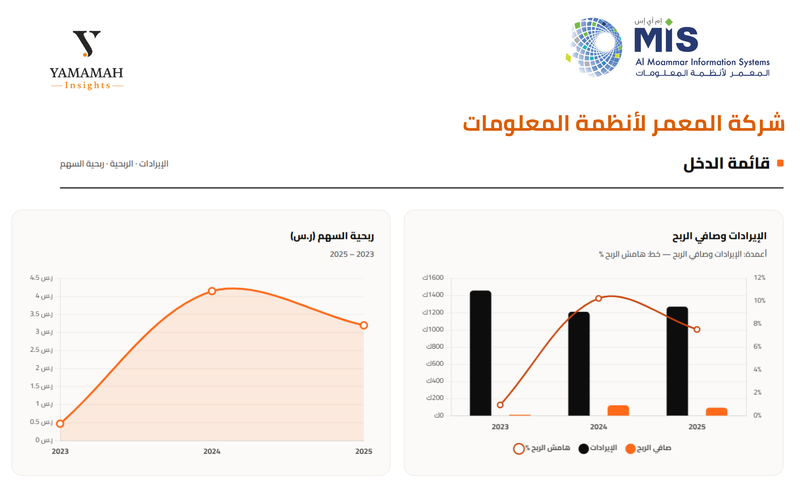
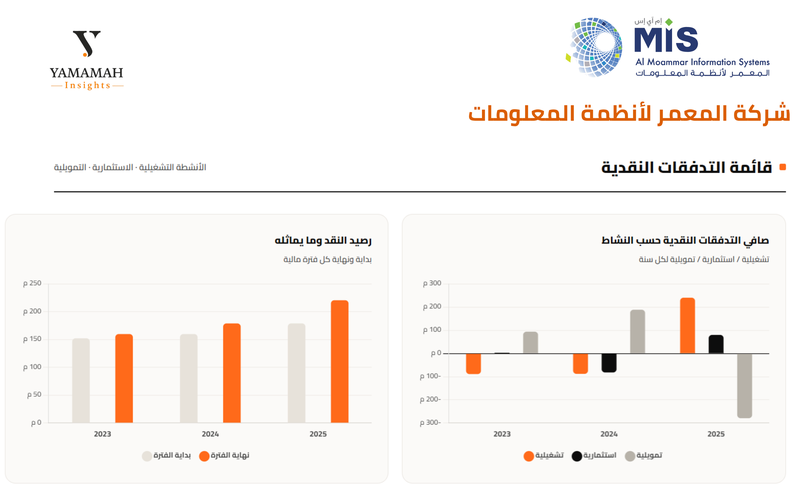
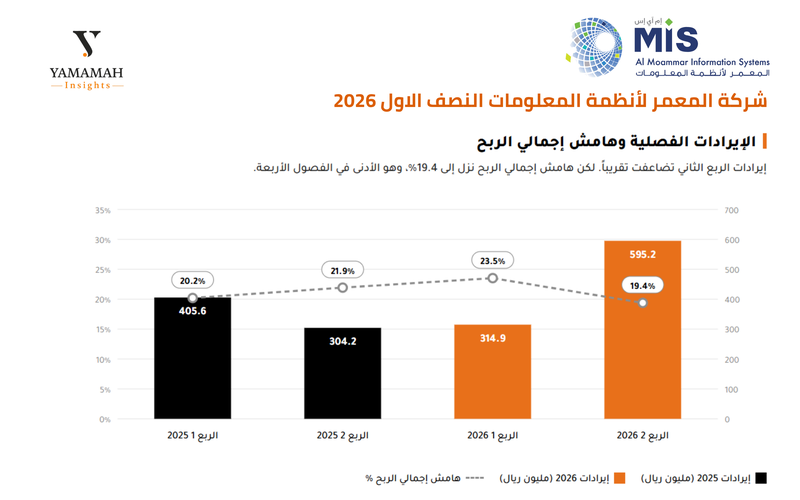
Al-Moammar recorded revenue of SAR 910 million in the first half, up 28%. The doubling of second-quarter revenue coincided with the start of the financial impact of a contract with HUMAIN to build an artificial intelligence data center. The company expanded this project from 50 to 250 megawatts, with a value exceeding 689% of 2025 revenue. However, execution is taking place through successive work orders, so the value is added to remaining performance obligations only when each order is issued. The company also recorded 36-month contracts with the Capital Market Authority, SADAYA, and the National Water Company worth approximately SAR 210 million.
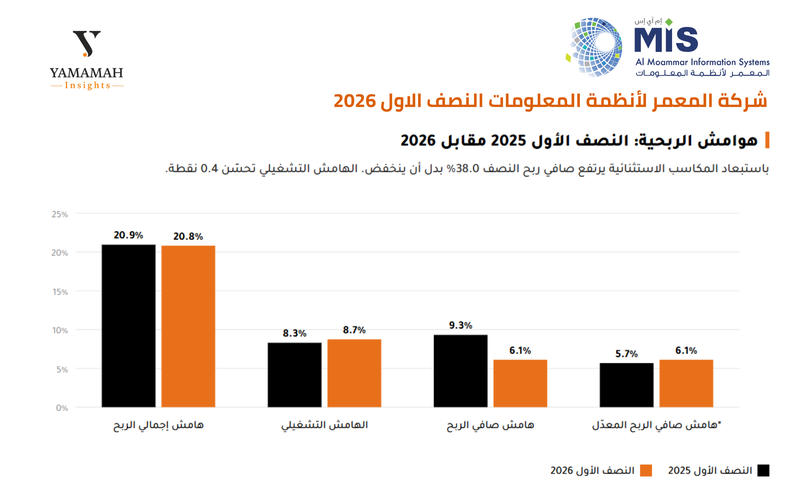
This expansion increases revenue concentration with a single customer. Gross profit margin also fell to 19.4% in the second quarter, as construction and procurement activities carry lower margins.
The company is at the heart of the artificial intelligence computing boom, supported by the Kingdom’s Vision 2030 drive to become a regional data-center hub, and is targeting 20% of data-center construction opportunities. We believe growth in remaining performance obligations will be the most accurate indicator of the strength of upcoming results, provided it is accompanied by margin preservation.

Comments (3)
No comments yet. Be the first to comment!