

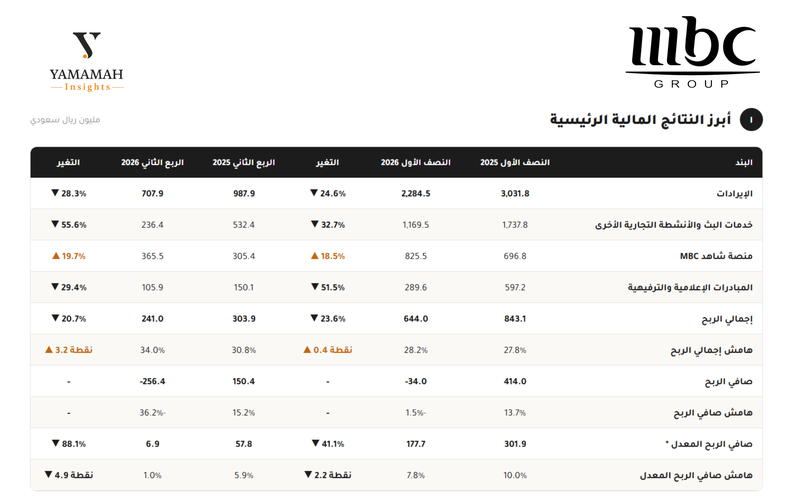
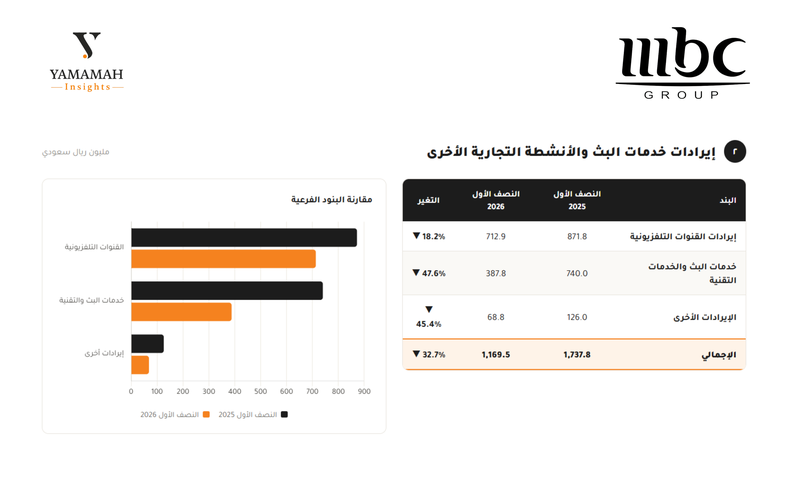
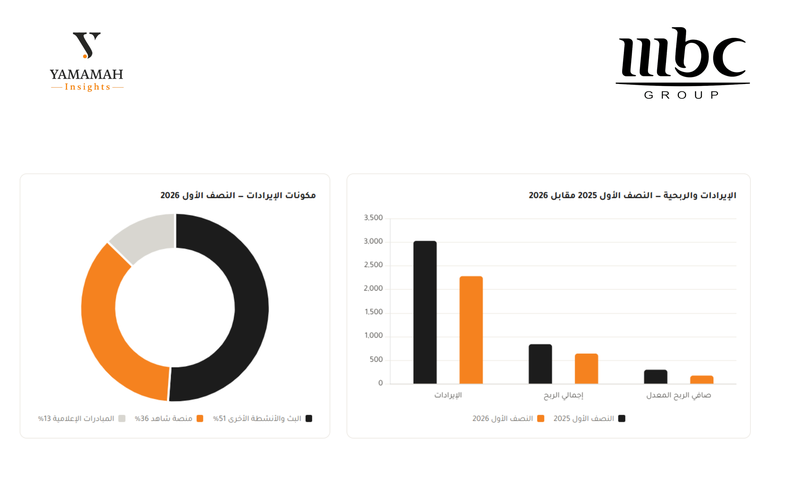
MBC Group Company announced its preliminary financial results for the period ended June 30, 2026. Revenue during the first half of 2026 declined by SAR 747 million compared with the first half of 2025, affected by lower advertising revenue due to slower demand amid geopolitical tensions and the expiry of certain broadcasting and technical services contracts. Revenue from the Media and Entertainment Initiatives segment also declined by SAR 308 million due to differences in project delivery timing.
In contrast, "MBC Shahid" revenue increased by SAR 129 million during the same period as a result of higher subscriber revenue.
Net profit during the first half of 2026 also declined by SAR 448 million compared with the first half of 2025, mainly due to a SAR 294 million decline in investment gains resulting from the recognition of unrealized losses arising from changes in the fair value of a financial investment, in addition to a SAR 122 million decline in operating profit. This was partially offset by a SAR 52 million increase in "MBC Shahid" profit during the same period.
At the level of the second quarter of 2026, revenue declined by SAR 280 million and net profit by SAR 413.5 million compared with the second quarter of 2025, while "MBC Shahid" revenue increased by SAR 60 million over the same comparison period.
Compared with the first quarter of 2026, revenue in the second quarter of 2026 fell by SAR 869 million and net profit by SAR 479 million, amid Ramadan’s positive seasonal impact on first-quarter results, in addition to unrealized losses arising from changes in the fair value of the investment during the second quarter.
The company also issued a corrective announcement, clarifying that the previously reported net profit/loss attributable to the issuer’s shareholders included amounts attributable to non-controlling interests. Therefore, the net loss was corrected from SAR 34.0 million to SAR 64.5 million for the first half of 2026, and net profit for the corresponding period of 2025 was corrected from SAR 414.0 million to SAR 382.8 million. The company had also restated the comparative figures for the three- and six-month periods ended June 30, 2025 to reflect the impact of additional shares received from Arabian Contracting Services Co. The effect of that adjustment amounted to SAR 79 million.
Al Yamamah University students discussed the implications of these financial results and what they reflect about challenges in revenue and profitability compared with the growth of the "MBC Shahid" segment, as well as the future of digital transformation and competition in the media sector, as follows:
Digital transformation and changing consumer behavior
Colleague "Abeer Altuwaijri" @Abeer Altuwaijri commented with a financial analysis, saying: "I believe that the increase in the number of Shahid subscribers reflects a clear shift in consumer behavior, as digital platforms have become more attractive thanks to convenient access to content and the ability to watch at any time.
This shift gives MBC Group an opportunity to diversify its revenue sources and avoid relying heavily on television advertising.
As the subscriber base continues to grow, I expect subscription revenue to become a more important element in supporting the group’s growth, particularly if Shahid can maintain exclusive and engaging content that encourages subscribers to remain".
Challenges to sustainable profitability and digital competition
Student "Mohammad Alghaihab" @Mohammad Alghaihab added, from an investment and digital perspective: "MBC Group’s results clearly show that the future of the media sector is increasingly shifting toward digital platforms, particularly as Shahid continues to grow while traditional broadcasting and advertising revenue declines.
However, the group’s real challenge lies in its ability to convert this growth in "Shahid" into sustainable profitability, because revenue growth alone is not enough if margins and profitability remain under pressure.
I believe that diversifying revenue sources across subscriptions, advertising, and content is the most important factor in strengthening the group’s resilience in the future.
Competition from social media platforms does not necessarily mean television will decline, but it does require MBC to develop its advertising tools and measure advertising returns more accurately, combining the power of mass reach with digital targeting".
The hybrid model and future investment in data
Student "Faisal Al-Qahtani" @فيصل القحطاني shared this view in his financial analysis, saying: "In my view, the media sector is clearly moving away from reliance on traditional television toward a model that combines television and digital platforms. I believe Shahid’s growth is very important because it gives MBC a more stable and scalable source of revenue.
As for advertising, geopolitical tensions may put pressure on corporate budgets, but content and platform diversity helps MBC mitigate the impact and avoid relying on a single source of revenue.
Regarding competition from social media platforms, I believe it has forced broadcasters to develop their advertising tools, particularly in targeting and measuring results. Therefore, investing in digital platforms and analyzing viewer data will be a very important factor in maintaining MBC’s advertising strength in the future".
The need for digital expansion to reduce advertising risks
Student "Rimas Almashali" @Rimas Almashali added in a related comment: "MBC’s results highlight the importance of digital transformation. The increase in Shahid revenue by SAR 129 million reflects subscription growth, while revenue declined due to weak advertising.
Therefore, diversifying income sources and digital expansion have become essential to reduce reliance on advertising".
Operating profitability sensitivity and fixed costs
Student "Ghadah Alwallan" @Ghadah Alwallan analyzed the group’s profitability, saying: "What stood out to me most in MBC’s results was not only the decline in revenue, but also that operating profit fell by a larger percentage, reaching approximately 40%, compared with a 24.6% decline in revenue. This demonstrates the sensitivity of the group’s profitability to falling revenue, particularly with fixed costs increasing in connection with content and production.
Therefore, in my opinion, the success of the shift toward "Shahid" should not be measured solely by subscriber growth and digital revenue, but by the ability of this growth in the future to improve margins and offset advertising volatility without requiring a corresponding increase in content costs. This is where it will become clear whether digital transformation is creating value for the group or merely shifting growth from one channel to another".
More precise targeting and the challenges of platform competition
Student "Jumana Al Shehri" @Jumana Alshehri concluded the discussion by analyzing the future drivers, saying: "I believe Shahid’s growth is very important for MBC Group because the consumer shift toward digital platforms has become clear, particularly given the ease of access to content.
At the same time, competition from social media platforms is intense because they offer advertisers more precise targeting at a lower cost. Therefore, I believe that MBC’s strength in the future will lie in combining strong content with digital platforms, while developing advertising tools and measuring their results more accurately".
Assessing historical performance and Shahid’s early recovery
In a comprehensive analytical review of the financial results, Professor "Abdulaziz Khrais" pointed to aspects of the financial statements, saying: "MBC recorded its largest-ever loss in the second quarter of 2026, amounting to SAR 262 million. The company stated that the loss resulted from recognizing unrealized losses arising from changes in the fair value of a financial investment measured at fair value through profit or loss.
The company also noted in its statement that it recorded low revenue—the lowest in three years—due to slower demand amid the ongoing geopolitical tensions.
The notable aspect of the results, however, was the increase in revenue from the "MBC Shahid" segment by SAR 129 million as a result of higher subscriber revenue. Shahid revenue increased by 19% during the first half of 2026 to reach SAR 826 million, while subscription revenue rose by 23%.
Moreover, management revised its previous expectations, bringing forward the target date for achieving annual platform profitability to 2026 instead of 2027. This is expected to support the group in the coming periods".
"MBC" earnings quality under the microscope of structural and investment pressures
In an analytical review of the company’s performance, financial and economic analyst "Hamad Alsaeed" @Hamad Alsaeed explains: MBC Group’s first-half 2026 results reveal a deep problem in earnings quality. The loss attributable to shareholders amounted to SAR 64.5 million, resulting in a loss per share of SAR 0.19, compared with a previous profit of SAR 382.8 million. The direct source of this loss was the revaluation of the company’s stake in Arabian Contracting Services. This resulted in an unrealized loss of SAR 210.9 million, as investment gains declined year-on-year by SAR 294 million. This means that volatility in a single financial line exceeded total operating income of SAR 183.6 million.
Adjusted profit does not exempt the operating side from this decline. Operating profit fell by 41 percent to SAR 177.7 million, compared with approximately SAR 301.9 million. This was accompanied by a 24.6 percent decline in revenue to approximately SAR 2.28 billion. This financial erosion is structural rather than temporary. Revenue from other commercial activities fell by 42.4 percent to SAR 551.9 million following the expiry of sports and cultural contracts, while the decline in advertising was less severe at 20.8 percent.
Despite the improvement in gross margin in the second quarter from 30.8 percent to 34 percent, this improvement did not translate into operating performance. Quarterly operating margin contracted to 3.5 percent. This contraction provides clear evidence of negative operating leverage that the cost-cutting policy failed to keep pace with or mitigate.
Disclaimer: This material was prepared under the supervision of a “Yamamah Insights” editor with the assistance of artificial intelligence tools for financial education purposes. It does not constitute a recommendation to buy, sell, or hold any security, and it expresses the views of its authors, not those of the platform.


Comments (7)
No comments yet. Be the first to comment!