

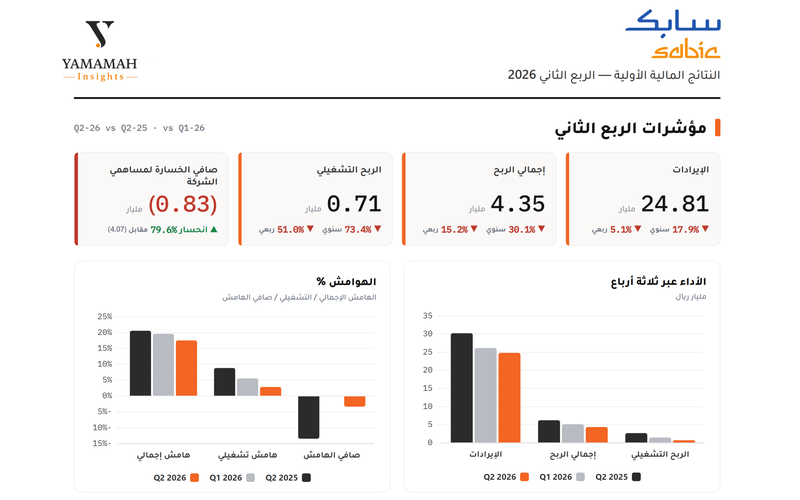
Saudi Basic Industries Corporation (SABIC) announced its preliminary financial results for the period ended June 30, 2026 (the first half), reporting a net loss of SAR 833 million in the second quarter, significantly narrowing its losses compared with SAR 4.07 billion in the same quarter of the previous year.
The company explained that revenue during the second quarter amounted to SAR 24.81 billion, compared with SAR 30.23 billion in the comparable quarter. This was mainly due to continuing challenges in supply chains and logistics services, although higher selling prices helped mitigate the impact of lower volumes sold.
SABIC stated that adjusted earnings before interest, zakat, taxes, depreciation and amortization (EBITDA) for the second quarter amounted to SAR 3.38 billion, resulting in an adjusted earnings margin of 13.6%.
The company attributed the notable improvement in reducing losses during the current quarter to lower losses from discontinued operations, as provisions recorded last year were not repeated, in addition to improved results from joint ventures and lower financing costs.
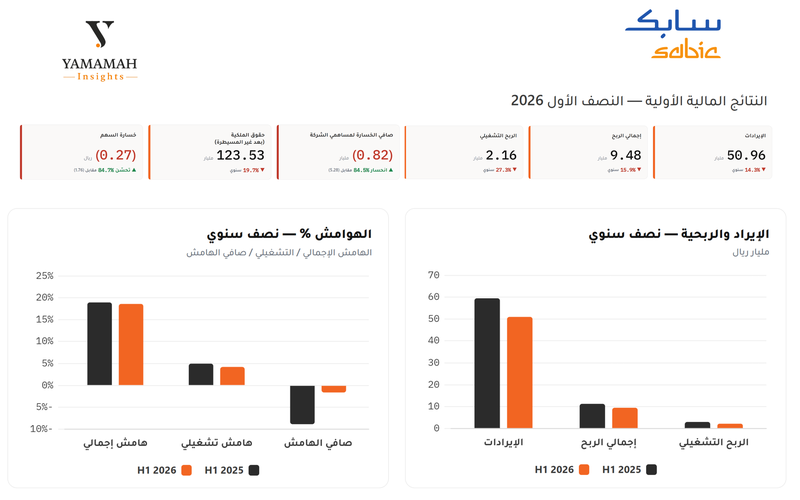
Regarding performance in the first half of 2026, the company's revenue amounted to SAR 50.96 billion, compared with SAR 59.49 billion, while the company significantly reduced its net loss for the period to SAR 820 million, compared with a loss of SAR 5.28 billion in the same period of the previous year.
Students from Al Yamamah University discussed the implications of these results and their impact on SABIC's operational and financial performance, as follows:
Quality of the Improvement and Challenges Facing Core Activity
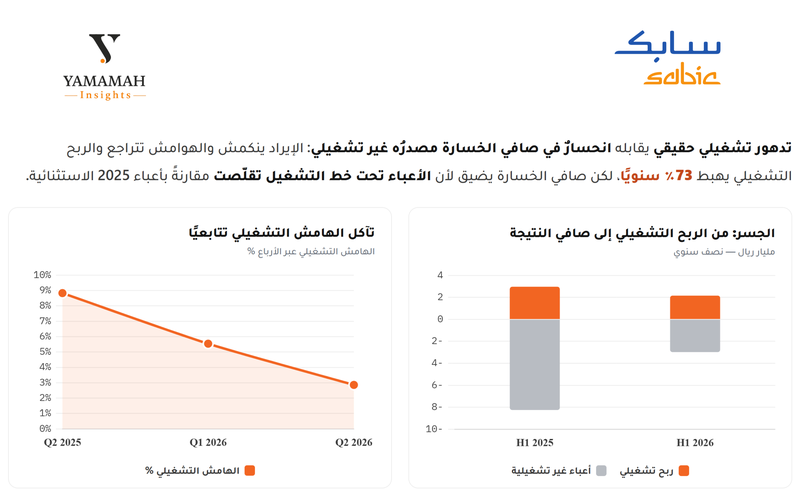
Student "Arwa Alhuwaiti" @Arwa Alhuwaiti began the analysis by saying: "The most notable point is that the decline in net loss did not result from a strong improvement in operational activity. Revenue, operating profit and margins all declined noticeably, giving the impression that the current improvement relies more heavily on non-operating factors. Therefore, I believe the real challenge for "SABIC" lies in restoring growth in its core activity, as it is the true driver of sustainable long-term performance."
Operating Performance and Interpreting Adjusted Indicators
Student "Noof Alanazi"@Noof Alanazi shared her view, saying: "As one of the largest petrochemical companies, the reduction in "SABIC's" losses is a positive indicator, but it is essential to examine the drivers of this improvement.
Excluding non-cash provisions helps reveal true operating performance, but it does not eliminate the impact of previous decisions. The continued supply-chain challenges and decline in volumes sold also contributed to lower revenue, necessitating a focus on improving operational efficiency rather than relying solely on higher prices.
The decline in second-quarter results compared with the first quarter was due to lower gross profit resulting from operational pressures.
As for the adjusted earnings indicator (EBITDA), it is useful for clarifying core business performance independently of exceptional items, but it must be read alongside the other indicators to obtain a comprehensive assessment."
Reducing Losses and Market Challenges
Student "Rimas Almashali"@Rimas Almashali commented: "Despite the decline in revenue, the substantial reduction in losses is a positive indicator of an overall improvement in performance.
Nevertheless, the continued decline in sales shows that the company still faces market challenges; therefore, it will be very important to monitor the pace of improvement in demand and profit margins over the coming quarters."
Earnings Quality and Cash Flows
Student "Ghadah Alwallan" @Ghadah Alwallan explained: "The point most worthy of monitoring is not the decline in losses itself, but rather SABIC's ability to convert this improvement in adjusted earnings (EBITDA) into stronger operating cash flows.
The company may report improvement in its adjusted indicators, but if this is not reflected in cash generated from operations, its long-term impact may be limited.
Therefore, monitoring cash flows and capital expenditure in upcoming periods will give us a more accurate picture of the quality of this improvement."
Signs of Recovery and Assessing Operating Performance
Student "Jumana Alshehri" @Jumana Alshehri noted: "SABIC's results contain positive signs, but they cannot be considered a full recovery.
Despite the significant decline in losses, part of this improvement resulted from the non-recurrence of exceptional items, making it necessary to assess operating performance separately.
The decline in revenue also indicates continued challenges in demand and supply chains. Although higher prices mitigated the impact, they do not represent a sustainable solution amid lower volumes sold.
In addition, the second quarter's shift from a slight profit to a loss demonstrates the impact of market fluctuations and operating costs on profit margins.
While adjusted earnings (EBITDA) provides a clearer picture of core performance by excluding non-recurring items, the focus on sales growth and improved operating profitability remains the most important factor in judging the sustainability of this improvement."
The Contrast Between Reduced Losses and Operating Pressures
Student @فهد الطيب added: "The results convey two contrasting messages. The first is positive: net loss declined as non-cash charges decreased. The second, and more important, is the persistence of operating pressures.
The 14.3% decline in revenue, the 27.3% decrease in operating profit and the drop in the operating margin all indicate weakness in the core activity.
Accordingly, indicators such as adjusted (EBITDA) are useful for understanding operating performance, but they do not eliminate the need to monitor sales growth and margin improvement in the coming quarters, as these are the true measures of the company's recovery."
Global Demand Challenges and Supply Stability
Student @شهد المحيسن noted: "Excluding non-cash provisions helps reveal SABIC's true operating performance, as it reflects the results of the core activity independently of exceptional items.
Nevertheless, the continued decline in sales and supply-chain challenges confirm that the company continues to face tangible operational challenges, even amid improved prices.
Therefore, the recovery in global demand and supply stability will remain among the key factors needed for the company to return to a sustainable earnings-growth path."
Balancing Prices, Volumes and Pricing Power
Student "Khalid Waleed" @khalid waleed shared his view, saying: "There is a highly important investment perspective concerning the balance between prices and volumes. The decline in sales volumes resulting from supply-chain challenges could have put much greater pressure on revenue.
I believe the next challenge for management does not lie in prices, since they are subject to market cycles and global demand. Rather, the actual operational challenge is addressing supply-chain bottlenecks and restoring normal sales volumes; to ensure that any future improvement in prices translates directly and strongly into the company's overall results."
Results Contrary to Expectations and a Historic Decline in Revenue
Financial expert Abdulaziz Khrais commented on these results, saying: "In a figure contrary to expectations, SABIC recorded a loss of SAR 833 million in the second quarter of 2026, versus an average forecast by research houses of a profit of approximately SAR 438 million. Excluding the fourth quarter of 2024, the company's revenue is its weakest in six years, at SAR 24.8 billion. It appears that SABIC sought to leverage its global presence across different regions, enabling it to increase volumes sold at prices better than the market, particularly since supply chains affected the company's sales, as stated in its announcement on Tadawul. It should also be noted that there were non-recurring profits of SAR 300 million, possibly from asset sales or insurance compensation. As for the stock, it reacted negatively to the news, reaching its lowest levels in seven months at SAR 49.10."
Earnings Quality and the Strategy for Protecting the Financial Position
In an analytical review of the company's performance, financial and economic analyst "Hamad Alsaeed"@Hamad Alsaeed explained: Commenting on SABIC's second-quarter 2026 results, the contrast between the accounting outcome and operating reality becomes clear. The 84.5% reduction in net loss in the first half, to SAR 820 million from SAR 5.3 billion, does not reflect an operational recovery. Rather, it is a direct result of lower losses from discontinued operations in the United Kingdom, higher contributions from associates and joint ventures, and the absence of exceptional restructuring expenses that weighed on 2025.
Operating pressures remain severe, with revenue contracting by approximately 14% year-on-year in the first half and declining 5% sequentially in the second quarter to SAR 24.8 billion. Meanwhile, adjusted operating profit "compared with the first quarter of 2026" plunged 72% to just SAR 0.41 billion. This disconnect between operational deterioration and accounting improvement demonstrates a decline in earnings quality.
Against this challenging broader backdrop, reducing distributions to SAR 3.3 billion from SAR 4.5 billion in the first half of 2025, a decrease of more than a quarter, is an important defensive step. Management is balancing weak margins with a capital expenditure commitment of between USD 3.5 billion and USD 4 billion. Protecting the financial position and directing liquidity toward strategic investments have become top priorities for navigating this downturn, pending a recovery driven by fundamentals rather than accounting adjustments.
Disclaimer: This material was prepared under the supervision of a Yamamah Insights editor with the assistance of artificial intelligence tools for financial education purposes. It does not constitute a recommendation to buy, sell or hold any security, and expresses the views of its authors rather than those of the platform.
 Ask Yamami

Comments (5)
No comments yet. Be the first to comment!