

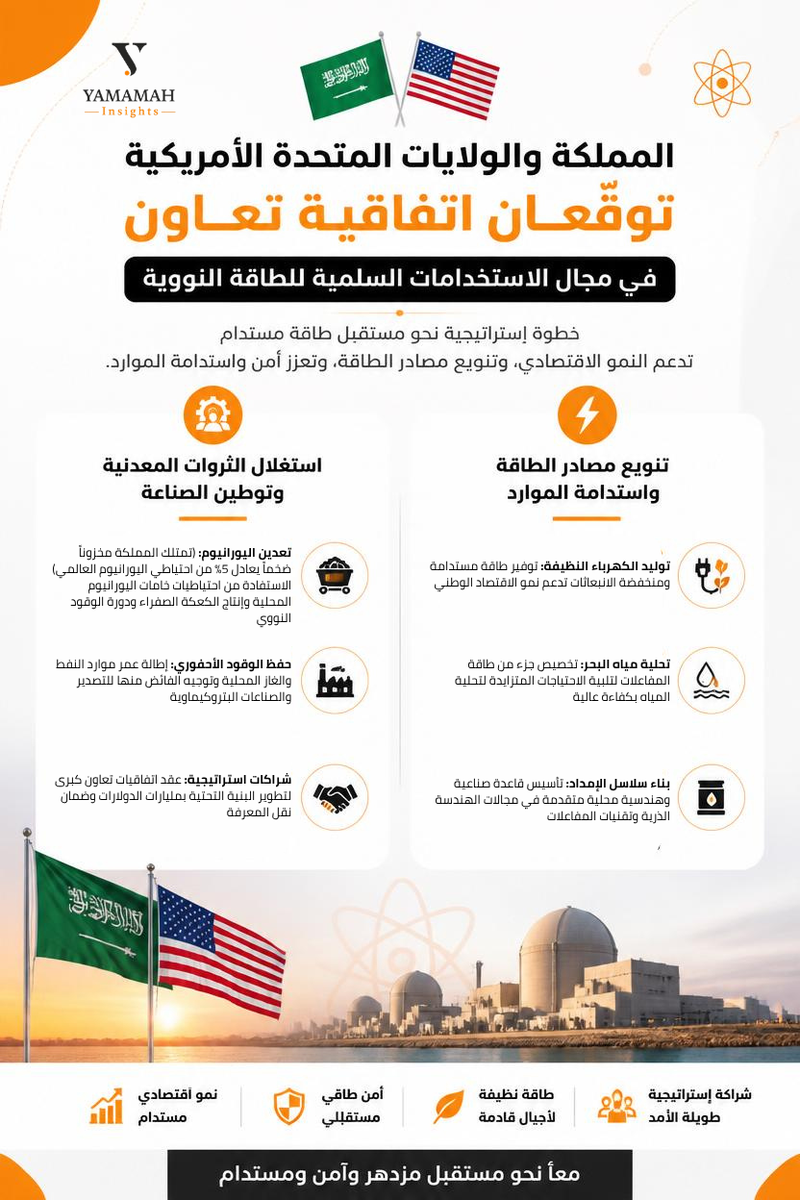
The Kingdom of Saudi Arabia and the United States of America have signed a strategic cooperation agreement in the field of peaceful uses of nuclear energy.
This agreement, signed by the Saudi Minister of Energy and the U.S. Secretary of Energy, aims to exchange knowledge and advanced technologies, in accordance with the highest international standards for nuclear security and safety.
This step comes as a continuation of previous negotiations, representing an extension of the partnership aimed at diversifying energy sources and supporting sustainable development between the two countries.

Students from Al Yamamah University discussed the strategic and economic dimensions of this agreement and its future implications for the energy sector, as follows:
Diversifying Energy Sources and Developing National Competencies
Student Rimas Almashali @Rimas Almashali expressed her view, saying: "In my opinion, the agreement reflects the Kingdom's transition to a more advanced stage in diversifying energy sources and investing in advanced technologies.
Moreover, cooperation with the United States in the peaceful uses of nuclear energy may support knowledge transfer and the development of national competencies, while adhering to the highest standards of nuclear safety and security."
Building an Integrated Nuclear Industry and Maximizing Added Value
Student @Shahad Al-Muhaysin pointed out that: "This agreement represents a strategic step that goes beyond the energy sector, as it contributes to building an integrated nuclear industry within the Kingdom, starting from utilizing local uranium reserves to technology transfer and developing national competencies.
Additionally, introducing peaceful nuclear energy will support the diversification of the energy mix, reduce oil consumption in electricity generation and water desalination, allowing for larger quantities to be directed towards exports or value-added manufacturing.
On the other hand, commitment to international safety and transparency standards will enhance the confidence of investors and global companies, accelerating project implementation, which will positively reflect on economic growth and sustainability in the long term."
The Economic Impact and Operational Efficiency to Support Exports
Student Ghadah Alwallan @Ghadah Alwallan stated that: "The most significant economic impact of the agreement is not just electricity production, but better utilization of the Kingdom's resources.
If nuclear energy is used to generate part of the electricity, larger quantities of oil and gas can be directed towards exports or industries that achieve higher value.
However, this impact will not be immediate; it depends on the successful implementation of projects and their efficient operation."
Sustainable Urban Development and Supporting Vision 2030 Goals
Student @Tina Azy added another dimension by saying: "Investing in peaceful nuclear energy is not limited to electricity production only, but also reflects on sustainable urban development.
Providing a stable and low-emission energy source supports the development of cities and major projects, enhancing the achievement of Vision 2030 goals in sustainability and quality of life, with the importance of adhering to the highest safety and security standards in the design and operation of these projects."
Knowledge Transfer and Sector Sustainability to Enhance the Local Economy
Student Mohammad Alghaihab @Mohammad Alghaihab emphasized that: "The agreement represents a strategic step for the Kingdom to diversify energy sources and reduce reliance on conventional fuels, as it will enable the utilization of local uranium reserves and the development of an integrated nuclear industry with technical and regulatory support from the United States.
In the long term, nuclear energy can contribute to providing stable and low-emission electricity, directing a larger portion of oil and gas towards exports or manufacturing industries, thus supporting economic growth. The success of these projects depends on adherence to the highest safety standards, along with investment in qualifying national competencies and knowledge transfer to ensure the sustainability of the sector and maximize its impact on the Saudi economy."
Technology Transfer and Associated Challenges
Student @Mohammad Alabdallah added, saying: "While the agreement is an excellent step, there are important aspects that need attention, namely that building nuclear reactors requires a long time and very high costs, which is normal for these projects.
However, the point that concerns me more is the issue of nuclear waste and how to handle it safely.
Therefore, I hope that the technology transfer from the American side does not only include building reactors but also extends to include methods for managing and dealing with nuclear waste, as this is what ensures the continuity of the project in a safe and sustainable manner."
The Economic Impact on the Kingdom
In an analytical reading of the economic impact of the agreement, financial and economic analyst Hamad Alsaeed @Hamad Alsaeed stated: Signing the cooperation agreement in the field of peaceful uses of nuclear energy is not just an event related to the energy sector, but represents a strategic step that enhances the efficiency of the Saudi economy and supports the goals of Vision 2030.
The Kingdom consumes an average of about 1.1 million barrels per day of oil liquids for electricity generation. Introducing nuclear energy into the energy mix means reducing this consumption and allowing for larger quantities to be exported at global prices, thereby increasing economic returns. Estimates indicate that operating the first 3.2 gigawatts could reduce consumption by about 120,000 barrels per day, equivalent to an economic impact of nearly 3 billion dollars annually, with this impact increasing in the future.
Nuclear energy also supports the sustainability of the water desalination sector, where the Kingdom is the largest globally with a capacity exceeding 16 million cubic meters per day, contributing to stabilizing water and electricity costs and reducing carbon emissions to achieve the zero neutrality target by 2060.
Economically, the impact extends to developing local content and qualifying national competencies, in parallel with the expansion of industrial and mining sectors. The timing of the agreement aligns with the accelerating growth in data centers (which target a capacity exceeding 1,300 megawatts and require stable operational energy with an efficiency exceeding 92% around the clock), making nuclear energy an important pillar to support the digital economy and enhance energy security in the long term.
Disclaimer: This material has been prepared under the supervision of the editor of “Yamamah Insights” and with the assistance of artificial intelligence tools for financial education purposes, and it does not constitute a recommendation to buy, sell, or hold any security, nor does it reflect the views of the platform.
 Ask Yamami

Comments (10)
No comments yet. Be the first to comment!