

Wsam Al أعمال Information Technology Company announced its intention to offer its Sukuk for public subscription and list them on the Sukuk and Bonds Market of Saudi Exchange (Tadawul), following its previous announcement in August 2025 regarding the establishment of a Saudi riyal-denominated local Sukuk program compliant with Islamic Sharia principles, with a total value of SAR 500 million.
Following the publication of the program’s offering circular, the company explained that the offering would be available to both individual and institutional investors. The Sukuk will be issued in series with a nominal value of SAR 1,000 per Sukuk, noting that Tathmeer Financial Company had been appointed as financial adviser and sole arranger for the transaction, aimed at supporting the company’s business and expansions that advance its financial and strategic objectives.
Discussing diversifying the financing structure, the impact of debt instruments on the balance sheet, and the growth opportunities available in the financial sector, Al Yamamah University students examined the dimensions of this decision and its implications for the company’s strategic targets as follows:
Financing Expansion and Protecting Shareholders’ Ownership
The student "Najd Al-Otaibi" began the analysis by saying: "In my opinion, issuing Sukuk is a good step for Wsam Al أعمال because it helps the company finance expansion and technology projects without needing to increase capital directly.
With the significant growth in the technology and artificial intelligence sectors, I expect investors to be interested in this type of investment, especially if the financing is used for projects that generate sustainable growth and revenue.
However, attention must also be paid to the cost of debt and its impact on the company’s liabilities and leverage."
Deployment Efficiency and Financial Performance Indicators
For her part, the student "Zikra Abdulkareem" @Zikra Abdulkareem explained the dimensions of the financial assessment, saying: "In my personal opinion, issuing Sukuk could give Wsam Al أعمال more room to finance its expansions without relying entirely on increasing capital or bank financing.
But what matters most to me is how the SAR 500 million will be deployed, and whether the financing will actually be reflected in the growth of revenue, projects, and cash flows.
I believe monitoring revenue growth, profit margin, cash flows, and the debt-to-equity ratio will be important indicators for assessing the efficiency of financing utilization over the coming period."
Managing Liabilities and Structuring Issuances
The student "Albatool Bedairi" @Albatool Bedairi analyzed financial readiness and costs, saying: "Issuing Sukuk will increase financing and liabilities on the financial statements, and may therefore increase leverage and financing costs.
However, the SAR 500 million represents the size of the program and is not necessarily an amount that will be issued in full at once. Therefore, the actual impact will depend on the size and terms of each issuance, as well as the company’s ability to generate a return higher than the cost of financing."
Investment Flexibility and Sector Momentum
The student "Fahad Alruwaished" @Fahad Alruwaished commented on the strategic dimensions, saying: "In my opinion, Wsam Al أعمال Information Technology Company’s decision to launch a Sukuk program worth up to SAR 500 million is an excellent and smart step to fund strategic expansions. Relying on Sukuk as a Sharia-compliant debt instrument protects existing shareholders from dilution of their ownership stakes compared with a capital increase.
It also gives the company a lower financing cost and greater flexibility compared with traditional bank loans. At the same time, the technology and artificial intelligence sector is witnessing strong demand and investment momentum from individuals and institutions interested in subscribing to these Sukuk to obtain relatively safe periodic returns while benefiting from the strong growth of the technology sector in the Kingdom."
Converting Financing into Contracts and Recurring Revenue
The student "Halah Alalsheikh" @Halah Alalsheikh shared her operational analysis, saying: "I believe the most important point for Wsam Al أعمال is to direct the financing proceeds toward projects that deliver real and sustainable growth, such as expanding technology and artificial intelligence solutions and increasing its ability to execute larger projects.
If the company can convert the financing into contracts and recurring revenue, this could help strengthen its market share and improve its financial performance over the long term."
Operating Cash Flows and Phased Issuance
For his part, the student "Yazan Hamoud" @Yazan Hamoud explained the cash and execution risks, saying: "I believe the size of the opportunities in the technology sector alone is not enough to justify financing of this scale, especially given the company’s negative operating cash flows. The SAR 500 million is the program ceiling, and is not necessarily going to be issued in full.
Therefore, I think it would be better for the issuance to take place in stages, with each stage linked to clear contracts, while taking into account the timing of collecting project receivables against the Sukuk obligations.
Revenue growth will not solve the liquidity problem if collections are delayed."
Selecting Projects and Investing in Promising Opportunities
In turn, the student @ثناء الشايب highlighted the feasibility criterion, saying: "I think Sukuk could be a good step for the company, especially if it uses the funds for projects and expansions that increase revenue. However, SAR 500 million is a large amount, so in my opinion, what matters most is not the size of the financing, but how it will be used and whether its returns will exceed its cost without increasing debt to a level that puts pressure on the company.
The technology sector also currently offers significant growth opportunities, which could allow the company to benefit from the financing more quickly. Ultimately, the success of the move will depend on selecting the right projects and the company’s ability to turn the financing into actual growth and profits."
Covering Obligations and the Ability to Meet Them
Meanwhile, the student "Rabiah Almugait" @Rabiah Almugait detailed the financing and competitive dimensions, saying: "In terms of financing structure and growth, issuing Sukuk is a suitable option for Wsam Al أعمال to expand without affecting shareholders’ ownership stakes.
As for investor interest, the momentum in the technology and artificial intelligence sector will increase attention. However, investors care about the Sukuk return, the company’s risks, and its ability to meet its obligations.
Regarding growth opportunities, the financing supports expansion into projects, services, and major contracts. Finally, the financial impact highlights the importance of providing sufficient cash flows to cover the cost of financing and limiting the risks arising from financial leverage."
Developing Services and Strengthening Market Share
The student "Rand Alkhalaf" @Rand Alkhalaf emphasized leveraging the sector’s momentum, saying: "I think issuing Sukuk could help Wsam Al أعمال finance its expansions and technology projects without increasing capital, especially given the growth of the technology and artificial intelligence sector.
There could also be interest from investors, whether individuals or institutions, if the use of the financing is clear.
The company can benefit from the financing to develop its services and increase its market share. However, the Sukuk value reaching SAR 500 million means higher liabilities and financing costs, so it is important to use the funds effectively and generate returns that help cover the costs."
Testing Repayment Capacity and Sector Attractiveness
The student "Kنان Sayer" commented on the investment risk dimensions, saying: "Sukuk could be an excellent step if the company knows how to use them properly, especially since a capital increase could reduce shareholders’ ownership percentages, while bank loans may sometimes have higher terms and costs.
But the most important point here is that the SAR 500 million is the program ceiling; the company is not necessarily required to take the full amount at once.
As for investor interest, the technology sector certainly attracts considerable attention. However, a Sukuk investor is more concerned with whether the company has sound cash flows and the ability to repay, and what return they will receive in exchange for the risk."
Directing Liquidity and Turning Obligations into Opportunities
The colleague "Lujain Algorashi" @Lujain Algorashi added her perspective on technology expansion, saying: "I believe issuing Sukuk gives Wsam Al أعمال more room for growth, especially in a fast-changing sector such as technology.
However, the success of the financing depends not only on the size of the amount, but also on how it is used. If it is directed toward technology projects with genuine demand, the financing could be transformed from a financial obligation into an opportunity to increase revenue and strengthen the company’s market presence."
Aligning Issuance Timing with Project Readiness
The student "Ghadah Alwallan" @Ghadah Alwallan concluded the analysis by pointing to the most appropriate timing for liquidity, saying: "What caught my attention is that the challenge is not only for the company to generate a return higher than the cost of the Sukuk, but also when that return begins.
If the Sukuk are issued before projects are ready to deploy the liquidity, financing costs will begin while the funds remain unused.
Therefore, I believe that the timing of each issuance and linking it to clear projects is as important as the size of the financing itself."
Financing Solvency and Debt Service in the Financial Structure
In an analytical reading, financial and economic analyst "Hamad Alsaeed" @Hamad Alsaeed adds: "Wsam Al أعمال Information Technology Company’s announcement of its intention to offer Sukuk for public subscription under a program with a ceiling of up to SAR 500 million represents a case of a company granting itself borrowing capacity far exceeding its current size. The planned program ceiling is equivalent to more than seven times its total assets and ten times its equity as of the end of June 2026."
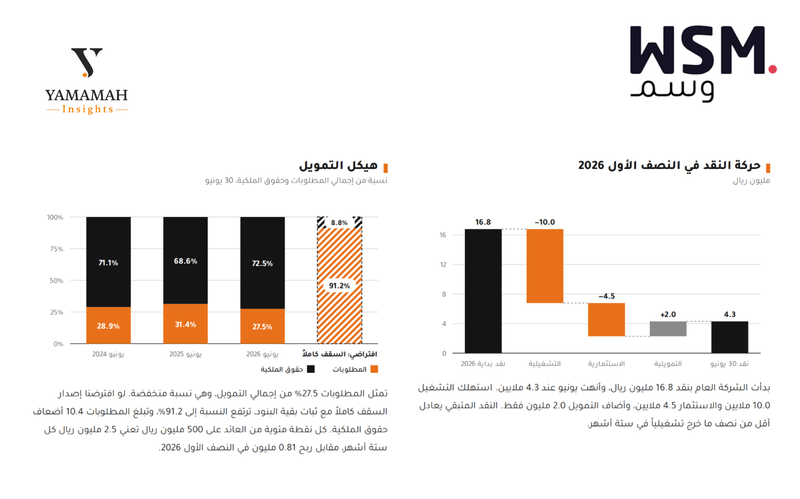
In this context, the financial statements reveal that the most prominent weakness lies in liquidity rather than profitability. Net profit fell by 74% in the first half to SAR 0.81 million, while operating cash flow remained negative in the first half for the third consecutive year, at SAR 10 million. This caused the cash balance to decline from SAR 16.8 million at the beginning of the year to SAR 4.3 million, less than half the amount of cash consumed in operating activities in just six months.
The financial impact is expected to be determined by the ability to service the debt. Although liabilities currently account for no more than 27.5% of total financing, full use of the program ceiling would raise liabilities to more than ten times equity. Each percentage point of return would also add an estimated cost of approximately SAR 2.5 million every six months, compared with net profit of SAR 0.81 million in the first half. The program’s success will ultimately depend on converting the company’s contracts into regular cash collections, particularly given the signing of a SAR 500 million framework agreement with a government entity, whose value depends on issued purchase orders and does not constitute guaranteed revenue.


Comments (4)
No comments yet. Be the first to comment!