

The Capital Market Authority announced its decision approving the request submitted by Tabuk Agricultural Development Company to reduce its capital from SAR 391,767,000 to SAR 76,524,600, representing a reduction of 80.47%. This will result in reducing the company's shares from 39,176,700 shares to 7,652,460 shares.
The approval is conditional on the ratification of the company's Extraordinary General Assembly and the completion of all regulatory requirements. The company will publish a detailed report outlining the proposed mechanism for reducing the capital and its expected impact before the meeting is held, enabling shareholders to vote. The Authority emphasized that its decision reflects compliance with the Capital Market Law and its implementing regulations and does not in any way constitute approval of the investment merits of the reduction.
Al Yamamah University students discussed the financial and administrative aspects of the capital reduction decision and its implications for the company's capital structure, as follows:
Accounting treatment requires operational improvement to achieve growth
Student Ghadah Alwallan @Ghadah Alwallan explained her view, saying: "In my opinion, reducing capital by itself does not solve the problem; rather, it addresses its accounting impact. The more important question is whether the company will be able to improve its operational performance after this step, particularly since revenue has declined significantly in recent years, while debt has increased relative to equity. Therefore, the success of the decision will be measured by the company's ability to halt this decline, generate sustainable profits, and deliver better returns on shareholders' equity in the future. A capital reduction does not create value in itself; it simply gives the company an opportunity to reorganize its position if its operational performance improves."
Focusing on operational plans as an alternative to accounting adjustments
Student Arwa Alhuwaiti @Arwa Alhuwaiti shared her view, explaining: "In the case of Tabuk Agricultural Development, the capital reduction is a result, not a cause. More important than the reduction decision itself is determining whether the company has identified the real causes of the losses, whether rising operating costs, weak profitability, or inefficient asset utilization. Writing off the losses will improve the financial position and the financial statements, but it will not create value for shareholders unless it leads to improved cash flows and sustainable profits. Therefore, I believe the market will focus in the coming period on the company's operating plan more than on the reduction decision itself."
Financial restructuring is conditional on stopping the losses
Student Jumana Alshehri @Jumana Alshehri said: "The problem is not financial performance in itself, but rather operational performance, which has affected the financial results. Continued losses indicate a weakness in the company's ability to generate profits that cover its costs, which is why it was forced to reduce its capital to write off losses and restructure its financial position. However, the success of this step depends on improving operational performance so that the losses do not recur in the future."
Investor confidence challenges and the bet on a return through profitability
Student Mohammad Alghaihab @Mohammad Alghaihab noted: "The capital reduction decision may negatively affect investor confidence in the short term because it reflects the presence of financial challenges and accumulated losses that necessitated a capital restructuring. Although the decision aims to improve the financial position, investors generally focus on the reasons the company reached this stage. Confidence will therefore return only if the company succeeds in improving its operating results and achieving sustainable growth and profitability in the coming periods."
A stable starting point depends on addressing the root causes
Student Rimas Almashali @Rimas Almashali considered that: "A capital reduction is not necessarily negative news; it may instead be a step toward restructuring the financial position and writing off accumulated losses, giving the company an opportunity to start from a more stable financial base. However, the success of this step depends on management's ability to address the operational causes of the losses and improve performance. A reduction alone does not create value for shareholders unless it translates into profitability and growth in the future."
Restructuring the financial statements is a regulatory step requiring efficient asset utilization
Student @شهد المحيسن affirmed: "A capital reduction is not inherently a negative indicator; it may be a financial and regulatory step to restructure the company and write off losses, thereby improving the presentation of the financial statements. However, the success of this step will depend not only on the reduction, but also on the company's ability to address the actual causes of the losses. If it can improve operational performance and make better use of its assets, this may eventually improve earnings per share and restore investor confidence. If the operational problems remain unchanged, however, the capital reduction will have little long-term impact."
Balanced dimensions of the decision: correcting the course and distributing profits
Student Khalid bin Waleed @khalid waleed outlined the decision's dimensions, saying: "The capital reduction to write off losses is an unavoidable surgical procedure to correct the company's course. I see the decision from four main perspectives. First is the accounting rationale, enabling the distribution of profits in the future after cleaning up the financial statements. Second is the operational perspective: a financial restructuring remains merely words on paper unless it is linked to improving operational efficiency and controlling expenses. Third, reducing the number of shares could eventually have a positive effect on earnings per share and accelerate the resumption of distributions. Fourth is market confidence: an informed investor sees cleaned-up financial statements as an opportunity for a fresh start."
Balance-sheet shocks underscore the need for solutions beyond temporary write-offs
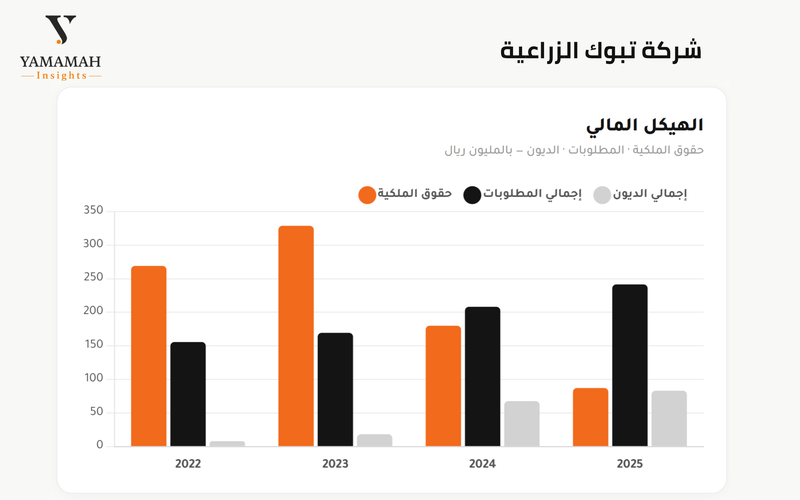
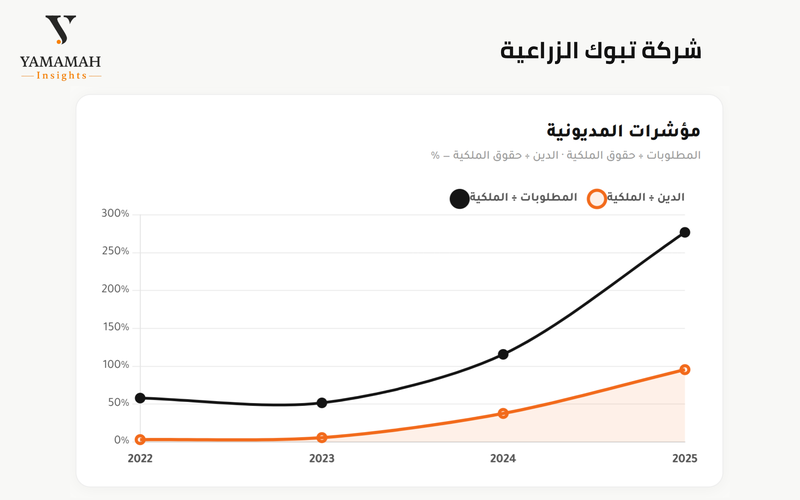
Student Rana Alshamrani @Rana Alshamrani offered a notable numerical analysis, saying: "I believe that the capital reduction in the case of Tabuk Agricultural Development is an accounting consequence of a deeper operational crisis. Notably, shareholders' equity had been improving through 2023, but it lost more than SAR 148 million all at once in 2024, a pattern indicating an exceptional balance-sheet shock. Therefore, the real measure of success is confirming that the 2024 crisis was a one-off event. By 2025, debt had approached parity with shareholders' equity, bringing the company close to repeating the scenario. The reduction here should be viewed as a temporary solution, not a permanent one."
Analytical and economic perspective
In an analytical review of the company's performance, financial and economic analyst "Hamad Alsaeed" @Hamad Alsaeed explains: The Capital Market Authority's approval to reduce Tabuk Agricultural's capital from SAR 391.77 million to SAR 76.52 million by canceling approximately 80% of its shares to write off SAR 315.24 million in losses may appear to be a corrective measure, but in reality it is merely a regulatory procedure and an accounting entry that offsets losses against capital. This procedure injects no liquidity and does not address the root problem. It leaves total shareholders' equity and the shareholder's book value unchanged, serving only to remove the company from the threshold of statutory losses that would trigger distress.
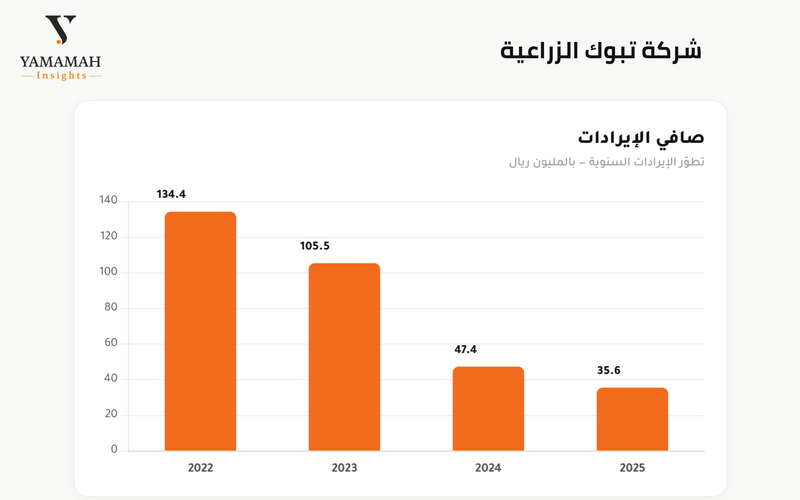
From a fundamental analysis perspective, the reduction does not address the collapse in revenue from SAR 134 million to SAR 35 million between 2022 and 2025, nor the negative profit margins and erosion of shareholders' equity. The General Assembly's rejection last December of a smaller reduction may reflect shareholders' lack of reassurance, which aligns with the Authority's explicit warning that its approval is not a judgment on the economic merits.
Because the reduction resets the financial statements without stopping the losses, the priority remains providing liquidity to revitalize operations. In this regard, management has taken steps including plans to cut expenses by 40% by the end of 2026 and exit Afaq Al-Ghida by selling 286,250 shares. Although the transaction will result in an immediate book loss of SAR 1.06 million, it is a necessary step to inject urgently needed cash and liquidity into the treasury and help the company overcome its financial crisis.
Disclaimer: This material was prepared under the supervision of a “Yamamah Insights” editor with the assistance of artificial intelligence tools for financial education purposes. It does not constitute a recommendation to buy, sell, or hold any security, and it expresses the views of its contributors, not those of the platform.
 Ask Yamami

Comments (6)
No comments yet. Be the first to comment!