

The infrastructure of religious facilities in the Gulf region is experiencing a structural transformation that goes beyond traditional architectural dimensions to the depth of economic efficiency. In this context, the joint collaboration between the Qatari Ministry of Awqaf and Islamic Affairs and the Qatar General Electricity and Water Corporation (Kahramaa) through the "BeSolar" initiative represents a practical model for the applications of "Green Waqf Economics". This transformation is not merely a response to environmental commitments, but a re-engineering of operational expenses in the non-profit sector, transforming mosques from energy-intensive consumers to smart facilities that contribute to financial sustainability and alleviate the burden on national energy grids.
Breaking Down the Economic Impact: Operational Efficiency and Return on Investment
Mosques have a distinctive energy consumption pattern; peak loads occur five times daily coinciding with prayer times, especially during summer periods when air conditioning and cooling consumption doubles. Integrating photovoltaic (PV) energy systems in these facilities achieves direct economic savings through two main levels:
- Reducing Operational Expenses (OpEx): The electricity bill represents the largest portion of maintenance and operational expenses for mosques. Relying on solar energy significantly reduces these costs, allowing the redirection of waqf revenues towards community development and educational initiatives instead of being consumed in energy bills.
- Peak Shaving: The times of the Dhuhr and Asr prayers coincide with peak hours of high temperatures and demand on the national grid. Generating solar energy locally in mosques during these hours reduces pressure on central generation stations, adding value to the overall economy.
Measuring Impact in Numbers: Social Return on Investment (SROI)
Although detailed financial data for the project has not been disclosed, economic modeling of similar projects indicates that converting mosques to a hybrid solar energy system (grid-connected) achieves a payback period ranging from 4 to 6 years, while the lifespan of solar panels extends to 25 years. This means obtaining nearly free energy for about two decades, enhancing the value of the "social and investment return" for every riyal spent from waqf funds.
Financial Engineering of the Initiative: Governance and Institutional Partnership
The Ministry of Awqaf's transition to a technical partnership with "Kahramaa" reflects maturity in the governance system and management of waqf assets. Relying on approved technical standards and defining specifications for panels and contractors protects waqf funds from the risks of investing in low-quality or non-compliant technologies.
The partnership is distributed across developmental pathways that ensure the sustainability of impact:
- Proactive Design: Conducting technical studies for existing mosques and those still in design to ensure that angular buildings and roof capacities are directed to achieve the highest efficiency in capturing solar radiation.
- Human Capital Qualification: Transforming the internal engineering competencies of waqf from traditional maintenance engineers to renewable energy consultants, enhancing the asset and knowledge value of the institution.
Ripple Effect: From the Mosque to the Neighborhood
The impact of the "BeSolar" project does not stop at the mosque walls, but extends to create what is economically known as the "ripple effect" in the local market:
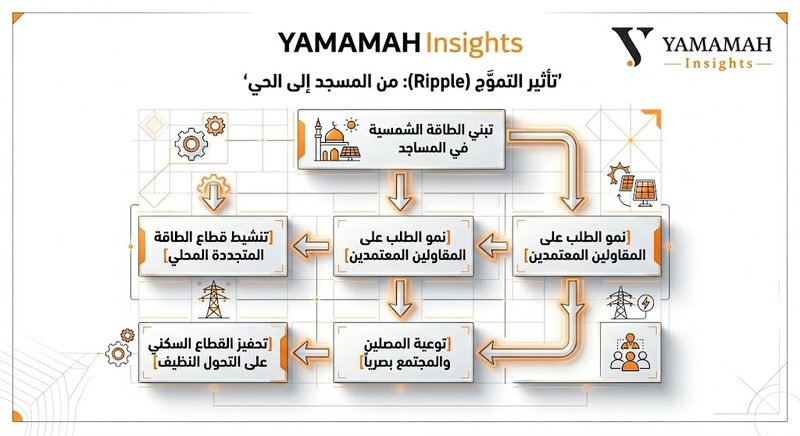
Seeing solar panels daily in vital facilities like mosques serves as a powerful visual awareness tool that contributes to "normalizing" the culture of clean energy among community members, accelerating the pace of transformation in the residential and commercial sectors, and directly supporting the strategic directions of Qatar National Vision 2030 towards a green economy.
Future Prospects: Green Bonds and Green Waqf
The next step to deepen the impact of this initiative lies in financial innovation. The waqf sector can explore sustainable financing solutions such as "green bonds" aimed at funding renewable energy projects in religious facilities, or activating a "net metering" system that allows mosques to sell excess energy generated during non-use periods (between prayer times or in attached Quranic schools during holidays) to the public grid, transforming mosques from cost centers to profit centers and value generators that contribute to sustainable development.
 Ask Yamami
Comments (6)
No comments yet. Be the first to comment!