

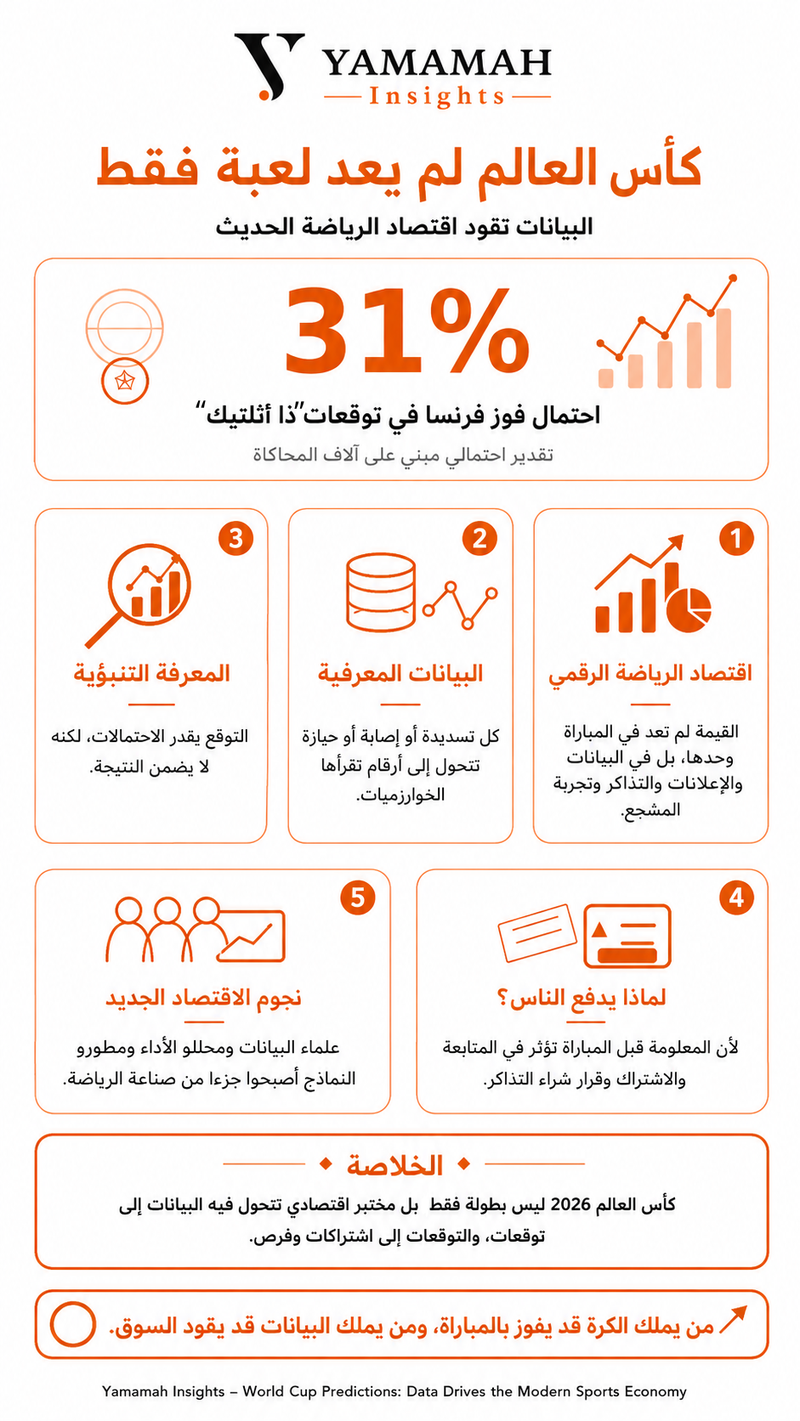
World Cup tournaments are no longer just a ninety-minute competition on the green field, but have transformed into a main driver of what is known today as "digital sports economy". In this era, value is no longer confined to match proceedings alone, but has extended to include data, advertising, tickets, and the entire fan experience.
This massive transformation depends on an integrated system driven by numbers, and its features are shaped in the following points:
1. Converting Movement into "Numbers"
Every detail on the field—whether a shot, a hit, or even ball possession—is no longer fleeting; it is immediately converted into cognitive data and precise numbers that intelligent algorithms read to analyze performance with meticulous accuracy.
2. Predictive Knowledge and Future Insight
Thanks to this data, companies and platforms are now able to provide "predictive knowledge". For example, "The Athletic" platform provided predictions of France's winning probability at 31% based on a probabilistic estimate grounded in thousands of computer simulations. Although the prediction estimates probabilities, it naturally does not guarantee the final result, but it gives the market an anticipatory view.
3. Why Do People Pay?
Data and information preceding matches are no longer just entertainment; they have become directly influencing the behavior of audiences and investors, starting from viewership rates and subscriptions, all the way to making the decision to buy tickets.
4. Stars of the New Economy
In modern sports, stars are no longer just players and coaches on the field; "behind-the-scenes stars" have emerged: data scientists, performance analysts, and mathematical model developers, who have become an integral part of the sports industry and directing its investments.
In summary:
The 2026 World Cup is not just a football tournament, but a massive economic laboratory where data is converted into predictions, and predictions into subscriptions and promising investment opportunities. In short: Whoever owns the ball may win the match, but whoever owns the data.. leads the market!
 Ask Yamami

Comments (4)
No comments yet. Be the first to comment!