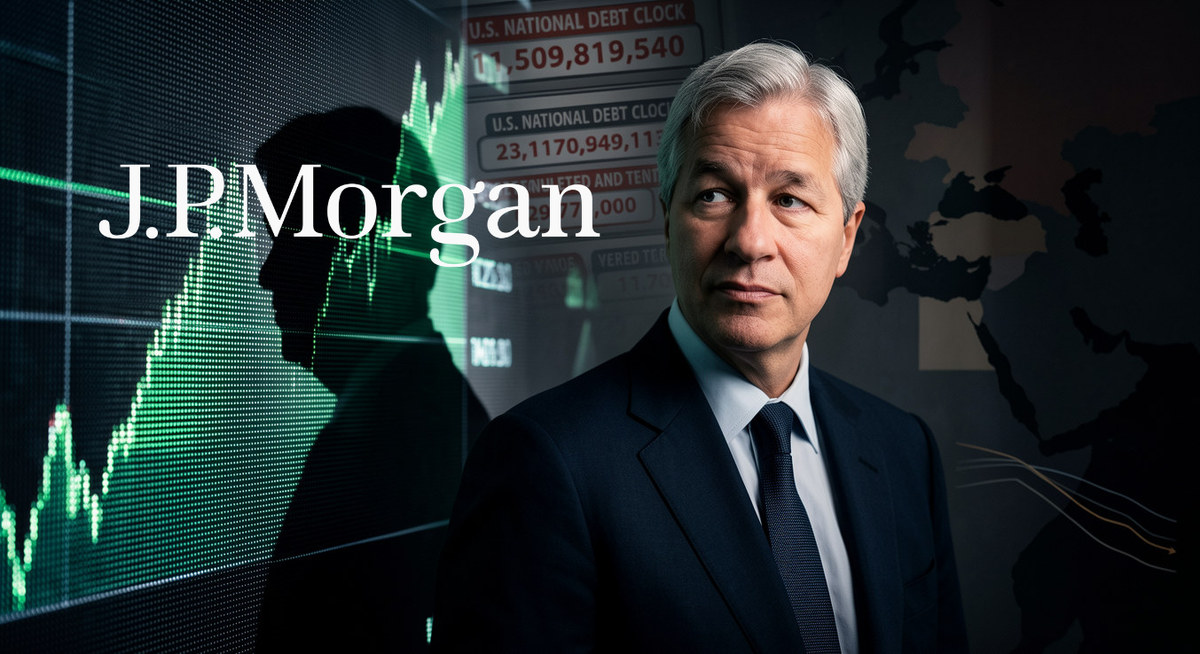

Jamie Dimon, the CEO of "J.P. Morgan Chase," the largest American bank by assets, issued a notable double warning to the markets, stating that investors are underestimating the geopolitical and financial risks facing the global economy, and that he personally will not be a buyer of either the broad U.S. stock market or long-term U.S. Treasury bonds at current prices.
Dimon's remarks came during a nearly hour-long interview with Wilfred Frost on the "Master Investor" podcast, recorded on July 16 and published on the evening of the 21st, as reported by CNBC. He clearly stated that he "will never buy" the overall U.S. stock market at its current pricing, and that he will also not be a buyer of long-term government bonds.
The Risks Are Greater Than Others Imagine
Dimon listed four areas of risk that he believes the market is not pricing adequately: the wars in Ukraine and the Middle East, tensions between the U.S. and China, rising military spending by governments, and widening budget deficits. He said, "I believe these risks are likely greater than others think."
However, Dimon did not predict an imminent collapse. He explained that the economy has become more resilient, and shocks that would have shaken the markets in previous cycles are now absorbed with little disruption, adding that it "may take more straws to break the camel's back," and that further escalation in ongoing wars may not be enough on its own to spark a crisis. He also distinguished between his view of the market as a whole and his view of individual stocks, expressing a willingness to buy a specific stock if he finds it an "excellent investment," while refraining from entering the broad market at its current levels.
Long-Term Bonds: No Attractive Upside
In the realm of debt instruments, Dimon saw that the yield does not leave enough room for profit. He stated that "even if inflation is at 2%, a ten-year bond should be around 4% to 4.5%,” noting that yields are indeed approaching this range. The ten-year Treasury bond is currently trading at a yield of about 4.6%, following an upward trend for most of the year as market expectations shifted from betting on interest rate cuts to the possibility of rate hikes.
Since bond prices move inversely with yields, the prospect of interest rate hikes and the uncertainty of the inflation path keep long-term bond prices under pressure. Dimon believes that unaddressed financial imbalances could push "bond vigilantes" to impose higher yields, leading to volatility in the markets.
This is not just an investment decision; the message has implications for stockholders as well. The conventional wisdom has been to move from stocks to bonds during sell-off waves as a "safe haven," but Dimon warns that this maneuver is no longer working as effectively as before, leaving investors with narrower options if stock markets correct.
Public Debt at the Core of Concern
Dimon attributed part of his concern to the financial situation of governments, noting that debt-to-GDP ratios have risen to nearly 100% in the U.S. and Europe, and that government deficits remain historically high despite the absence of a major recession or widespread war. He stated that governments should address these imbalances maturely before the markets impose a solution, adding that allowing the problem to worsen is the most likely scenario in his view.
These remarks come days after U.S. federal debt held by the public surpassed 100% of GDP for the first time since World War II, renewing the debate over the country’s fiscal path and concerns about an increasing share of government spending going toward servicing debt rather than productive investment. His current tone aligns with previous warnings he issued throughout the year; in May, from the "Reagan" National Economic Forum, he urged policymakers to address rising government borrowing before the markets react, warning that unchecked deficits could ultimately lead to "a kind of bond crisis."
Artificial Intelligence: Delayed Returns, Not Wasted Spending
In the realm of artificial intelligence, Dimon likened the current wave of spending to the early boom phases of the internet, without labeling it as wasteful. He acknowledged the massive amounts being allocated but distinguished between the viability of the spending in the end and the timing of the returns, saying: "Will it pay off overall? Most likely, just as the internet did. But will it pay off in the form and timeline you expect? Definitely not."
Contradiction with Market Sentiment and Record Results for the Bank
Dimon's cautious stance contrasts with the prevailing market sentiment; the S&P 500 index has risen about 10% since the beginning of the year, driven by resilient consumer spending, declining inflation, and a wave of enthusiasm for artificial intelligence. The interview also came days after "J.P. Morgan" announced its highest quarterly profit in its history, with a net income of $21.2 billion in the second quarter, driven by a surge in trading revenues and a gain on the bank's stake in "Visa." As a representative of the most profitable banks in the U.S., its aversion to the broad market represents a signal worth noting.
Flow data shows that many investors have already heeded his advice on bonds; the "iShares 0-3 Month Treasury Bond" (SGOV) fund, which specializes in short-term Treasury instruments, has attracted $47.5 billion in flows since the beginning of the year, raising its assets to nearly $100 billion, in a clear shift toward short-term maturities in search of safety rather than long-term ones.
Criticism of the British Bank Tax
Dimon's discussion was not without a competitive dimension, as he criticized the additional tax imposed on banks in the United Kingdom, warning that a non-competitive tax system could drive investment and capital to other destinations. His remarks coincided with "J.P. Morgan" and other major banks announcing strong quarterly results supported by trading activity and investment banking services.
Analytical Summary: Pricing Risks and Valuation Gaps in the Markets
In conclusion, Jamie Dimon's statements summarize an economic scene characterized by a clear gap between the high valuations of financial assets and the structural risks surrounding the global economy. This reading is based on the observation that markets are ignoring the pricing of complex challenges, most notably the rising geopolitical tensions, the steady increase in public debt levels, and budget deficits.
The statements also highlight a notable change in the dynamics of traditional safe havens; long-term Treasury bonds are facing pressures that limit their usual hedging efficiency amid the uncertainty of inflation paths and interest rates. Overall, this position reflects a diagnosis of financial and political uncertainty, highlighting the contradiction between the current positive performance of indices and the ongoing accumulation of unpriced risks.
 Ask Yamami
Comments (10)
No comments yet. Be the first to comment!