

In mid-June 2026, preliminary analyses published on the "Yamamah Insights" platform indicated a complex financial landscape characterized by "reverse acquisition".
At that time, the local company "Ninja", valued at $1.5 billion, emerged as a competitor seeking to acquire the assets of "Delivery Hero" in Saudi Arabia and the UAE, supported by a banking alliance including "Goldman Sachs" and "Citigroup".
However, the subsequent course of events revealed a completely different economic reality; on July 16, 2026, "Uber Technologies" decisively won the battle with a comprehensive acquisition deal for the German "Delivery Hero" group valued at €12.7 billion (approximately $14.6 billion).
Here, we attempt to analyze the details of this strategic shift and the financial motivations that tipped the scales in favor of the global giant to swallow one of the most important consumer infrastructures in the region.
From Local Maneuvering to Global Resolution: Unpacking the Acquisition Deal
"Uber"'s move was not merely a defensive response to the actions of local players, but represented a strategic financial assault to acquire stable cash flows.
- Acquisition Premium as a Barrier to Entry:
The deal was made at €41.5 per share, representing a massive price premium of 127% compared to the average share price of "Delivery Hero" before the news of the deal emerged in May, and a 34% premium over the average price during the three months prior to the announcement.
This bold pricing reflects "Uber"'s desire to cut off any competing investment alliances. - Regulatory Engineering to Overcome Antitrust Hurdles:
To navigate the complexities of competition protection laws that represented a stronghold for emerging local companies, the deal structure included the acquisition of "Delivery Hero"'s operations in 14 markets where it competes with "Uber" by the American investment firm "SSW Partners" for €1.4 billion.
The Saudi Market: A Bet on Recurring Revenues and Unit Economics
The economic justification for the deal's value lies in the quality of operational assets within the Saudi market, which has transformed from merely a rapid growth environment to a key driver of sustainable profitability for digital economy platforms.
- Shift Towards Stable Revenues:
"Delivery Hero"'s results showed that 61% of the total order value in Saudi Arabia came from customers subscribed to paid subscription programs.
This is the highest percentage across the group globally and is a critical indicator of revenue quality and customer loyalty. - Dominance Over Sales Channels:
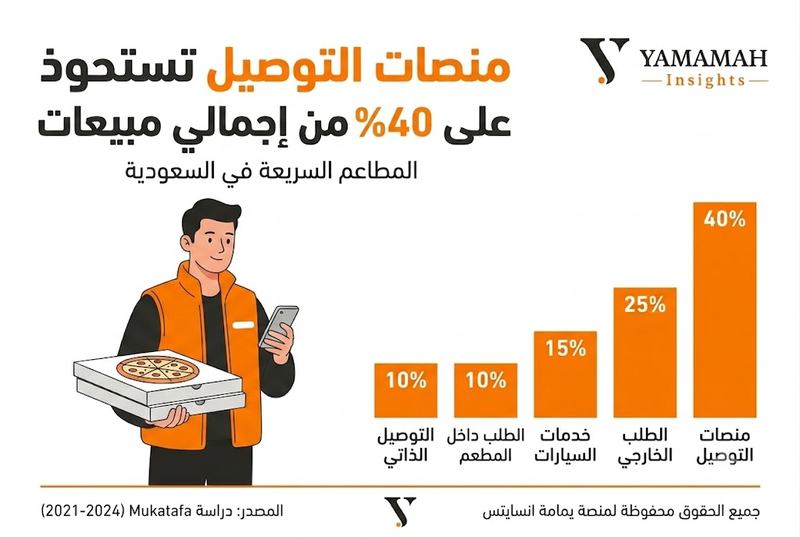
Delivery platforms have become the most important sales channel in the Saudi food sector, accounting for 40% of total fast food restaurant sales in the Kingdom.
In contrast, traditional channels have declined, with external orders representing 25%, car services 15%, while both dine-in orders and self-delivery account for 10% each.
- Pricing Power and Profit Margins:
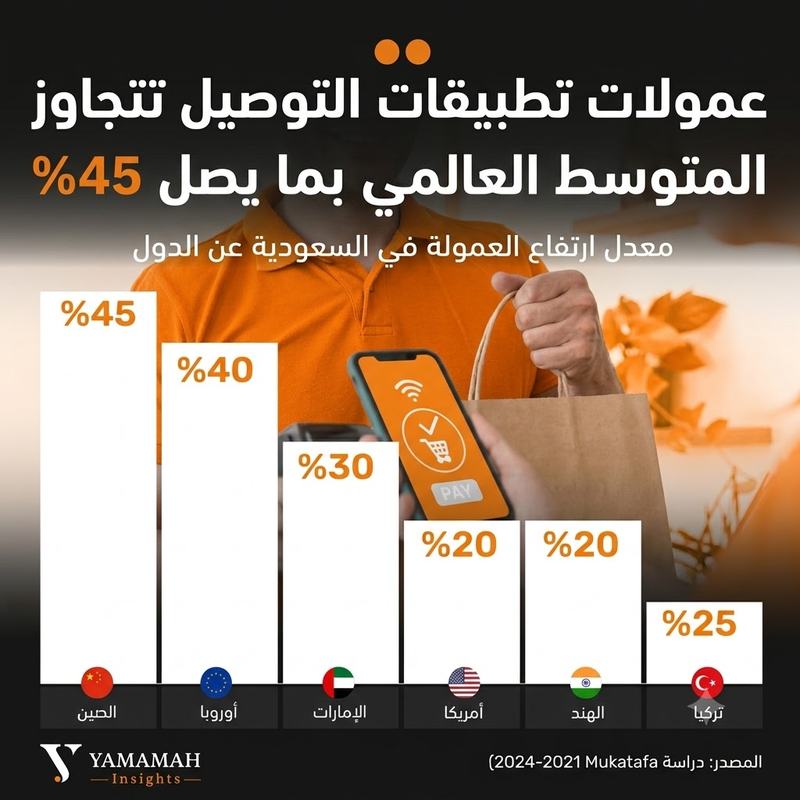
Delivery apps in Saudi Arabia enjoy exceptional pricing power, as their commissions exceed the global average by significant margins; they are 45% higher than in China, 40% higher than in Europe, 30% higher than in the UAE, 25% higher than in Turkey, and 20% higher than in both the United States and India.
The Gap in Economies of Scale: Why Local Players' Chances Diminished?
Despite the sharp growth in order volume in Saudi Arabia during the first quarter of 2026, which recorded over 118 million orders with a growth rate of 49%, the ambitions of local players faced a massive gap in "Economies of Scale".
- Global Network Size: By merging the operations of both entities, the "Uber" platform now operates in 99 countries, with a total order value of $236 billion according to 2025 data.
- Growth of Quick Commerce (Q-Commerce): Competition is no longer limited to meal delivery but has extended to groceries and pharmaceuticals. The value of quick commerce orders at "Delivery Hero" increased by 30% to reach €2.2 billion, raising its contribution to 18% of total order value.
- Operational Readiness for Penetration: This acquisition grants "Uber" direct and dominant access to the Saudi market through the "HungerStation" app. Estimates suggest that "HungerStation" captures about 40% of the Saudi market by the end of 2025, outperforming "Kita" (33%) and "Jahez" (over 20%). This ready access saves "Uber" the costs of building a customer base or a new operational network from scratch.
Economic Conclusion: The Era of Financial Maturity and the Victory of Global Capital in the "Quick Commerce" Sector
This investment case has proven that regional markets with high purchasing density and high commissions are no longer just arenas for local tactical competition, but have become pivotal strategic targets for global capital. "Uber" did not merely acquire market shares in this deal; it acquired a "consumer infrastructure" characterized by high loyalty rates (61% of orders through subscriptions) and an exceptional ability to generate profit margins. This merger establishes a new phase of financial maturity in the "quick commerce" economy in the region, where the advantage will go to entities capable of integrating global technological innovation with deep local operational networks.

Comments (8)
No comments yet. Be the first to comment!