
Imagine with me that you live in the late sixties; the golden age of the global economy. Jobs are available for everyone, factories are operating at full capacity, massive cars greedily consume cheap fuel, and people think this party of prosperity will never end. Everything was proceeding according to clear and stable rules, exactly like a Swiss clock.
But as soon as 1970 struck, clouds began to gather. The world did not know that it was about to enter a dark tunnel that would change money, energy, and politics forever. Welcome to "The 1970s Crisis"; the decade when the world held its breath.
The First Scene: The Night of Delinking.. or "Nixon Shock"
On a summer evening in 1971, President "Richard Nixon" sat before television screens to deliver a speech that seemed calm, but it was like an earthquake that shook global markets.
Until that moment, the world operated under a comfortable monetary system: the American dollar is the most important currency in the world, and it is backed by gold. If you had 35 dollars, you could go to the American Treasury and exchange them for an ounce of pure gold. But America was spending lavishly on the Vietnam War and its domestic programs, and its gold reserves began to erode.
In simple terms, Nixon announced: "We will no longer exchange your dollars for gold after today". In that night, the dollar transformed from a paper representing a piece of gold, into a paper deriving its value from faith in the American government alone. This moment became known as "Nixon Shock". Global currencies floated on the surface, their values fluctuating up and down each day, and the beast of inflation (rising prices) stirred in his arrogance preparing to emerge.
The Second Scene: Oil becomes a weapon (1973)
While the world was trying to absorb the dollar shock, the big blow came from the Middle East. In the autumn of 1973, the October War broke out. In response to Western support for Israel, the Arab oil-producing nations made a historic, firm decision: to embargo oil exports and reduce production.
Suddenly, major industrialized nations realized a terrifying reality: their giant economy, their amazing factories, and their luxurious cars, are nothing but scrap metal if Arab oil drops stop.
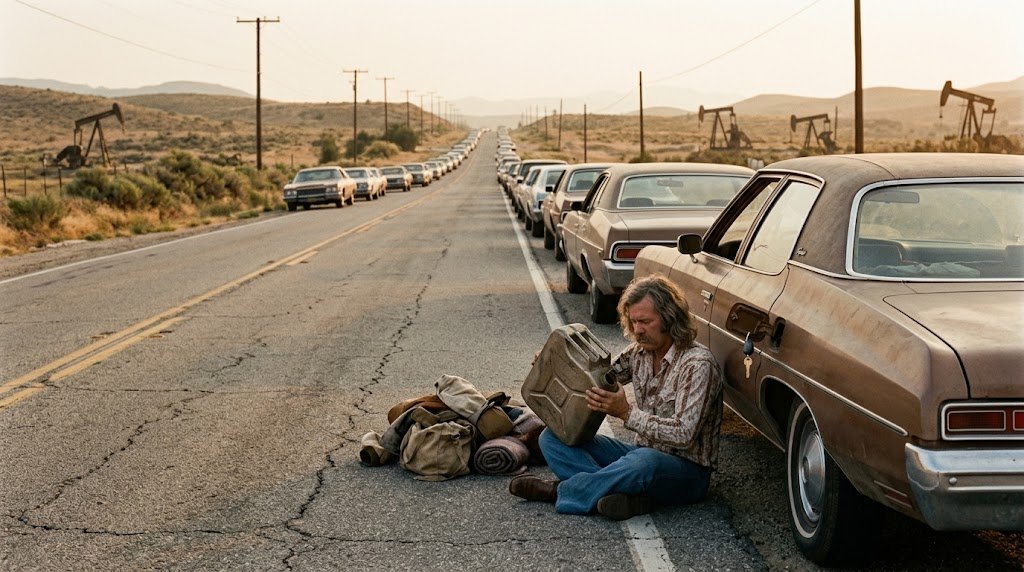
Oil prices quadrupled in the blink of an eye. The streets of America and Europe turned into scenes from science fiction films; lines stretching for miles at gas stations, turning off street lights at night to save energy, and factories closing their doors and laying off workers. In contrast, the Arab Gulf region witnessed a historic flow of wealth, and its countries began building a modern renaissance that would change the map of global financial influence.
The Third Scene: The Birth of the Beast That Puzzled Scientists
Here, a new and frightening term appeared in the dictionaries of economics, a term that made great experts pull their hair in confusion: "Stagflation".
What is this beast? The old economic rule said: either you have "growth and expensive prices" (because people work and buy), or you have "recession and falling prices" (because people lost their jobs so they stopped buying).
But in the 1970s, the impossible happened: factories close and people lose their jobs (recession), and at the same time prices skyrocket every day (inflation)! The ordinary citizen became trapped between the jaws of a vise: he has no salary, and if he finds one, it is not enough to buy bread whose price has doubled. The old economic theories that the world had lived by for decades collapsed.
The Fourth Scene: The Killing Blow (1979)
Barely the world began catching its breath and adapting to the new prices, the revolution erupted in Iran in 1979, followed by a sudden halt in Iranian oil pumping. The result? "The Second Oil Shock". Oil barrel prices soared to astronomical figures (about 40 dollars, a staggering figure by the standards of that time). And the gas lines and panic returned to the streets again, to close the 1970s decade with a killing blow that left the global economy reeling.
After the storm: A new world is born from the womb of crisis
The 1970s crisis did not end without changing the genes of the global economy forever. These lean years taught us harsh lessons that we have not forgotten to this day:
- The age of efficiency: The world realized that energy is not free. America abandoned its large fuel-hungry cars, which opened the door wide for small, economical Japanese cars to conquer the world.
- Revolution in policies: People became convinced that governments have no magic wand, and their excessive intervention can spoil things. This paved the way for leaders like "Margaret Thatcher" in Britain and "Ronald Reagan" in America in the eighties, who adopted free market policies, reducing government's role, and raising interest rates brutally to kill the beast of inflation.
- New power: The crisis proved that natural resources are the real nerve of the economy, consolidating the position of Middle Eastern countries as a pivotal and essential player in world stability.
The 1970s were not just a passing financial crisis; they were the "operating room" where our modern economy was painfully born. It was the era in which humanity realized that growth is not guaranteed forever, and that a banknote in your pocket, or a drop of fuel in your car, is subject to complex political and economic balances whose threads are woven in distant continents.
 Ask Yamami
Comments (5)
No comments yet. Be the first to comment!