

Machines are coming, but they are not looking for your job as much as they are looking for a partner.
A latent concern has always prevailed in university corridors whenever the term "artificial intelligence" is mentioned. A student who spends years mastering a complex programming language or memorizing precise accounting principles suddenly finds themselves facing headlines warning of the imminent replacement of humans by algorithms. However, a careful reading of the data reveals a completely different reality; a reality that does not call for panic, but rather for a reordering of priorities.
In a detailed analysis published by researchers at the "McKinsey" Institute (Silvan Johansson, Anu Madhavkar, Ulf Schrader, and others), the "Skill Change Index" was highlighted. This index, which studies the extent to which various skills are exposed to automation risks, provides us with a clear roadmap of what the job market will look like in the near future.
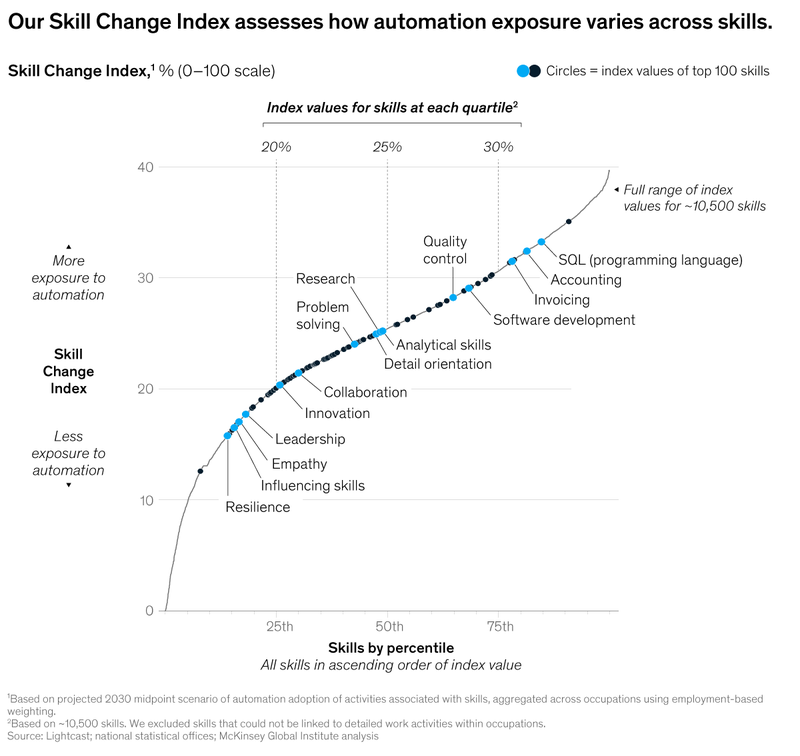
@yamami yamami.ai attempted to translate the chart and came up with this result:

The Graph Curve Paradox: The Fall of the "Routine" and the Resilience of the "Flexible"
Upon reflecting on the graph presented in the report, we discover an intriguing economic paradox. Historically, technical and routine skills were viewed as the safe haven and absolute job security. However, the curve places these tasks—such as billing, accounting, and even software development and coding (SQL)—at the highest point on the risk ladder. The reason is simple: algorithms decisively excel at performing repetitive tasks based on strict logical rules.
In stark contrast, pure human skills rest at the bottom of the graph, safe and fortified against the winds of digital change. Skills such as adaptability, influence, empathy, and leadership are resistant to mechanical replication. A robot may be able to audit a financial budget in seconds, but it will inevitably fail to read the body language of an angry client, motivate a team in crisis, or devise an unconventional solution to a complex problem.
The Survival Recipe
Data indicates that most of the top 100 in-demand skills in the job market are exposed, at least partially, to automation. This widespread change may seem alarming at first glance, but it carries a golden opportunity for the current generation.
The secret does not lie in abandoning the study of technical or scientific disciplines, but in realizing that the future work environment will increasingly require close "collaboration" between humans, intelligent agents, and robots. Artificial intelligence will not take your job; rather, the professional who masters the use of artificial intelligence will outperform those who ignore it.
Here is the roadmap for survival and excellence:
- Invest in your human identity: Make your academic specialization just a tool, while your soft skills (emotional intelligence, leadership, and collaboration) are your professional essence.
- Rapid Adaptation Mindset (Flexibility): The ability to continuously learn and reinvent oneself is the skill least exposed to automation. Do not settle for what you learn in classrooms; learn how to adapt to what has not yet been written in books.
- Complex Problem Solving: Algorithms solve pre-defined problems, while humans excel at exploring ambiguous problems and finding innovative solutions.
The Fourth Industrial Revolution and the astonishing evolution of machines will not turn us into cogs in a massive machine, but will force us to be "more human" than ever. The market value of empathy, creativity, and leadership is on the rise. So, to every student standing on the brink of graduation: Arm yourselves with technology, yes, but always bet on your humanity; it is your constant essence that cannot be automated.
 Ask Yamami
Comments (8)
No comments yet. Be the first to comment!