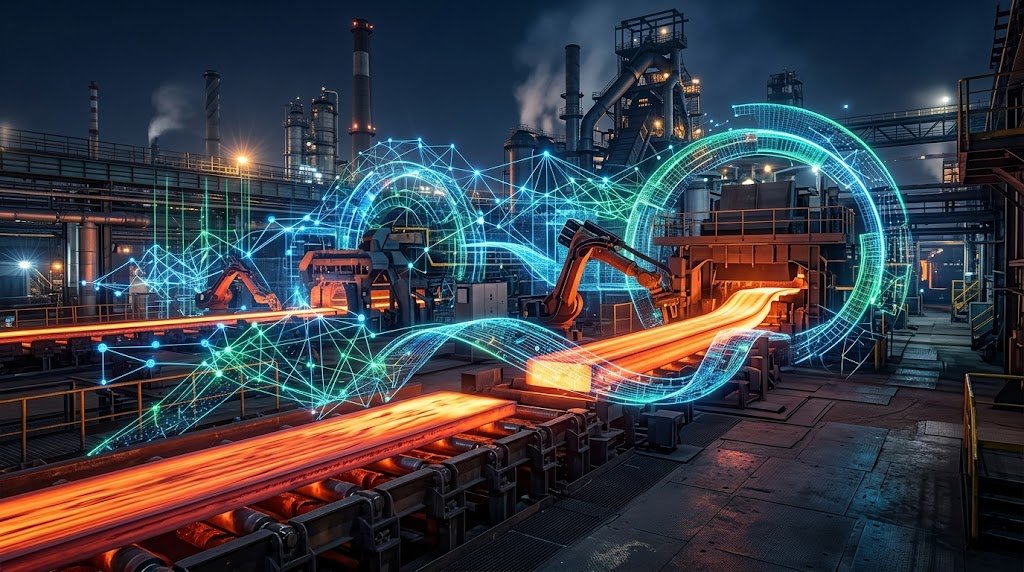

Heavy industries, like steel manufacturing, no longer depend solely on massive furnaces and raw materials; data and the ability to analyze it have become the new "raw material" ensuring survival and competition in global markets.
The strategic partnership extending for three years between American steel industry giant "Cleveland-Cliffs" and leading artificial intelligence company "Palantir" represents a fundamental turning point highlighting digital transformation's future in complex industrial sectors.
How Do Artificial Intelligence Platforms Work in Steel Factories?
Platforms like "Palantir" don't work as traditional computer programs, but as an integrated "intelligent operating system" for the factory. Technically, this transformation depends on several hidden but crucial pillars:
- Digital Twins: AI platforms create a digital copy identical to the actual factory. This allows engineers to simulate complex smelting and production processes, testing different scenarios virtually before applying them to reality, reducing risks and increasing output accuracy.
- Breaking Data Isolation (Data Integration & Ontology): In traditional factories, data is isolated (maintenance data in one system, sales in another, thermal sensors in a third). Artificial intelligence algorithms unite this massive data in one integrated environment, analyzing hidden links between them for comprehensive decision-making.
- Data-Driven Predictive Maintenance: Instead of traditional maintenance schedules or waiting for machines to break down, "machine learning" models analyze real-time sensor data (like vibrations, temperature, and pressure) to predict failures before they happen, preventing production line shutdowns.
- Real-time Process Optimization: Algorithms calculate the precise mix of raw materials and energy needed for each production cycle in fractions of a second, ensuring the highest steel quality with minimal energy waste.
Redrawing the Industrial Competition Map
Economically, this step transcends being merely a technological upgrade; it's a complete restructuring of the business model in heavy industries, evident in industrial markets as follows:
- Cost reduction and profit margin protection: By reducing unexpected downtime and precisely optimizing energy consumption (the largest cost in steel manufacturing), companies can significantly improve profit margins, providing financial protection even during economic recession.
- Flexibility and Market Responsiveness (Agility): The steel market is heavily affected by geopolitical fluctuations and commodity prices. Artificial intelligence gives the company the ability to dynamically adjust production and pricing plans based on global demand forecasts and supply chain conditions, protecting it from inventory buildup or supply shortages.
- Raising Entry Barriers: Companies adopting these technologies early will create a huge competitive gap. It will become nearly impossible for traditional entities to compete with companies possessing AI-backed production efficiency and pricing advantages. This may later lead to a wave of acquisitions and mergers, as tech-advanced companies swallow struggling competitors.
The convergence of advanced artificial intelligence with heavy industries creates a completely new economic model where efficiency and data are the most valuable currency. Steel industry competition is no longer between who owns bigger furnaces or cheaper labor, but who has the smartest algorithms capable of turning every data point into added economic value and sustainable competitive advantage.

Comments (4)
No comments yet. Be the first to comment!