
How much can a fraction of a millisecond be worth? In everyday life, we may not notice it passing, but in financial markets, it can present an opportunity to make millions of dollars.
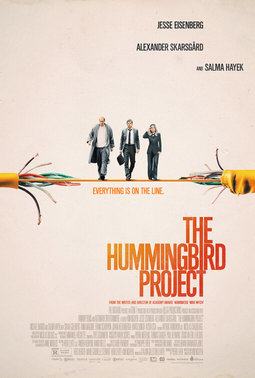
That paradox drives The Hummingbird Project, first released in 2018 and directed by Kim Nguyen. It takes viewers into a world where financial firms compete to execute trades faster.
A race beyond the naked eye
The film follows cousins Vincent and Anton Zaleski, who decide to pursue an ambitious project: building a fiber-optic line between the financial markets in Kansas and New York to cut data transmission time from 17 to 16 milliseconds.
The difference may seem tiny, but in electronic trading it could give someone the chance to execute trades before competitors.
To achieve this, the pair take on an engineering project requiring substantial funding, software development, and solutions to geographic, legal, and technical obstacles—all while competitors work on faster alternatives.
How does speed turn into profit?
The film explores what is known as high-frequency trading, a method that uses sophisticated computer programs to execute large numbers of buy and sell orders in fractions of a second.
To simplify the idea, suppose a stock trades for $100 in one market while its price rises to $100.01 in another. Faster systems may be able to exploit this temporary gap by buying in the lower-priced market and selling in the higher-priced one before the opportunity disappears.
Although the gap is only one cent per share, repeating the process at high trading volumes can generate significant profits after costs and risks are taken into account.
That makes connection and data-processing speeds a source of competitive advantage: the ability to outperform rivals economically.
When speed becomes an industry
This competition is not limited to the film. In a 2021 study, researchers at the Bank for International Settlements (BIS) estimated that the financial value tied to races to exploit trading-speed differences was about $5 billion a year in global equity markets alone.
The study found that these races most commonly lasted between 5 and 10 millionths of a second.
This competition raises questions about market efficiency and fairness, and about whether firms with advanced technical infrastructure have an equal footing with other market participants.
Is a technical edge worth the cost?
As the film unfolds, the competition moves beyond technology to pose a fundamental question in the world of investment: do the expected returns justify the money spent to gain an edge?
A company may succeed in developing faster technology, yet struggle to recoup its costs if a more efficient rival technology emerges or profit opportunities decline.
This is where feasibility analysis matters: it compares a project’s costs with its expected returns, while also assessing risks and its ability to retain a competitive edge over time.
The Hummingbird Project offers a perspective that reaches beyond the stock market to business more broadly. Innovation’s economic value is measured not just by its ability to outperform, but by its ability to turn that edge into lasting returns.
Being first may be a technical achievement, but creating value from it is the economic achievement.
 Ask Yamami

Comments (3)
No comments yet. Be the first to comment!