
Saudi banks announced their financial results for the second quarter of 2026 (the first half); where the banking sector continues to establish itself as a fundamental and structural pillar for economic growth in the Kingdom. Despite the varying performance of stocks following the announcements, the disclosed bank statements so far have shown high operational strength and an exceptional ability to absorb financing cost pressures and rising interest rates.
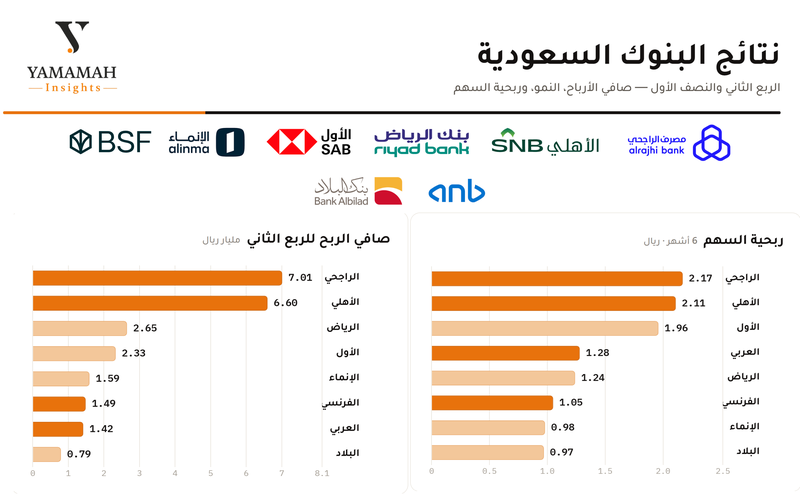
Regarding the performance of 8 Saudi banks (Al-Rajhi, Al-Ahli, Al-Inma, Al-Awwal, Al-Bilad, Al-Arabi, BSF, and Riyadh), the statements revealed the continuation of the upward profit trend, with earnings per share ranging between 0.97 and 2.17 riyals over six months, awaiting the completion of the disclosure cycle with the announcement of two banks (Al-Jazeera and Investment).
This solid financial performance has directly reflected on the trends of major investment funds; as bank stocks accounted for 31.2% of the holdings of the top 10 investment funds in the Kingdom, valued at 3.25 billion riyals, with Al-Rajhi Bank alone accounting for about 2.4 billion riyals of that (14.3%).
However, these positive results were not without market paradoxes; as some leading bank stocks experienced selling pressures and declines following the announcement, a phenomenon interpreted by observers either as the market preemptively pricing in the profits ("selling the news"), or as investors' tactical desire to take profits.
Students from Al-Yamamah University discussed the implications of these results, growth drivers, competition dynamics, digital transformation, and mechanisms for attracting institutional liquidity as follows:
The strength of the banking sector and its impact on the market:
Student Turki Al-Ashri opened the analysis by saying: "The Saudi banking sector is witnessing significant development and growth, with Al-Rajhi Bank standing out, which announced today a 14% increase in its profits, reaching about 7.01 billion riyals during the second quarter of 2026.
Although some banks did not achieve the expected results or growth, the sector as a whole still enjoys clear strength and stability, as no listed Saudi bank has reported losses.
The banking sector is considered one of the heavyweight and influential sectors, so the strength of its results and profit growth clearly reflects on the overall market performance."
Growth drivers and the future impact of interest rates
Student Rimas Al-Mashali @Rimas Almashali commented: "I believe that the growth in bank profits was supported by the expansion of financing portfolios, an increase in net commission income, while maintaining asset quality and controlling provisions at some banks. The decline of some stocks despite the positive results may be due to the market having already priced in these profits, in addition to profit-taking.
In the future, a reduction in interest rates may gradually pressure profit margins, but on the other hand, it will support demand for financing, which may compensate for part of the margin decline."
Performance variation and challenges in income diversification
Student Mohammad Alghaihab @Mohammad Alghaihab shared his opinion, saying: "The results of the banks showed the continued strength of the sector, but performance varied according to their ability to grow financing portfolios and improve non-interest revenues.
Al-Rajhi Bank stands out as the strongest bank benefiting from its strong digital transformation and financing growth.
The decline of some bank stocks is due to the market's preemptive pricing and profit-taking. Overall, Saudi banks still enjoy strong financial solvency, but continued growth will depend on interest rate movements, the growth of financing demand, and each bank's ability to diversify its income sources beyond just interest margin."
Operational efficiency and investor confidence
Student @شهد المحيسن added: "The results showed the continued strength of the banking sector, with Al-Rajhi being the most prominent in terms of growth supported by the expansion in financing and operational efficiency, while other banks benefited from reduced provisions.
The continued profit margins reflect the banks' ability to manage financing costs despite changing interest rates, while the oversight of the central bank and strong governance have enhanced investor confidence.
I believe that Al-Rajhi's superiority in attracting market shares is due to its strong brand, leadership in digital services, and a broad customer base."
Competition and balanced growth in the long term
Student Faisal Bashir analyzed: "The results of the second quarter confirm that the Saudi banking sector remains one of the strongest sectors, and the variation in results is natural due to the different strategies of each bank and the nature of its financing portfolio.
What matters to me is not just net profit, but the growth rate of loans and deposits, and the quality of assets.
The significant weight of bank stocks in portfolios reflects investor confidence, and I believe that competition will increase in the coming period, and banks that can achieve balanced growth while maintaining the quality of their credit portfolio will be the most distinguished in the long term."
Quality of profits and sustainable growth
For her part, student Ghadah Alwallan @Ghadah Alwallan highlighted the sources of profitability, saying: "In my opinion, it is not enough to look at the profit growth rate alone, but rather at the source of this growth. There is a difference between a bank whose profits increased due to growth in core activities such as financing expansion and increased commission income, and a bank that benefited more from reduced provisions or non-recurring factors.
Therefore, I see that the quality of profits is the most important criterion when comparing the performance of banks, as it provides a clearer indication of the bank's ability to achieve sustainable growth in the coming periods."
Market behavior and digital incentives
Regarding the market's reaction to the results, student Mohammad Bashir commented: "The drop in stocks after the profit announcement is considered a classic move (selling on the news) because the results were already priced in.
The real growth in the sector comes from corporate financing and reduced provisions.
Al-Rajhi's superiority is attributed to digital ease and the strength of the retail sector, and the banks' distributions with central bank oversight are what drive funds to hold onto the sector as a safe haven and source of liquidity."
Quarterly acceleration versus financial maturity
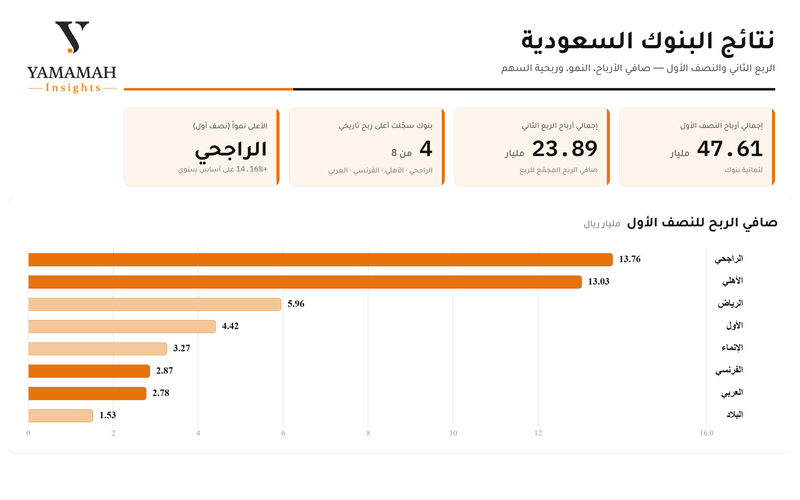
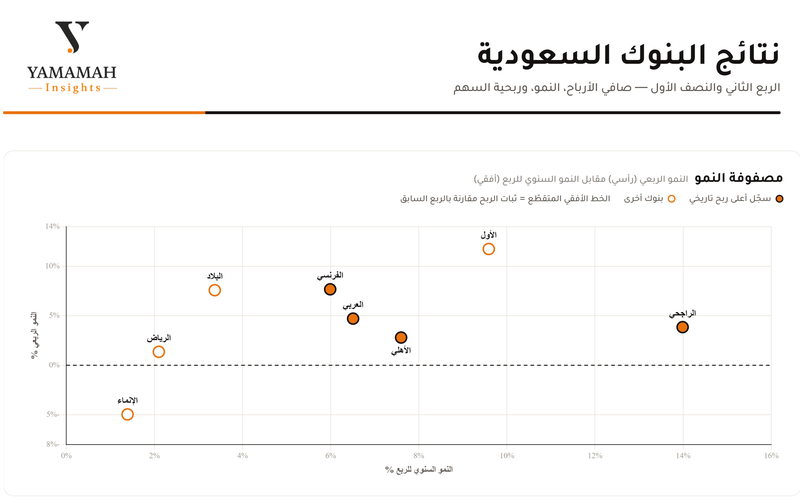
Student Rana Alshamrani @Rana Alshamrani concluded the analysis with a detailed breakdown of growth rates, saying: "Al-Rajhi Bank achieved the highest semi-annual growth rate of 14.16% with earnings per share of 2.17 riyals, but the quarterly growth matrix shows a slowdown in momentum to less than 4% compared to other banks, indicating its entry into a maturity phase rather than acceleration based on a massive profit base of 13.76 billion riyals. Therefore, accurate comparison depends on analyzing the quarterly growth acceleration curve rather than absolute profit."
Between operational flexibility and financial hedging
In an analytical reading of the company's performance, financial and economic analyst Hamad Alsaeed @Hamad Alsaeed stated: The banking sector balanced operational flexibility and financial hedging by the end of the second quarter of 2026, with variation in the performance of interest margins and efficient management of the deposit structure that kept the overall financing cost at 3.2% to alleviate the pressures of the LIBOR. This positively reflected in the growth of Al-Rajhi's profits by 14% to reach 7 billion riyals, and Al-Ahli's by 7.6% recording 6.6 billion riyals.
Credit-wise, banks adopted a strict hedging approach as Al-Rajhi's provisions jumped 46.8% to 881 million riyals, and Al-Ahli's rose 144.6% quarterly. This measure is preventive to enhance asset quality, and despite its pressure on current quarter profitability, it will turn into net profits in the future as the need and risks diminish.
Conversely, the persistence of high interest rates will directly affect the sector. While it supports short-term profits through the repricing of variable-yield assets, it will reduce demand for corporate expansion borrowing. This credit slowdown, along with the burden of current provisions, may negatively impact the overall profit growth rate in the coming periods.
Therefore, we expect stable credit growth between 7.5% and 8% for 2026. Despite the pressing factors, the outlook remains optimistic driven by the flow of Vision projects, with the preference for banks that are most efficient in managing financing costs and deposits.
Disclaimer: This material was prepared under the supervision of the “Yamamah Insights” editor and with the assistance of artificial intelligence tools for financial education purposes, and it does not constitute a recommendation to buy, sell, or hold any security, nor does it reflect the opinion of the platform.
 Ask Yamami

Comments (7)
No comments yet. Be the first to comment!