
ADES Holding Company announced that its subsidiary, ADES Saudi Limited, had completed the full acquisition of Saipem Arabia Saudi Limited for a total value of SAR 1.07 billion (USD 285 million), financed through available liquidity and existing financing facilities.
The deal includes the acquisition of five premium jack-up drilling rigs (three owned and two leased), four of which operate within the Kingdom of Saudi Arabia, while the fifth operates in Mexico under an existing contract.
The company explained that the acquisition adds approximately SAR 3.8 billion (USD 1 billion) to its backlog, supporting long-term revenue and cash-flow visibility as part of its strategy of disciplined expansion through assets tied to existing contracts.
While assessing the financial impact and the expansion of the offshore fleet, students from Al Yamamah University discussed the implications of this decision for the sector and the company’s future growth as follows:
Enhancing operational efficiency and accelerating growth through existing assets
Student "Rand Alkhalaf"@Rand Alkhalaf began the analysis, saying: "I believe the acquisition gives ADES an opportunity to increase its revenue and cash flows by adding ready-to-operate rigs, rather than building new assets from scratch. Expanding through acquisitions also helps the company increase the size of its fleet and strengthen its competitiveness.
As for investing in oil and gas, I believe it still offers growth opportunities despite the world’s shift toward renewable energy, particularly given the continued demand for oil and gas. International expansion can support the company by diversifying revenue sources and increasing the contribution of Saudi companies to global markets."
Balancing cash flows and financial leverage risks
Student "Yazan Hamoud" @Yazan Hamoud explained the dimensions of the deal, saying: "I believe the acquisition is a positive step because it adds ready-to-operate rigs and increases revenue without waiting for new rigs to be built.
However, attention must be paid to the increase in debt and financial leverage. Therefore, the success of the deal depends on the new rigs’ ability to generate cash flows and profits sufficient to cover the acquisition and financing costs."
Contractual readiness and cost-management efficiency
Student "Dina Alarjani" @Dina Alarjani shared her analysis, saying: "In my view, ADES’s acquisition is a positive step because it added assets operating under existing contracts, which could quickly be reflected in revenue and cash flows.
I also believe its expansion in oil and gas is a growth opportunity despite the shift toward renewable energy, because demand for conventional energy remains ongoing. However, the success of the deal depends on managing the assets and costs efficiently."
Shortening the timeline for expansion and international presence
Student "Rabiah Almugait" @Rabiah Almugait shared her perspective, saying: "I believe adding five drilling rigs could give ADES a boost in revenue and cash flows, particularly if the rigs enter into new or existing contracts.
I believe acquiring ready-to-operate assets saves the company considerable time and effort, but ultimately the outcome depends on its ability to operate and manage them effectively.
Regarding oil and gas, I believe the sector still offers opportunities despite the major shift toward renewable energy, because demand for oil and gas remains. I also believe expansion outside Saudi Arabia is an important step for ADES, as it diversifies its income sources, gives it a greater opportunity to establish a presence in global markets, and could positively affect the local economy."
Sustainable cash flows and geographic risk diversification
Student @ثناء الشايب emphasized the importance of the operating model, saying: "What stands out about ADES’s deal is that the company is not expanding merely by increasing the number of rigs; it is also saving time by acquiring existing, ready-to-operate assets.
In my view, the success of this strategy depends on the company’s ability to turn this rapid expansion into sustainable cash flows, particularly since its global presence gives it an opportunity to diversify its income sources and reduce reliance on a single market."
Strengthening competitiveness and expanding abroad
Student "Jumana Alshehri" @Jumana Alshehri added her analysis, saying: "I believe the acquisition is an important step for ADES because it adds five drilling rigs and expands the company’s business scale, which could support revenue and cash flows as the assets begin operating and are integrated. The strategy of acquiring existing assets also helps the company expand faster than building new assets from scratch and increases its competitiveness.
As for expansion in oil and gas, I believe there is still sustained demand for drilling services, so it can represent a growth opportunity despite the global energy transition. As ADES expands internationally, diversifying revenue sources and entering global markets can support the company’s growth and strengthen the global presence of Saudi companies."
Managing the risks of changes in the energy mix
Student "Albatool Bedairi" @Albatool Bedairi pointed to the strategic trade-offs, saying: "I believe this expansion represents an opportunity linked to continued demand for drilling services, but it also carries long-term risks associated with changes in the energy mix. Existing contracts and the increased utilization of offshore drilling rigs help mitigate some of these risks."
Direct financial impact and backlog growth
Student "Fahad Alruwaished" @Fahad Alruwaished commented on the financial value, saying: "In my view, ADES’s acquisition of Saipem Arabia for SAR 1.07 billion is a masterstroke, and its financial impact will be rapid and significant because the five acquired rigs are operational and tied to existing contracts. This means revenue and cash flows will enter the company’s accounts immediately, without any waiting period.
Moreover, adding SAR 3.8 billion to the company’s backlog gives ADES excellent stability and sustainability in its long-term revenue, covers the cost of the financing and facilities used for the deal, and generates additional value."
Integration challenges and controlling profit margins
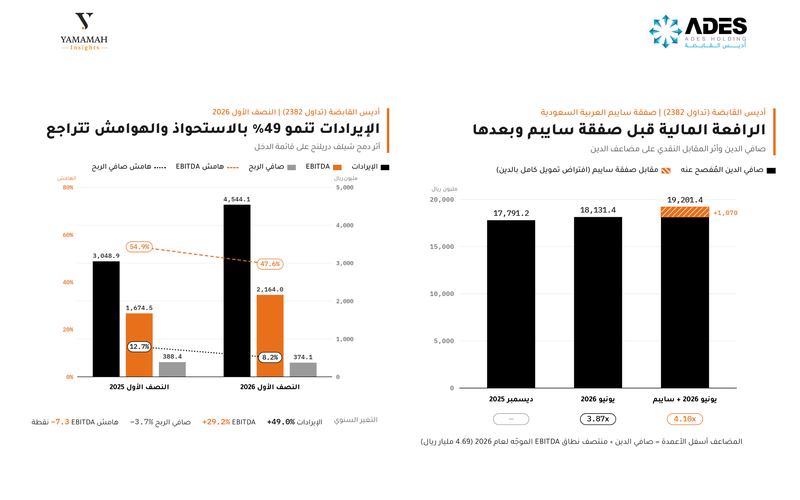
Student "Ghadah Alwallan" @Ghadah Alwallan warned of the operational challenges, saying: "I believe the deal’s real challenge will emerge after integration, particularly since ADES entered 2026 with strong revenue growth but a decline in EBITDA margin and an increase in net debt.
Therefore, the success of the acquisition should not be measured solely by the addition of SAR 3.8 billion to the backlog, but by the new rigs’ ability to generate sufficient profits and cash flows to improve return on capital without increasing pressure on margins and debt."
Increasing productivity and improving asset returns
Student "Rimas Almashali" @Rimas Almashali highlighted asset efficiency, saying: "I believe Saipem Arabia’s revenue declined from approximately SAR 870 million in 2023 to SAR 636 million in 2025. Therefore, what matters most to me is not the number of rigs added, but whether ADES can increase their productivity after the acquisition. If it can improve the utilization of these assets and generate higher returns from them compared with their previous performance, then the acquisition will truly have created value rather than merely increased scale."
Governance and the legal dimensions of acquisition contracts
Student "Ryouf Alsewailim" @Ryouf Alsewailim presented the regulatory perspective, saying: "From a legal and regulatory perspective on acquisitions and corporate governance, completing the Share Purchase Agreement (SPA) demonstrates that all conditions precedent to closing have been satisfied. This means that legal ownership of the shares of 'Saipem Saudi' has transferred to ADES Saudi Limited, resulting in the consolidation of the financial statements and the immediate acquisition of legal and operational control over the rigs.
Risk management in hybrid contracts, which combine owned and leased assets—three owned rigs and two leased rigs—also requires precision in transferring the existing operating contracts and assigning the lease agreements to ensure continuity of cash flows without contractual disputes or operational interruptions.
In addition, compliance and expansion through subsidiaries, along with using an indirectly owned subsidiary to execute the acquisition, represent flexible governance and investment practices. They help contain risk, facilitate financing operations, and allocate legal obligations in a way that supports the company’s domestic and international expansion."
Assessing the acquisition’s viability against its investment cost
Student "Arwa Alhuwaiti" @Arwa Alhuwaiti pointed to the financial indicators, saying: "Financially, I believe the deal can provide ADES with a clear growth boost, particularly because the acquisition adds five jack-up drilling rigs and increases the company’s backlog by approximately SAR 3.8 billion.
The most important point is that the acquired assets are already operational, meaning the company does not need to start building a new fleet from scratch. However, in my view, the success of the deal will become clearer by monitoring the revenue, cash flows, and profit margins generated by operating the rigs in comparison with the acquisition cost of approximately SAR 1.07 billion."
Economic impact and international operational influence
Student "Ahmed Aljada'an" outlined the national implications, saying: "My view of the fourth theme is that ADES’s international expansion and its transformation into the world’s largest offshore drilling-rig operator represent a qualitative step that directly affects our national economy. Generating profits from overseas operations and bringing them into the country strengthens gross national income and reduces exposure and dependence on the domestic market alone by diversifying income sources and distributing geographic risk.
Furthermore, this leading position gives our national companies operational influence and bargaining power worldwide, demonstrating that the Kingdom is a leader not only in oil production but also in providing and managing logistics and technical services for the global energy sector.""
Capitalizing on operational opportunities and meeting demand
Student "Noof Alanazi"@Noof Alanazi stated in her analysis: "I believe ADES’s acquisition is a positive step because it increases the number of its rigs and expands its business, which could contribute to higher revenue.
Acquiring ready-to-operate assets also helps the company expand faster and strengthen its competitiveness. With continued demand for oil and gas, this could represent a growth opportunity, particularly if the company can operate the rigs efficiently and achieve strong returns."
Capital efficiency and capturing investment gaps
Student "Fay Aldossari" @Fay Aldossari emphasized the strategic dimensions, saying: "The investment strategy is a smart move that enhances capital efficiency. Acquiring existing assets is faster and less costly than building new rigs, which strengthens the company’s competitive position. ADES’s investment in conventional energy is not a risk but a strategic opportunity, as it takes advantage of declining global investment in the sector to meet continued demand for oil and gas at attractive returns.
ADES’s steps reflect a balanced strategic approach that combines rapid growth, cost reduction, and the use of the global financing gap to strengthen national economic power."
Converting assets into rapid cash flows
Colleague "Lujain Algorashi" @Lujain Algorashi shared her analytical perspective, saying: "I believe the deal does not merely add five rigs to the fleet; it expands the company’s ability to convert existing assets into revenue and cash flows more quickly. The strategy of acquiring existing rigs and companies gives it greater opportunities for expansion without having to build new assets from scratch.
With continued demand for oil and gas, this approach could support the company’s growth, particularly as it expands into foreign markets and strengthens the global presence of Saudi companies. However, its success depends on management’s ability to operate these assets efficiently and generate returns commensurate with the size of the investment."
Macroeconomic impact and the challenges of converting contracts into free cash flow
In an analytical reading, financial and economic analyst "Hamad Alsaeed" @Hamad Alsaeed added, saying: With the completion of the acquisition of five offshore rigs for USD 285 million, ADES’s fleet rises to 128 units, and its operations extend from Nigeria to the North Sea and Mexico. Returns from these Saudi-owned assets operating abroad do not enter gross domestic product; rather, they are reflected through net factor income in gross national income. The company therefore becomes a channel for exporting operational capital, not merely a local contractor.
Perhaps most notably, in the second quarter, revenue rose 36.4% to SAR 2.15 billion, while net profit declined 30.5% to SAR 133.3 million. This gap reveals the nature of a sector dependent on depreciation, financing, and operating crews—costs that do not decline when a rig stops operating—causing margins to move up and down faster than revenue.
Maintaining EBITDA guidance at SAR 4.50–4.87 billion after the resumption of operations points to a bet on acquisition synergies. Purchasing assets with existing contracts and a backlog of SAR 3.8 billion reduces operational risks, but the burden of depreciation and financing precedes their effect on earnings. Ultimately, the judgment rests on the fleet’s ability to convert revenue into free cash flow.

Comments (3)
No comments yet. Be the first to comment!