

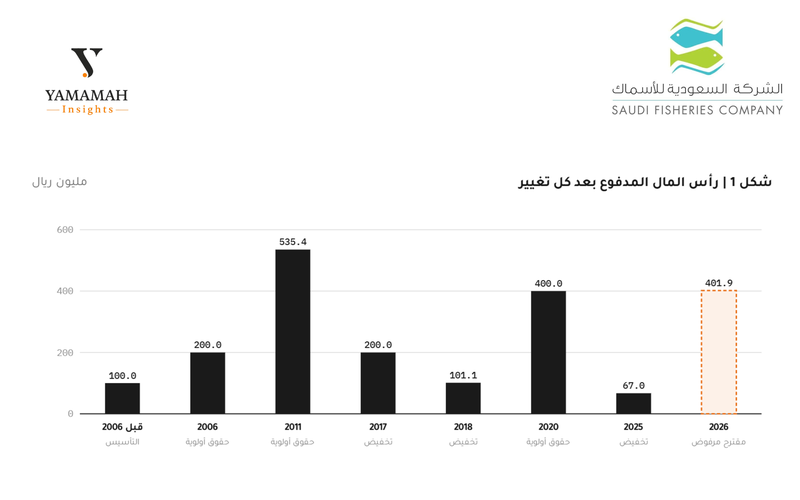
Saudi Fisheries announced the results of the extraordinary general assembly meeting (the third meeting), which resulted in the rejection of the board’s recommendation to increase the capital by 500% through a rights issue with a total value of SAR 334.9 million.
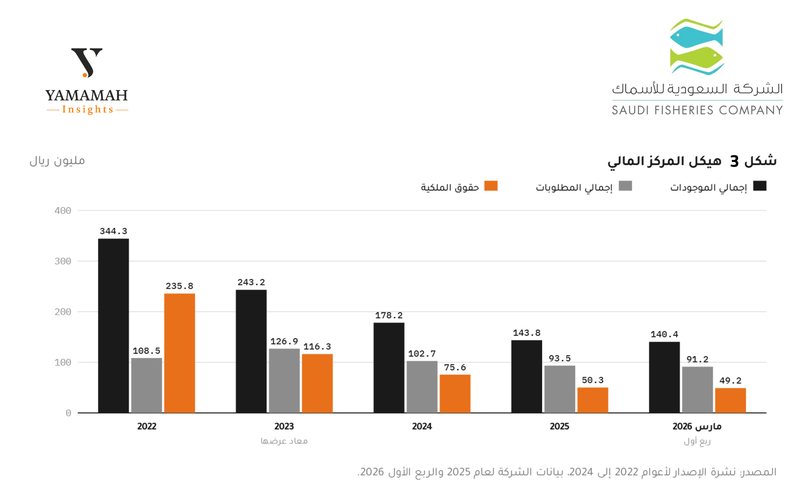
The rejected increase was intended to raise the company’s capital from approximately SAR 66.9 million to nearly SAR 401.9 million to enable it to implement its strategic plans.
In a related development, the assembly approved the election of members of the board of directors for the new three-year term, before the company announced on the same day that it had accepted the resignation of the board chairman, Abdulaziz Abdullah Al-Humaid, for personal reasons.
Students from Al Yamamah University discussed the financial and strategic implications of rejecting the capital increase and its coincidence with the administrative changes, as well as the impact on the company’s investment path, as follows:
Financing and operational challenges, and shareholders’ reservations about the new expansion
Student Rand Alkhalaf @Rand Alkhalaf explained her view, saying: "I believe that rejecting the capital increase reflects shareholders’ reservations about the company’s position and puts the new board before the challenge of finding alternative financing and reducing expenses.
As for expanding into the dates sector, it requires a careful assessment of returns and risks, with a focus on resuming the company’s operations and generating revenue."
The importance of repairing the core business before expanding amid accumulated losses
Student Dina Alarjani @Dina Alarjani shared her opinion, explaining: "In my view, rejecting the capital increase despite 72.36% approval shows that the plan received substantial support but was not convincing to everyone, particularly given the losses and lack of revenue.
The decline in the chairman’s ownership, followed by his resignation, could also weaken shareholder confidence.
I believe that expanding into dates at this stage is risky. It would be better for the company to focus first on repairing its core business, reducing expenses, and resuming operations, and then consider expansion once its financial position has stabilized."
Resuming operations and securing liquidity as priorities for the new board
Colleague Lujain Alqorashi @Lujain Algorashi noted: "In my opinion, the voting result shows that most shareholders supported the capital increase, but the plan did not convince everyone.
Given the company’s current position, the new board’s priority should be to resume operations and secure liquidity, while focusing on a business that generates clear revenue before undertaking any new expansion."
The need for a clear operational plan to justify substantial financing
Student Ghadah Alwallan @Ghadah Alwallan added: "What stands out is that the increase was very large, raising the capital by 500%.
Although 72.36% of the votes supported it, the required percentage for approval was not reached.
Therefore, the challenge facing the new board is not only finding an alternative to the financing, but also explaining how the funds will be used and what return is expected, particularly given the plans to expand into new activities.
Without a clear operational plan, financing alone may not solve the problem."
Cutting costs and linking expansion’s success to feasibility and actual revenue
Student Rabiah Almugait @Rabiah Almugait affirmed: "I believe the company currently needs to focus on improving liquidity and cutting costs while seeking alternative sources of financing.
As for expanding into new activities such as dates, its success depends on its feasibility and ability to generate actual revenue, especially given the company’s current position."
Managing liquidity and investment efficiency as priorities before expansion plans
Student Arwa Alhuwaiti @Arwa Alhuwaiti said: "I believe the most important thing now is to monitor the company’s ability to improve its financial position after the rejection of the capital increase, particularly given the unavailability of the additional SAR 335 million in financing.
Financially, it is essential to monitor the development of operating cash flows, the level of accumulated losses, the fixed-cost coverage ratio, and the company’s ability to regenerate revenue.
Most importantly, any new plan should not be merely an expansion. We need to see whether it will generate cash flows and a return on capital that justifies the investment, because the company’s current position makes managing liquidity and using capital efficiently priorities before entering new investments."
Rebuilding cash flows and restoring the core business
Student Nada Asiri @nada Asiri shared her opinion, explaining: "I believe that rejecting the capital increase, despite an approval rate of 72.36%, reflects the need to clearly address the company’s financial and operational position before expanding into new activities.
Amid liquidity pressures and accumulated losses, the new board’s priority is to rebuild cash flows and improve operational efficiency.
Diversifying into the dates sector could also open new sources of revenue, but its success depends on having a clear plan and the company’s ability to manage risks.
It is therefore important for the next phase to focus on restoring the core business and generating sustainable revenue before expanding further."
Securing liquidity as an alternative to diversification that could increase the burden
Student Zikra Abdulkareem @Zikra Abdulkareem noted: "I believe the voting result reflects shareholders’ reservations, particularly with losses continuing and revenue absent.
In my view, the priority now should be securing liquidity and resuming the core business, followed by considering expansion and dates, because diversification without clear cash flows could increase pressure rather than resolve it."
Execution risks and directing investments to support the efficiency of core activities
Student Albatool Bedairi @Albatool Bedairi added: "Expanding into dates could open a new source of revenue and reduce reliance on a single activity, but entering a different business requires expertise and investment and may increase execution risks.
Therefore, the idea’s success depends on having a clear study and an expected return that justifies directing this amount of money toward the new activity instead of focusing on restoring the efficiency of the core business."
The urgent need for a turnaround plan before any new financial injection
Student Yazan Hamoud @Yazan Hamoud affirmed: "What caught my attention was that 72.36% of the votes approved the capital increase, but the resolution failed because the required percentage was not reached.
This means that most votes were in favor, but the increase was not approved.
I believe the challenge now is not only finding alternative financing, but also presenting a clear plan to resume the company’s operations, generate revenue, and reduce expenses.
As for expanding into dates, its feasibility must be clear, because injecting new funds without addressing operational problems could return the company to the same situation."
Reducing expenses and seeking alternative sources of cash liquidity
Student Noof Alanazi @Noof Alanazi said: "In my opinion, the vote shows support for the capital increase, but failing to reach 75% means the company needs to seek other sources of liquidity.
With losses continuing, it is important for the new board to focus on resuming operations and reducing expenses.
As for expanding into dates, I believe it requires careful study, particularly given the company’s current position, to determine whether it would be better to expand or focus on the fisheries business."
Enhancing transparency and developing robust plans to support shareholder confidence
Student Rahaf Alanazi @Rahaf Alanazi shared her opinion, explaining: "I believe the current phase requires the new board to focus on liquidity and reducing expenses, while developing a clear plan to restore revenue.
Diversifying the business could also be an opportunity, but its success depends on a feasibility study and appropriate financing, along with the importance of enhancing transparency and shareholder confidence."
The importance of administrative efficiency and interpreting the implications of the chairman’s resignation
Student Shahad Alkhamis @Shahad Alkhamis presented her analysis, saying: "I believe rejecting the capital increase was the right decision, and if I had been a shareholder, I would have voted against it.
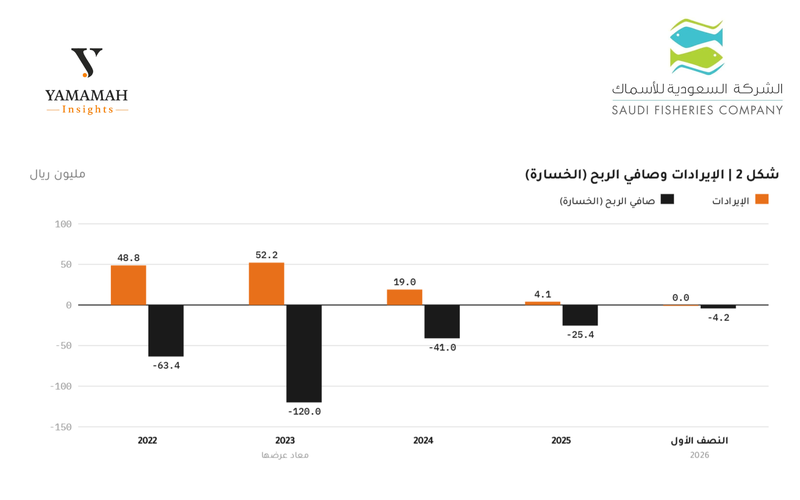
Not because the company does not need the money, but because it needs a credible plan before receiving the money. Injecting SAR 335 million into a company reporting zero revenue and managed by an administration that has not demonstrated its competence is like throwing money into a bottomless pit.
The chairman’s resignation is the most troubling indicator. Someone who owns 40%, sells down to 10%, and then resigns is not selling his shares because he is optimistic.
This man knows the company from the inside better than any analyst, and his decision to gradually exit tells us a great deal that financial reports may overlook.
Small shareholders would do well to read this signal carefully.
As for dates, the idea is strange. A fisheries company fails in fisheries and wants to succeed in dates? The two businesses are entirely different in terms of supply chains, marketing, and competition. This is not diversification; it is an escape from the original problem. The better course would have been to repair the fisheries business first or sell the company as a going concern."
Management stability as a requirement for restoring confidence after ownership changes
Student Jumana Alshehri @Jumana Alshehri added: "I believe that the approval of 72.36% means most shareholders supported the increase, but failing to reach 75% put the company before a clear financing challenge. With losses and no revenue, the company needs to focus on cutting costs, securing alternative financing, and gradually resuming its business.
As for expanding into dates, it could be a new source of income, but it would be better pursued after studying the returns and risks.
Changes in the ownership of major shareholders and the chairman’s resignation make transparency and management stability especially important for restoring shareholder confidence."
Restructuring and liquidation options amid the absence of an operational vision
Student Fay Aldossari @Fay Aldossari elaborated on her analytical reading, saying: "The crisis at Saudi Fisheries can be summarized as a loss of direction and eroding confidence. The previous leadership relinquished most of its holdings and resigned, while the company is seeking to shift toward the dates sector at a time when it is reporting zero revenue and accumulated losses.
Shareholders’ reluctance to inject new funds is a natural reaction to the absence of a clear operational vision.
Its survival today requires one of two options: either a comprehensive, radical restructuring led by a strategic partner with the expertise and liquidity to restart the assets, or facing a liquidation scenario and the options available under the bankruptcy law."
Moving quickly to sell assets and prevent further erosion of the remaining capital
Student Fahad Alruwaished @Fahad Alruwaished concluded the comprehensive analysis, saying: "In my opinion, the approval rate for the capital increase reaching 72.36% and its failure by a narrow margin to meet the required quorum reflects dissatisfaction and a loss of confidence among a significant portion of shareholders in the previous strategic plans.
This confirms the soundness of the Capital Market Authority’s approach of linking management compensation to actual financial performance to ensure the protection of shareholders’ rights and motivate management to deliver results.
With the resignation of the chairman and the absence of the new SAR 335 million in financing, the company is now facing severe liquidity pressure and financial difficulty. This is forcing the new management to move quickly to immediately restructure fixed costs, sell non-performing assets, and seek alternative financing options or strategic partnerships to prevent further erosion of the remaining capital and cover operating expenses."
The success of future financing depends on clarity about the business
In an analytical reading, financial and economic analyst "Hamad Alsaeed" @Hamad Alsaeed adds: The results of Saudi Fisheries’ extraordinary general assembly, coinciding with the chairman’s resignation, reveal that shareholders voted more on the company’s future identity than on the capital increase itself. The plan directed nearly three-quarters of the proceeds toward trading in and processing dates, at a time when the company is moving to exit aquaculture and reduce its retail outlets. A minority of approximately 27% was enough to stop it.
Perhaps the history of the company’s capital explains this caution. Since 2006, the company has undergone three rights-based capital increases accompanied by three reductions, so shareholders now require a clear plan before injecting new liquidity.
As for the next phase, the obligations that the increase was intended to settle have not disappeared following its rejection, and the resignation of the chairman puts the plan before an almost inevitable review. The company is expected to return with a smaller offering and a clearer business plan, as the success of any future increase appears to depend on defining the business before determining the financing amount.

Comments (3)
No comments yet. Be the first to comment!