

Almarai announced its preliminary consolidated financial results for the period ending on June 30, 2026, achieving a revenue growth of 11% in the current quarter compared to the same quarter of the previous year, and a growth of 9% for the first six months of the year.
This performance was driven by an increase in sales across all markets and categories and sales channels, supported by expansion projects in the poultry sector and an improved revenue mix in the dairy sector.
Conversely, the company's net profit faced challenges due to cost inflation pressures, with quarterly net profit declining by 2% compared to the same quarter, and by 13% compared to the previous quarter; primarily affected by rising feed shipping costs in the dairy sector, and increased distribution costs driven by higher energy expenses, along with seasonal changes in consumption patterns and supply conditions in the poultry market that impacted the first quarter results.
The auditor's report came with an unmodified opinion and free of any reservations, confirming the company's effective management of supply chains and operational risks.
Students from Al Yamamah University discussed the implications of these results and the structural cost impacts as follows:
Pricing Power and Cost Pass-Through
Student "Rimas Almashali" @Rimas Almashali opened the discussion by providing a structural analysis of profit margins, stating: "Almarai's results confirm that the company still maintains good pricing power and strong, growing demand for its products across various markets, which is clearly reflected in the 11% revenue growth.
However, the slight decline in net profit indicates that the company preferred not to pass on the full increase resulting from feed, shipping, and energy and distribution costs to the end consumer; aiming to maintain its competitive edge and high market share in the region.
Therefore, I see that Almarai's real challenge in the upcoming periods lies not in increasing sales volume, but in its ability to restore previous profit margins through enhancing operational efficiency and controlling cost items.
On the regulatory side, the issuance of the auditor's report with an unmodified opinion enhances confidence levels in the fairness and transparency of the financial statements, and the reclassification of some comparative figures does not affect the quality of profits, as it is an organizational step primarily aimed at improving the presentation of financial data and increasing its comparability across different time periods."
Operational Flexibility and Supply Chain Management
Student @Shahad Al-Muhaysin commented from an operational perspective, saying: "Expansion in the poultry sector alone is not enough to improve results; it must be accompanied by improvements in operational efficiency, such as better organizing distribution routes, using advanced inventory management systems, and reducing waste, which can alleviate transportation costs and energy expenses.
In my opinion, diversifying feed suppliers and maintaining an appropriate strategic inventory gives the company greater flexibility to deal with any price increases or delays in shipping operations."
Marketing Innovation and Maximizing Administrative Efficiency
For her part, student "Ghada Alsarheed" @Ghada Alsarheed added marketing and administrative dimensions to the analysis, stating: "The current situation of Almarai's sales is very strong and growing, but its profits have been slightly pressured due to rising shipping and energy costs globally and locally.
The solution is to break the summer (seasonal) slump through campaigns focusing on 'revival and trips', and launching cold and functional products (like protein drinks for athletes).
Regarding administrative efficiency, management has successfully directed consumers towards higher-margin products (like cheeses and creams), achieving excellent growth in the Egyptian market despite its economic challenges.
In summary: demand for Almarai is excellent, and the next challenge is to innovate premium and seasonal products that cover high shipping costs."
Cash Flows and Structural Investment Allocations
Student "Ghadah Alwallan" @Ghadah Alwallan continued the dialogue with an analysis of liquidity movements, stating: "The most noteworthy point in these statements is not just tracking sales growth or declining profit margins, but observing the significant decrease in free cash flow during this quarter.
This indicator shows that a large portion of the available cash liquidity is still being directed towards capital expenditures and the company's expansion projects and strategic investments, and therefore, profit items alone may not reflect the complete picture of the operational reality at this transitional stage.
If these projects succeed in raising the company's production capacities and improving overall efficiency in the future, their positive impact will be more clearly reflected on profit margins and cash flow generation rates in the upcoming financial periods."
Structural Ratio Analysis of Financial Indicators
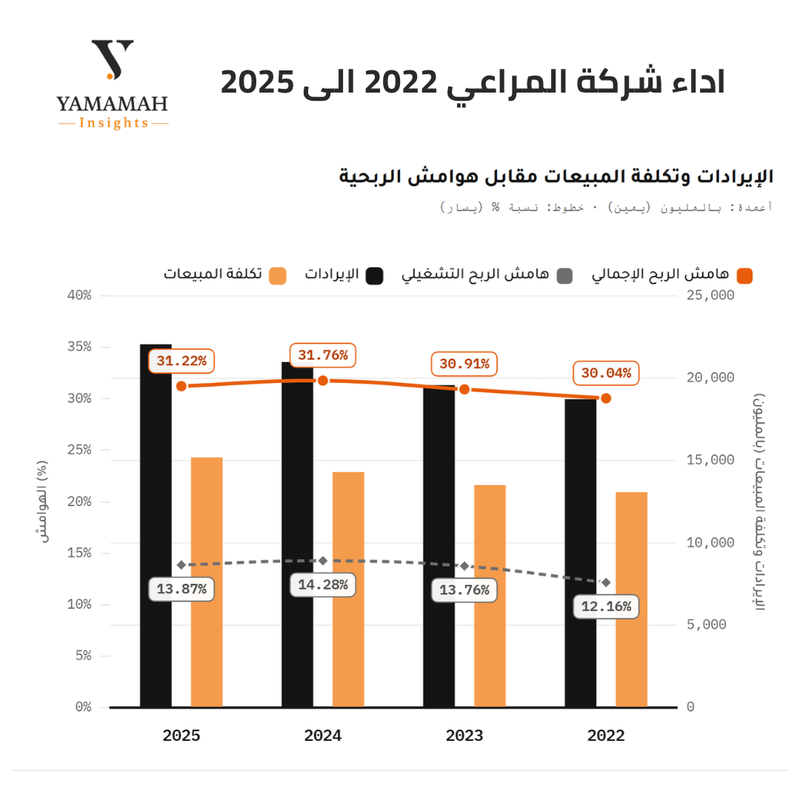
Student "Rana Alshamrani" @Rana Alshamrani concluded the analysis with a precise numerical reading of the margins, stating: "Although the 11% revenue growth in the second quarter reflects strong and vibrant demand, this momentum did not translate with the same strength into cash profitability items; the operating profit margin declined from 15.4% to 13.9%, accompanied by a decrease in the net profit margin from 12.2% to 10.8%.
These structural ratios indicate that the company possesses partial pricing power, as it has operationally succeeded in improving the revenue mix, but it chose to absorb part of the shipping cost inflation and energy instead of fully passing it on to the end consumer, in order to maintain its leadership and market share.
The analysis also shows that the current pressure on margins is primarily due to external factors related to feed shipping and energy costs, rather than an internal operational efficiency deficit; a conclusion clearly supported by the stability of overall operating profit over the first six months, despite the acute situational challenges posed by the second quarter."
Professor Abdulaziz Khrais analyzes the company's financial performance and market interactions, stating:
As usual, Almarai opened the results for the second quarter for listed companies in TASI, recording a notable revenue growth of 11% to reach 5.87 billion SAR, driven by sales momentum in the poultry and dairy sectors.
However, this growth was accompanied by a clear rise in feed, shipping, and energy costs; which exerted direct pressure on cash profitability levels.
As a result of rising distribution and financing costs, the net profit achieved for this quarter was approximately 636 million SAR, marking a decrease of 1.7% compared to the same quarter of the previous year, with a decline in the net profit margin to 10.8%.
In terms of performance in the financial market, the stock reacted negatively to this data, ending trading down by more than 3%, despite the fact that the stock is currently trading at a price-to-earnings ratio expected for 2026 that is below its historical average.

Financial and Economic Analyst "Hamad Alsaeed" @Hamad Alsaeed concluded the discussion with his comment:
The financial results of Almarai for the first half of 2026 showed remarkable strength in demand levels despite significant inflationary pressures. Revenues jumped by 9% for the first half to reach 12.03 billion SAR, accompanied by strong quarterly growth in the second quarter of 11% to reach 5.86 billion SAR, directly supported by expansions in the poultry sector and an improved sales mix in the dairy and bakery sectors.
Conversely, profit margins faced severe operational pressures. Despite a 6% growth in gross profit for the first half, achieving 3.69 billion SAR, the gross profit margin for the second quarter contracted by 131 basis points to settle at 31.1%, while the operating margin declined by 151 basis points to 13.9%, affected by supply chain shocks and feed and energy shipping costs.
As a result, net profit for the second quarter decreased by 2% year-on-year and 13% quarter-on-quarter to reach 635.6 million SAR, stabilizing the earnings per share for the first half at 1.38 SAR, which illustrates the magnitude of current challenges compared to the historical compound growth of profits at 11.7%.
In terms of cash flows, operating liquidity for the second quarter declined by 25% to reach 1.09 billion SAR. With the investment spending cycle peaking at 1.05 billion SAR during the current quarter, free cash flows dropped by 89% to fall to 42.1 million SAR, reflecting the necessity of sacrificing liquidity in the short term to finance operational efficiency and the company's future expansion infrastructure.


Comments (9)
No comments yet. Be the first to comment!