

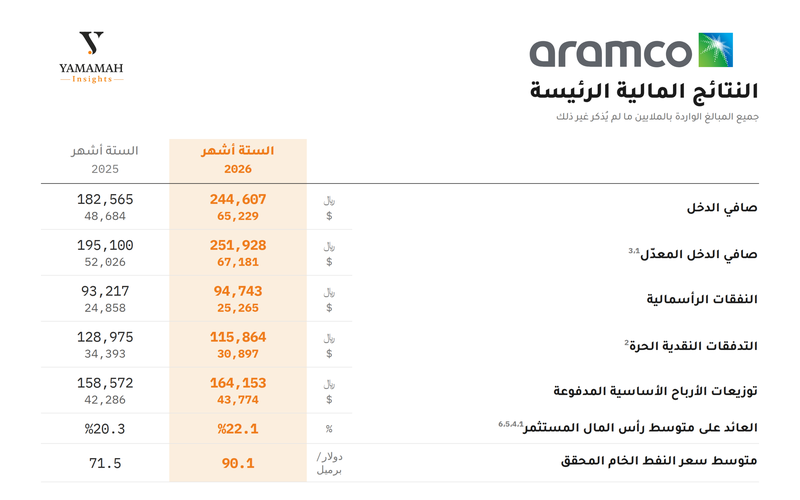
Saudi Arabian Oil Company (Saudi Aramco) announced its preliminary financial results for the period ending June 30, 2026 (a six-month period). The results showed strong levels of revenue and net income, supported by improved crude oil, refined product, and chemical prices, enabling the company to offset the impact of higher costs and declining volumes sold.
Earnings Exceed Expectations
The company continued to post strong figures during the second quarter of the year, with net income jumping approximately 41.9% year on year to reach SAR 121.5 billion, clearly exceeding market estimates. This was accompanied by 19% revenue growth to SAR 450.8 billion, driven mainly by an increase in the average oil price per barrel to USD 108.1, compared with USD 66.7 in the same quarter last year.
Operational Resilience and Supply Continuity
Commenting on the results, Amin H. Nasser, President and Chief Executive Officer of Saudi Aramco, highlighted the company’s high resilience despite geopolitical challenges and unprecedented supply disruptions in the Strait of Hormuz. Reliance on diversified strategic infrastructure, specifically the “East-West Pipeline” and storage facilities, contributed to maintaining export and production continuity.
Market Reaction and Increased Capital Expenditure
These developments had a positive impact on the stock’s performance in the financial market, with the share price rising to SAR 27.12, driven by investors’ confidence in the company’s ability to manage regional crises.
Students from Al Yamamah University discussed the economic and financial dimensions of these results and their implications for the company’s future performance, as follows:
Prices as a Key Revenue Driver and the Challenges of Declining Volumes
Student Rimas Almashali @Rimas Almashali explained her view, saying: “In my opinion, the results are strong, but the reason for the increase in revenue was the rise in oil and product prices more than an increase in volumes sold. This means that sustaining these results in the future depends on prices remaining at favorable levels, because a decline in volumes could limit growth if prices fall.”
Offsetting Costs Through Prices and the Importance of Operational Efficiency
Student Abdulaziz Al-Yahya shared his view, explaining: “In my opinion, Aramco’s results were strong, and it appears that higher oil and refined product prices contributed to increasing revenue and offsetting higher costs and lower volumes sold. Lower taxes and zakat also supported net profit in the second quarter.
However, in the long term, relying solely on higher prices is not enough. The company must maintain production growth and improve operational efficiency to ensure continued strong performance.”
Sustained Demand as a Decisive Factor in Long-Term Growth
Student Yousef Farhat @Yousef Farhat noted: “I think higher prices can offset lower volumes for a while, but in the long term, I don’t think an increase alone is enough, because ultimately the company needs to maintain sales volume and revenue. Prices can rise and fall depending on market conditions, whereas sustained demand provides stronger support for growth.”
Diversifying Revenue Sources and Investing in Refining and Chemicals
Student @شهد المحيسن added: “In my opinion, Aramco’s results reflect clear strength in performance, particularly with growth in revenue and net income despite rising costs. However, what stands out is that part of the growth came from improved prices and other income, while volumes sold declined. This highlights the importance of diversifying revenue sources and not relying solely on prices.
If the company maintains strong margins and continues developing its operations in the refining and chemicals (Downstream) sector, this could support sustainable earnings in the future.”
Revenue Quality and Its Ability to Absorb Rising Costs
Student Jumana Al-Shehri @Jumana Alshehri emphasized: “Aramco’s results show that higher prices were the primary factor behind revenue growth despite lower volumes sold, helping the company achieve strong profits. However, in the long term, I don’t think relying solely on prices is sufficient, because oil prices fluctuate. Therefore, maintaining sales volume remains an important factor in sustaining this performance. The results confirm that revenue quality is no less important than its size; higher selling prices and improved other income enabled the company to absorb the impact of rising costs, but sustaining this performance will depend on Aramco’s ability to preserve its margins even if oil prices decline in the future.”
Balancing Capital Expenditure and Cash Flows
Student Mohammad Alghaihab @Mohammad Alghaihab elaborated on the results, saying: “Aramco’s results during the first half of 2026 showed strong performance, with net income and revenue rising compared with the same period last year, supported by improved prices for crude oil, refined products, and chemicals, despite lower volumes sold. This reflects the company’s ability to benefit from improved prices to maintain the strength of its financial results.
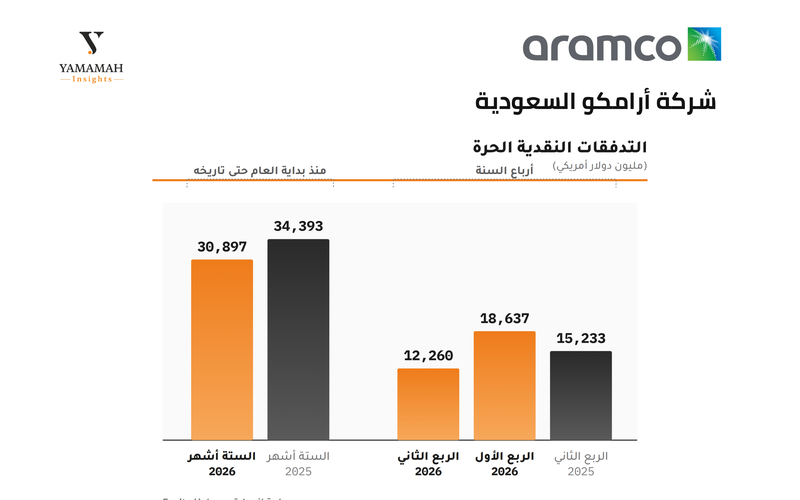
At the same time, free cash flow declined compared with the corresponding period, as a result of higher capital expenditure, indicating that the company continues to invest in its long-term projects.
Therefore, monitoring the development of cash flows and investment expenditure in the coming periods will be just as important as tracking revenue and net income growth, as these provide a clearer picture of the company’s ability to finance its expansions and maintain the strength of its financial position.
Operational Efficiency Under Pressure and the Need to Diversify Revenue
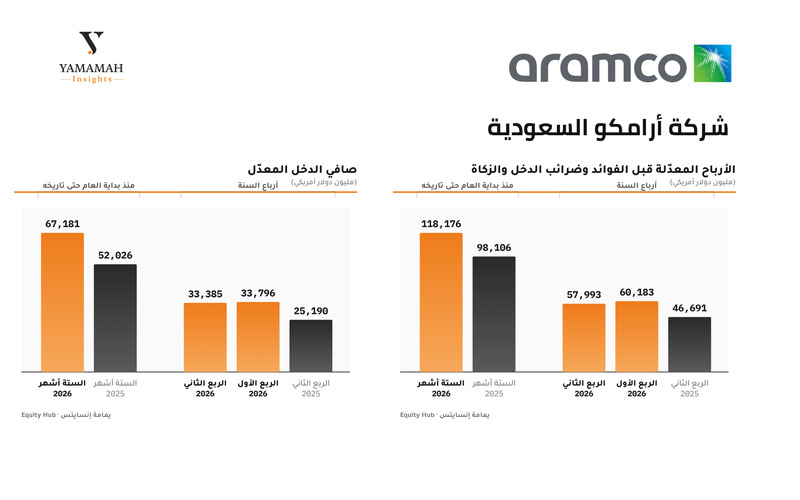
In an analytical reading of the company’s performance, financial and economic analyst “Hamad Al-Saeed” @Hamad Alsaeed explained: Aramco’s second-quarter results confirmed the quality of its operating model under pressure. Adjusted income reached SAR 125.2 billion, growing by more than one-third annually, while revenue reached SAR 450.8 billion, up 19%, supported by a selling price exceeding USD 108 per barrel, a jump of 40.5%.
More importantly, the company protected this performance despite the disruption in Hormuz through the 1,200-kilometer East-West Pipeline, which connects its facilities to export ports on the Red Sea—tangible evidence of strong infrastructure and significant competitive efficiency.
In terms of cash, operating cash flow before working capital reached USD 39 billion, exceeding consensus estimates by approximately 10%. Leverage remained among the lowest in the sector at 6.2%, with a cash position exceeding USD 60 billion and the lowest leverage in the sector.
Aramco’s ongoing challenge is the volatility of oil prices and the concentration of revenue from a single source. We are likely to see the company’s management take greater steps to diversify other revenue streams and avoid relying on oil as the company’s primary source of income.


Comments (4)
No comments yet. Be the first to comment!