

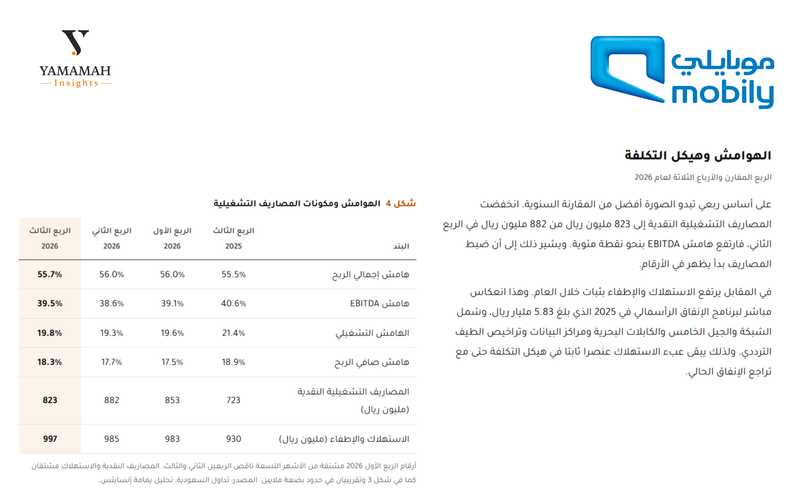
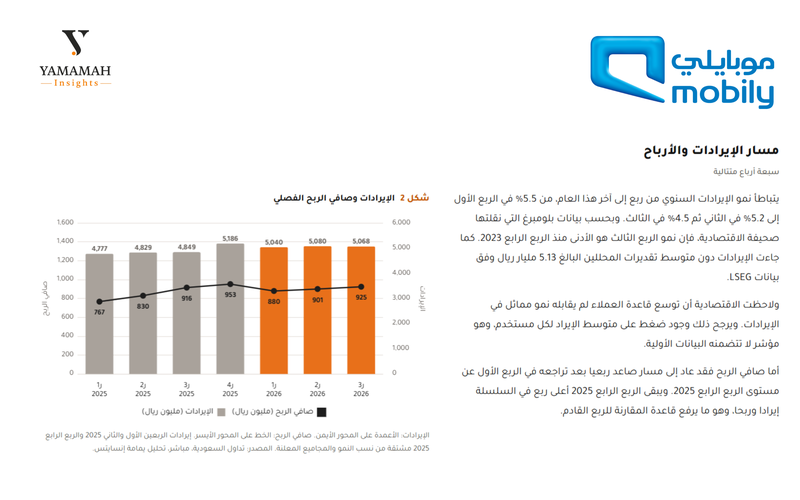
Etihad Etisalat Company ("Mobily") delivered balanced financial and operational performance in the third quarter of fiscal year 2026. Revenue grew 4.5% to SAR 5,068 million compared with SAR 4,849 million in the same quarter last year, driven by higher sales in the consumer and carrier and operator segments, as well as a growing customer base. The company reported net profit of SAR 925 million, up 1.0% year on year and 2.7% quarter on quarter, supported by an increase in gross profit to SAR 2,824 million and lower net other expenses and financing costs. However, the EBITDA margin declined to 39.5% from 40.6%.
For the nine-month period ended September 30, 2026, Mobily continued its strong growth momentum: cumulative revenue jumped 5.1% to SAR 15,188 million, while net profit rose 7.7% to SAR 2,706 million, compared with SAR 2,513 million in the same period of 2025. This was supported by improved operational efficiency, alongside more disciplined capital spending, which fell to SAR 2,021 million (compared with SAR 3,629 million in the same period last year).
Against a backdrop of stable profitability indicators, a growing subscriber base and more disciplined capital spending, Al Yamamah University students discussed the implications of these results and their impact on the company’s financial position and the competitiveness of Saudi Arabia’s telecommunications sector, as follows:
Free Cash Flow and Balancing Dividends
Student "Rahaf Al-Anazi" @Rahaf Alanazi began the financial analysis, saying: "I believe lower capital expenditure and financing costs can help Mobily improve its free cash flow, which may support cash distributions to shareholders. It is important, however, to strike a balance between paying dividends and investing in network development and sustainable growth."
Diversifying Revenue and Offsetting Slower Growth in Traditional Telecoms
Student "Rabiah Almugait" @Rabiah Almugait highlighted the implications of digital transformation, saying: "Mobily’s expansion into cloud services and cybersecurity could help it increase its revenue streams and improve profit margins, particularly as demand for digital solutions grows.
But the success of this expansion depends on its ability to manage costs and generate returns from these services, which could help it address slower growth in the traditional telecommunications sector."
The Gap Between Revenue and Profit Growth, and Fiber-Optic Competitiveness
Student "Dina Alarjani" @Dina Alarjani analyzed profitability indicators and technological alternatives, saying: "In my view, Mobily’s results are positive, but revenue growth outpaced net profit growth, which may indicate that costs weighed on earnings.
Satellite internet could compete with fiber in remote areas, but it would be difficult for it to replace fiber entirely. Digital services could help boost profits and diversify revenue, while lower capital expenditure supports cash flow and dividends alongside continued network development."
Cost Efficiency and Keeping Pace with Technological Change
Student "Meshail Al-Anazi" @Meshail ALANazi commented on the outlook, saying: "I believe Mobily’s future depends on its ability to keep pace with technological change and diversify its sources of income.
This is especially true in digital and cloud services, while maintaining cost efficiency and strong cash flows will be essential to ensuring sustainable growth and boosting the company’s profitability."
Turning Digital Demand into Tangible Profits
Student "Nouf Al-Ojayan" @Nouf Alojayan shared her operational analysis, saying: "Expanding into cloud services, cybersecurity and artificial intelligence presents an opportunity for Mobily to reduce its reliance on traditional telecom services and achieve healthy profit margins, especially as demand from companies and government entities increases.
Offering integrated services strengthens customer loyalty and increases revenue per customer. But success depends on efficient investment, building the right technology partnerships, and turning growing demand into tangible profits rather than simply adding costs."
Customer Experience and Value-Added Innovation
Student "Nouf Al-Anazi" @Noof Alanazi highlighted the factors that shape market share, saying: "Mobily needs to focus on service quality and the customer experience, not just increasing revenue.
With new technologies such as satellite internet emerging, companies that can innovate and deliver real value to customers are the ones that will protect their market share and achieve stronger long-term growth."
How Depreciation and Amortization Affect Profit Margins
Student "Yazan Hamoud" @Yazan Hamoud explained the difference in growth rates, saying: "I was struck by the fact that Mobily’s revenue rose 4.5%, while net profit grew by just 1%, which shows that some of the revenue growth was offset by higher costs, particularly depreciation and amortization.
I believe the real challenge is generating returns on past investments and improving margins. Digital expansion is important, but what matters more is that it has a clear impact on profits and cash flows."
Operational Efficiency and Protecting Market Share
Student "Nada Asiri" @nada Asiri emphasized the pillars of sustainability, saying: "Maintaining Mobily’s competitiveness requires a focus on service quality and keeping pace with technological developments, such as satellite solutions, as well as expanding digital services to diversify revenue and boost profitability.
In addition, improving operational efficiency and managing costs will support financial performance, helping the company protect its market share and achieve sustainable growth."
Infrastructure Investment and Recurring Contracts
Student "Albatool Bedairi" @Albatool Bedairi outlined the digital subscription strategy, saying: "Mobily’s digital expansion offers recurring revenue from contracts and subscriptions, reducing reliance on traditional telecommunications.
Financially, however, higher revenue from digital services does not immediately mean improved margins, since these services require investment in technology and specialized talent. The success of the expansion depends on generating an adequate return and leveraging its infrastructure and customer base to offer services at competitive costs."
Geographical Factors and the Cash Flow Trajectory
Student "Raneem Asiri" @Raneem Asiri shared her view of the competition, saying: "Satellite internet may compete in remote areas where fiber-optic networks are difficult to reach, but fiber will remain the stronger option in cities because of its speed and reliability.
Also, lower capital expenditure and financing costs improve cash flows and support dividends, while expansion into cybersecurity and artificial intelligence opens up new revenue streams that can boost profitability."
Contract Revenue and Sustainable Profits
Student @أناغي عطرجي highlighted the business segment, saying: "Mobily’s expansion into cloud services reduces its reliance on traditional telecommunications; digital solutions for businesses provide recurring revenue that supports stable profits.
The challenge lies in the high costs of infrastructure and competition. The company’s success depends on its ability to turn revenue growth into higher profit margins and sustainable cash flows."
Market Saturation and Shifts in the Business Sector
Student "Fay Aldossari" @Fay Aldossari described the sector’s structural landscape, saying: "Satellite internet has limited geographical reach and does not threaten fiber-optic networks in cities in terms of speed or cost. Slower growth is a natural result of market saturation and price competition in telecommunications, shifting the focus toward the business sector.
Disciplined capital spending and lower financing costs strengthen free cash flow and support dividends, while digital transformation is the real driver of higher margins."
Price Competition and New Drivers of Margin Growth
Student "Fahad Alruwaished" @Fahad Alruwaished commented on the financial and operational factors, saying: "Satellite internet will remain a complementary competitor in cities and will not threaten fiber-optic networks, given their reliability and speed. Meanwhile, slower growth in revenue (4.5%) and net profit (1.0%) reflects intensifying price competition and saturation in the traditional sector.
By contrast, disciplined capital spending (SAR 2,021 million) and lower financing costs support free cash flow and sustainable dividends, alongside expansion into cloud services and artificial intelligence as key drivers of margin growth."
Cost Control and Revenue Quality
Student "Jana Alshahrani" @Jana Alshahrani shared her perspective, saying: "Mobily’s results show positive growth, but slower net profit growth points to clear pressure on profit margins.
Digital expansion is an opportunity to diversify income, but its success depends on controlling costs and turning investments into tangible profits and strong cash flows that strengthen the company’s competitive advantage in the future."
Integrated Connectivity Bundles and Flexible Spending
Student "Jumanah Al-Shehri" @Jumana Alshehri outlined what the next phase requires, saying: "Mobily faces the challenge of sustaining growth amid intensifying competition; fiber remains the foundation for reliability and speed.
Sales growth has not fully translated into profits because of operating costs, while lower capital expenditure and financing costs support free cash flow and dividends, provided network development continues and the company leverages cloud and cybersecurity services to improve margins."
Turning Sales Growth into Sustainable Profitability
Student @عمر الشيخ detailed the operational and liquidity figures, saying: "Sustained growth depends on turning revenue into profits and stronger cash flows; the 3.3% decline in operating profit reflects clear operational pressures.
In terms of efficiency, quarterly capital expenditure fell by 21.2% and operating cash flow rose by 10.5%, strengthening cash flows.
But the challenge is balancing shareholder rewards with continued investment in data centers and networks."
Reaping the Benefits of Investments and Managing Cash Expenses
Student "Ahmed Al-Jadaan" @AHMED ALJADAAN emphasized the positive impact of investment cycles, saying: "Mobily has begun reaping the benefits of its substantial previous investments in its 5G network and data centers (around SAR 5.83 billion in 2025), giving it room to reduce capital expenditure for the nine-month period to SAR 2,021 million.
Management’s success in reducing cash operating expenses to SAR 823 million in the third quarter strengthens free cash flow and supports the continuity of dividends."
Assessing Earnings Quality and the Nature of Capital Spending
Student @ثناء الشايب concluded the analysis by raising key evaluation criteria, saying: "Higher depreciation and amortization weighed on operations, while lower financing costs supported net profit; it is therefore important to focus on the profitability of the core business.
As for capital expenditure, the fundamental question is: does lower spending reflect the completion of major projects or their postponement? Because postponement simply shifts obligations into the future.
The real test for Mobily is to increase dividends while continuing to develop digital services and improve their actual margins to meet shareholders’ expectations."
Shifting Growth Drivers and the Limits of Satellite Competition
In an analytical assessment, financial and economic analyst "Hamad Alsaeed" @Hamad Alsaeed added: "Telecommunications companies in the Kingdom are looking for growth beyond the consumer market, where growth has become limited. Mobily’s third-quarter results are part of this trend. Revenue increased by 4.5%, supported by the consumer and carrier and operator segments. In the first half of the year, carrier and operator revenue grew by around 14%, driven by demand for international connectivity and cloud computing provider services, compared with around 3% growth in the consumer segment, despite subscriber numbers increasing by nearly 17%.
This difference positions the carrier segment as the most important growth driver in the coming period, as demand expands for digital infrastructure related to artificial intelligence. Regarding the impact of satellite internet, it is worth noting that the Kingdom’s approval of Starlink has so far been limited to aviation and maritime navigation. This limits the near-term impact of satellite internet on operators, though the situation could be reviewed if circumstances change.
Accordingly, continued profit growth depends on faster revenue growth in the carrier and business segments, after lower financing costs—resulting from debt reduction despite rising interest rates—supported results this quarter.
 Ask Yamami
Comments (4)
No comments yet. Be the first to comment!