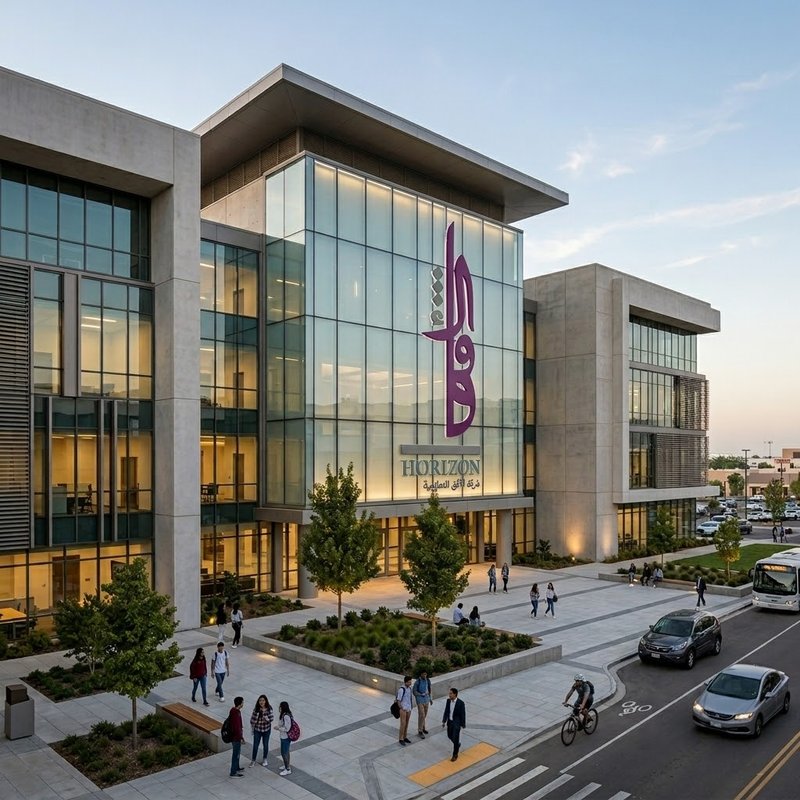

While traditional economic literature classifies real estate as a "fixed asset" for value preservation, the open dialogue among students at Al-Yamamah University has redefined this concept as a dynamic tool for liquidity management. This analysis followed a strategic paradox witnessed in the Saudi market; where "Al-Ufuq Educational" sought to protect its cash flows during a growth phase by securing a two-year grace period on a 21 million Riyal land lease, while the giant "Saudi Aramco" is considering monetizing its real estate assets for 10 billion dollars through a Sale and Leaseback strategy, opening the floor for student discussions on the shift in institutional thinking towards capital flexibility.
Market Maturity and the Shift Towards Capital Efficiency
Student "Faisal Almedshel" @Faisal Almedshel explained in a financial reading that these two news items illustrate how Saudi companies have begun to treat real estate as a financial tool rather than just a fixed asset; he stated: "Al-Ufuq successfully reduced cash flow pressure during the construction phase thanks to the grace period, while Aramco demonstrates that giant companies are now focusing on capital efficiency; instead of freezing billions in real estate assets, they are converting them into cash liquidity that generates higher operational returns, reflecting a maturity and a clear shift towards an asset-light model."
Cash Protection and Increasing Asset Returns
In a related context, student "Danah Alhussaini" @Danah Alhussaini shared her financial perspective, stating: "Al-Ufuq strategically succeeded in securing a two-year grace period, as it protected cash liquidity from depletion before actual operations, proving that the leasing expansion model is the most suitable for the education sector to reduce risks and increase asset returns. As for Aramco, the sale and leaseback strategy is an exceptionally smart financial engineering move to monetize fixed assets and convert them into substantial liquidity invested in higher-yielding projects, rather than freezing billions in properties and headquarters."
Corporate Finance: Recycling Financial Value to Serve Growth
From a corporate finance analysis perspective, student "Ghadah Alwallan" @Ghadah Alwallan pointed out that the interesting aspect is the variance in objectives for each company; she explained: "Al-Ufuq views real estate as a means to help it expand and operate its projects with minimal cash flow pressure, thus the grace period was a very smart step to alleviate cash pressure before starting to generate revenues. As for Aramco, real estate is an asset that can be financially recycled rather than remaining frozen for long periods, especially if this liquidity will be directed towards investment opportunities that yield higher returns."
"System Engineering" and Unfreezing Frozen Resources
Student @Shahad Almuhaisen provided a technical perspective from a systems engineering angle, likening these moves to software refactoring; she said: "The 'Al-Ufuq Educational' model is moving towards asset-light structures, similar to how tech companies rely on cloud computing and ready-made services instead of building costly infrastructure, focusing on the core product, rapid expansion, and reducing capital expenditures initially to gain higher flexibility. In contrast, Aramco's model resembles that of large enterprises that possess massive infrastructure but dismantle parts of it to convert them into cash and redirect resources towards more efficient areas."
The New Strength Standard in the Market
In an analytical reading of the scene, student "Yousef Fares" @Yousef Fares presented a technical perspective reflecting an integrative vision, stating: "It is noteworthy that Saudi companies have begun to treat real estate in the same way that tech companies treat infrastructure; the focus is no longer on 'ownership', but on operational efficiency and return. 'Al-Ufuq Educational' employed the asset-light model to accelerate expansion and protect cash liquidity, while 'Aramco' converted fixed assets into liquidity with higher returns. This transformation reflects a new reality in the Saudi market; that strength is no longer measured by the size of owned assets, but by the efficiency of capital deployment."
Strict Investment Mindset and Opportunity Cost
In the analysis by student "Khalid Waleed" @khalid waleed from a financial management perspective: "The two-year grace period for 'Al-Ufuq' is a professional maneuver to overcome the bottleneck of the construction phase; this model is capable of raising return on equity (ROE) to record levels as the company operates others' assets with its own resources. As for Aramco, the matter relates to opportunity cost; the strict investment mindset poses a fundamental question: why hold 10 billion dollars in administrative buildings in Dhahran with limited real estate returns? The optimal choice is to monetize them and inject them into energy or gas projects that yield multiplied returns."
Shifting Mindset Towards Liquid Assets
Student "Rimas Almashali" @Rimas Almashali also emphasized in the context of liquidity and budgets analysis: "Both companies approach real estate with a financial mindset completely different from the traditional ownership concept. 'Al-Ufuq' is not seeking land ownership as much as it is looking for financial flexibility and cash protection during the growth phase. Aramco believes that capital should remain fluid and active to be deployed in opportunities that achieve higher value and returns, and this shift is an indicator of advanced financial and investment maturity in the Saudi business environment."
Hedging and Contract Risk Management
On her part, student "Ghada Alsarheed" @Ghada Alsarheed presented a strategic marketing analysis stating: "The convergence of investment thinking among companies is promising, but the sale and leaseback mechanism requires strategic caution; all options must be studied and terms precisely formulated to ensure that no future constraints from buyers put the organization in a difficult position. It is prudent for companies to direct this liquidity towards investing in emerging projects in the Kingdom or in global markets, with the necessity of foresight and readiness for various circumstances to enhance market presence."
Focus on Cash First
Student "Thanaa Alshayib" @Thanaa Alshayib concluded the discussion with an accounting perspective focusing on the budget structure, stating: "Current data proves that companies are prioritizing cash liquidity over the idea of ownership; 'Al-Ufuq' initially preserved its liquidity to focus on operating schools rather than allocating large sums to purchase land, and the grace period is considered a very smart move. In contrast, 'Aramco' sees that real estate is not an end goal of ownership if it can generate liquidity that is invested in higher-yielding alternatives. Ultimately, the prevailing equation today is: it is not important to own massive assets, but what matters is how efficiently you deploy your money."
Yamamah Insights Opinion:
The financial maneuvers of "Aramco" and "Al-Ufuq" demonstrate that Saudi institutional thinking is undergoing a "historical turning point" towards capital expenditure efficiency. Transforming walls and lands from stagnant real estate assets into dynamic financial tools that generate or protect liquidity is a true reflection of applying the asset-light strategy. This maturity not only contributes to improving the return on invested capital (ROIC) indicators for companies individually but also reinjects frozen billions directly into the vital economy of the Kingdom to achieve the targets of the investment vision.

Comments (9)
No comments yet. Be the first to comment!