
On September 21, 2026, His Royal Highness Prince Mohammed bin Salman bin Abdulaziz Al Saud, Crown Prince, Prime Minister, and Chairman of the Board of Directors of the Public Investment Fund, launched the first products of the national automotive company “Ceer” under the name “Xbot”, in sedan and SUV categories. The launch is part of a fleet comprising seven models that will be introduced successively over the next five years to meet the diverse needs of customers. All models will be manufactured at the “Ceer” industrial complex within the King Salman Automotive City in King Abdullah Economic City.
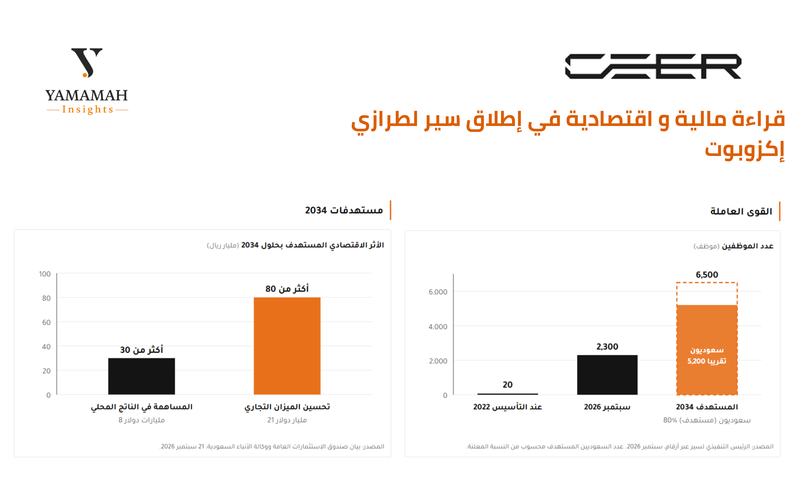
The launch of “Xbot” embodies the Kingdom’s strategic direction to develop an advanced industrial sector aligned with the objectives of Saudi Vision 2030, strengthen the Kingdom’s position on the global automotive map, and enable the automotive industry to serve as a key driver of economic growth by attracting investment, empowering national talent, and enhancing the role of the private sector. The company is expected to contribute more than SAR 30 billion to the Kingdom’s gross domestic product, improve the trade balance by approximately SAR 80 billion, and provide high-quality direct and indirect jobs by 2034.
Against the backdrop of the targeted economic impact by 2034 and the development of an integrated, competitive local automotive ecosystem, students from Al Yamamah University discussed the dimensions of this step and its implications for the industrial sector and future growth as follows:
Moving Toward Operations and Retaining Added Value Locally
Student “Nouf Al Alojayan” @Nouf Alojayan began the analysis, saying: “Regarding the financial and economic impact, I believe that moving into the actual manufacturing and sales phase represents a fundamental turning point. Today, we are moving from the investment-injection phase to the phase of generating direct returns.
The true value of this project lies in its ability to retain added value within our national economy. We are talking about adding more than SAR 30 billion to GDP and improving the trade balance by more than SAR 80 billion by 2034, supported by achieving a 45% local content rate. In my view, more important than the figures is the sustainable social and economic impact. The project is expected to create approximately 6,500 job opportunities, with a localization rate of up to 80%, which means building and qualifying specialized national talent to fulfill its potential in a vital and promising sector.”
Testing Product Quality and Building Supply Chains
For her part, student “Rabiah Almugait” @Rabiah Almugait explained the dimensions of operational assessment, saying: “I believe that the launch of “Xbot” represents an important step in building the automotive sector within the Kingdom, but the real impact will become apparent once large-scale production and sales begin. Ceer’s success depends on several factors, most importantly the quality and price of its vehicles, the availability of after-sales services and spare parts, and local consumer confidence. The company’s expansion into seven models over the next five years could also help it reach different market segments.
In the long term, sustainable growth will depend on its ability to develop its products, increase local content, and build strong supply chains capable of competing regionally.”
Stimulating Complementary Sectors and Supporting Industries
Student “Halah Alalsheikh” @Halah Alalsheikh shared her financial analysis, saying: “In my view, the project’s most important impact is creating a new industrial sector, not merely increasing car sales. Ceer’s success could encourage local companies to enter the manufacturing of components, batteries, and services related to electric vehicles, thereby expanding the project’s economic value into other sectors.”
Balancing Price Competitiveness and After-Sales Services
Student “Albatool Bedairi” @Albatool Bedairi analyzed competitive readiness, saying: “I believe that “Xbot”’s opportunity to compete depends largely on its ability to offer quality and technology on par with global companies, while benefiting from the advantage of local manufacturing.
If Ceer can strike a balance between price and quality and after-sales services, this could strengthen its presence in the Saudi market and support its subsequent expansion into regional markets.”
Transforming the Investment Model and Integrating the Industrial Ecosystem
Student “Fahad Alruwaished” @Fahad Alruwaished commented on the strategic dimensions, saying: “In my view, the Crown Prince’s launch of Xbot vehicles from Ceer represents a major strategic transformation in the national economy. Beginning actual manufacturing and sales places the Kingdom on the global automotive manufacturing map and supports the goal of adding SAR 30 billion to GDP and SAR 80 billion to the trade balance by reducing imports and exporting vehicles abroad.
The presence of major global companies such as Foxconn, BMW, Hyundai, and Rimac also gives international investors tremendous confidence to build supply chains and spare-parts factories within the Kingdom. This transforms the sector into an integrated industrial ecosystem that creates high-quality jobs and continuously attracts foreign capital.”
Operational Dimensions and Expanding Access to Regional Markets
Student “Ryouf Alsewailim”@Ryouf Alsewailim presented practical perspectives on the transformation, saying: “The launch of “Xbot” vehicles from “Ceer” represents the practical transformation of the Kingdom’s advanced manufacturing sector from investment plans to actual operations and production. This step’s significance is evident in the fact that moving to actual production and sales transforms capital expenditure into sustainable operating revenues that support GDP, limit the depletion of foreign currency through improved trade balance, and replace imports with a local product.
Ceer’s partnership with technology and manufacturing giants also creates an attractive environment for suppliers to localize supply chains within King Abdullah Economic City. It strengthens the competitive advantage of geographic proximity and compliance with Saudi requirements and specifications, ensuring fast supply and warranty response. In addition, protecting consumer rights and providing local maintenance reduce the vehicle life-cycle costs compared with imported products.
Furthermore, local design and global specifications give Xbot a cost and environmental-compliance advantage, facilitating its entry into regional and Gulf markets by benefiting from trade agreements and intra-regional customs exemptions. Meanwhile, support from the Public Investment Fund and the project’s integration provide the flexibility to launch seven diverse models over five years in response to technological developments and long-term market needs.”
Quality Requirements and Product Price Competitiveness
Student “Dina Alarjani” @Dina Alarjani added her perspective, saying: “I believe that launching the first Saudi car is a strong step that benefits the economy by creating jobs and attracting investment.
Having spare parts and maintenance available within the Kingdom will encourage people to choose it, but most importantly, its price must be reasonable and its quality excellent so that it can compete with global vehicles.”
Transferring Technical Expertise and Supporting Commercial Production
Colleague “Lujain Algorashi” @Lujain Algorashi emphasized the importance of performance efficiency, saying: “The launch of “Ceer” vehicles represents an important step in building a local automotive industry, but the real impact will become apparent with increased production and sales and the company’s ability to compete in terms of price, quality, and after-sales services. The entry of global companies into the sector can also support the transfer of expertise and technology and open greater opportunities for investment and local supply chains.”
Building Consumer Confidence and Expanding Gradually
Student “Jumana Alshehri” @Jumana Alshehri stated in her analysis: “I believe that launching “Ceer” is an important step for the Saudi economy, as it could increase local manufacturing, create jobs, and support GDP. The entry of global companies into this sector helps attract new investment and expertise to the Kingdom.
From the consumer’s perspective, the local availability of spare parts and maintenance could increase confidence and demand. However, competition also depends on price, quality, and performance. If Ceer can maintain the quality of its products and expand gradually, this could help it remain competitive and succeed locally and regionally.”
Moving Toward Profitability and Improving the Trade Balance
Student “Shahad Alkhamis” @Shahad Alkhamis highlighted all the key dimensions, saying: “In my opinion, the launch of “Xbot” by “Ceer” is a very important and commendable step, because it is the first time we have seen a fully Saudi car manufactured locally to global specifications. This is a national achievement in itself and reflects the Kingdom’s direction toward diversifying sources of income away from oil.
Economically, I expect local manufacturing to have a clear positive impact by reducing imports and increasing exports. Achieving the projected additions of SAR 30 billion to GDP and SAR 80 billion to the trade balance by 2034 will bring about a major transformation in the economy.
As for attracting investment, the presence of major companies such as Foxconn, BMW, Rimac, and Hyundai gives other investors great confidence, because these companies do not enter any market without extensive analysis. Their entry means Saudi Arabia has become a trusted destination for automotive manufacturing.
Regarding local demand, I believe that the availability of spare parts and speed of maintenance are the most important factors, because Saudi consumers are accustomed to excellent service from Japanese and Korean companies. If Ceer succeeds in this area during the first two years, I expect strong demand, particularly with government support.
In terms of competitiveness, the market faces strong competition from Tesla, BYD, and Lucid. However, “Xbot” has several advantages in its bold design and strong specifications, in addition to being Saudi-made, which is an important and distinctive factor in the eyes of local consumers.
Sustained success depends on quality, competitive pricing, and continued development. The Public Investment Fund has the financial capacity to provide support, but the most important thing is for “Ceer” to evolve from a supported project into a profitable, self-reliant company that represents us as Saudis in a competitive global market.”
Efficient Use of Production Capacity and Cost Distribution
Student “Ghadah Alwallan” @Ghadah Alwallan drew attention to the operational dimensions, saying: “What caught my attention is that the factory’s production capacity reaches 240,000 vehicles annually. Therefore, I believe the real challenge after launch will be Ceer’s ability to increase sales and use this capacity efficiently, because increasing production helps distribute fixed costs and improve return on investment.”
Building the Cumulative Ecosystem and Supply Chains
Student “Fay Aldossari” @Fay Aldossari explained her comprehensive analytical perspective, saying: “The launch of “Xbot” represents a practical step that goes beyond simply adding a new brand. It is a genuine transformation for the Kingdom from a consumer market for vehicles into a manufacturing and export hub.
The strength of this project lies in its cumulative economic impact through building a complete local supply ecosystem and creating high-quality jobs that go beyond direct sales profits. It also reinforces trust and maintenance speed by making spare parts available locally at competitive prices, making them preferable to imported parts. Moreover, smart partnerships with global names such as Foxconn and BMW provide the product with the technological credibility and reliability necessary for international competition. Ceer’s sustainability depends on expanding fast-charging networks and local innovation as a promising beginning for Saudi industrial sovereignty.”
Diversifying Sources of Income and Import Substitution
Student “Arwa Alhuwaiti” @Arwa Alhuwaiti pointed to the economic and financial implications, saying: “I believe that launching “Ceer” could have a financial impact on the Kingdom by increasing investment in the automotive sector and generating new revenues from manufacturing and future sales, in addition to attracting global capital and companies connected to the supply chain. As production expands, the sector’s contribution to GDP could grow and financial flows associated with manufacturing and exports could improve.
Economically, local manufacturing will help reduce imports, support the trade balance, create direct and indirect jobs, and transfer expertise and technology. With the expansion of exports, the Kingdom could gradually become a regional automotive manufacturing hub, supporting economic diversification away from dependence on oil.”
Expanding Exports and Balancing Trade
Student “Nouf Alanazi” @Noof Alanazi said in her contribution: “I noticed that the target for improving the trade balance is SAR 80 billion, which is greater than the expected impact on GDP. Therefore, I believe Ceer’s success will depend not only on domestic sales, but also on its ability to reduce reliance on imported vehicles and expand exports in the future.”
Industrial Clustering and Foreign Investment Flows
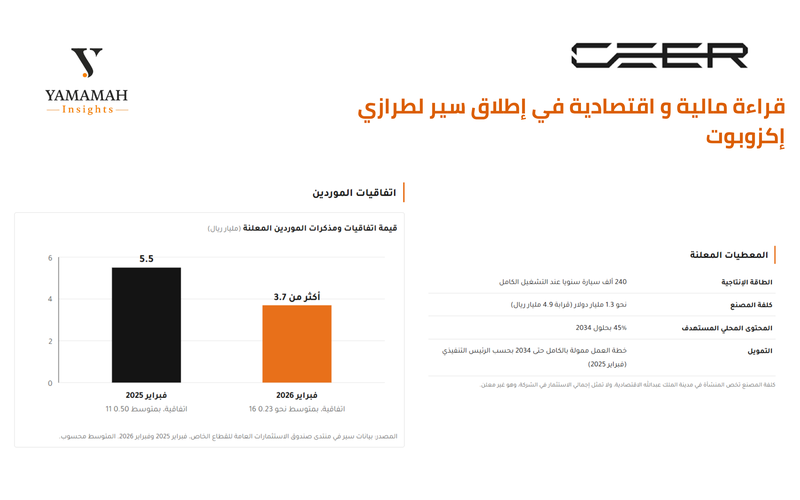
Student “Ahmed Aljadaan” @AHMED ALJADAAN addressed the engineering and industrial perspective, saying: “As an industrial engineering student, I believe that the entry of major global companies such as Foxconn, BMW, Rimac, and Hyundai creates what we call an Industrial Cluster in our field. The presence of a company such as “Ceer” as a key driver encourages suppliers and supporting spare-parts companies to invest and build factories within the Kingdom near the industrial complex, rather than relying on overseas shipping. This is clearly demonstrated by the signing of announced supplier agreements—SAR 5.5 billion in 2025 and more than SAR 3.7 billion in 2026. This integrated environment reduces risks for foreign investors and stimulates capital inflows.”
From Building Assets to Integrating the Production Ecosystem
In an analytical reading, financial and economic analyst “Hamad Alsaeed” @Hamad Alsaeed adds: The Crown Prince’s launch of Ceer’s first vehicles ushers Saudi automotive manufacturing into a new phase, in which the ecosystem moves from building assets and factories to actual production. We see the project’s economic value extending beyond the vehicle itself, encompassing component manufacturing, engineering and logistics services, and after-sales services.
In this context, the project’s impact on the trade balance and GDP is linked to the local content rate, which is targeted to reach 45% by 2034. Manufacturing a vehicle with imported components has a different economic impact from manufacturing it within a national supply chain. Xbot’s local design and engineering also add a dimension related to the localization of knowledge, alongside its technology partnerships with BMW and Foxconn.
The project’s actual impact is expected to be determined during its first years of operation by the company’s ability to increase its factory utilization rate and expand its base of local suppliers. Both factors have clear foundations, given the size of the domestic market and the support provided by the objectives of Saudi Vision 2030.

Comments (5)
No comments yet. Be the first to comment!