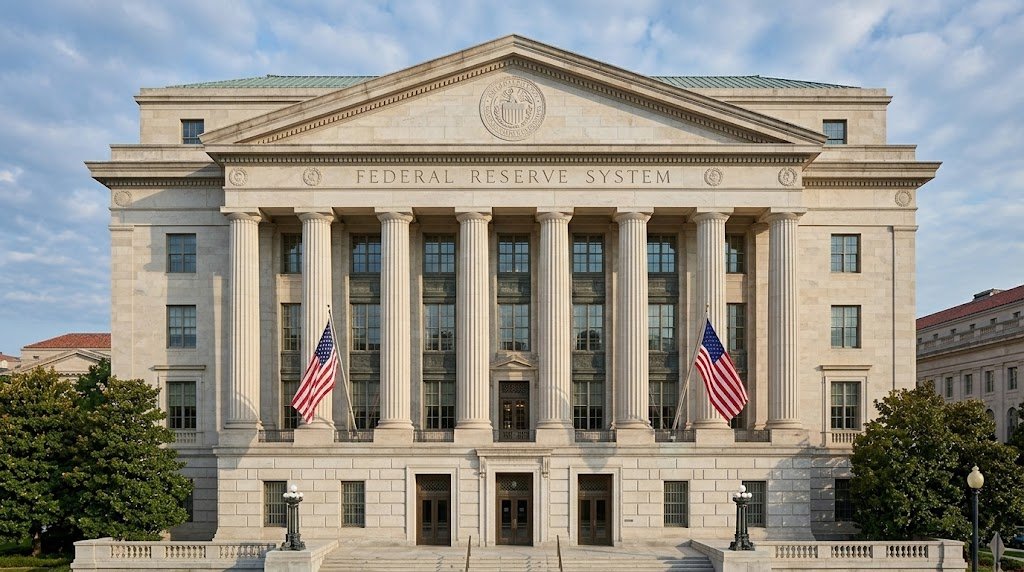

The U.S. Federal Reserve recently confirmed for the fourth consecutive time the maintenance of interest rates within the range of 3.5% to 3.75%, a move that ends an era of optimistic expectations for monetary easing and confirms the continuation of high 'cost of funds' to curb inflation.
Despite the consensus on the current hold, the "Dot Plot" of 19 members revealed a notable division; 9 members see the need for an additional increase before the end of the year, while 10 members lean towards keeping current rates.
These decisions automatically reflect on the local market, as the Saudi Central Bank (SAMA) follows the Fed's footsteps to maintain the riyal's peg to the dollar, which means high SAIBOR levels will persist for a longer period.
Students from Al Yamamah University discussed the implications of this decision and its direct effects, focusing their analyses on monetary policy mechanisms and how interest rates are used as a balancing tool to control the economy, liquidity migration, and the sustainability of funding for startups.
Stability Priorities and Liquidity Protection
Student "Fay Abdullah"@Fay Aldossari clarified the determinants of monetary policy, stating: "The Fed's decision to maintain high interest rates indicates that controlling inflation is the current priority at the expense of rapid growth, making the cost of funds a continuous burden. As a result, startups face challenges related to a shortage of bold liquidity and high borrowing costs, pushing them to focus on self-profitability rather than rapid expansion.
Consequently, liquidity naturally shifts from the stock market due to increased risks to deposits and bonds as a safe alternative offering guaranteed returns close to 4%. Locally, the Saudi Central Bank's alignment with the Fed is a necessary step to protect the riyal's peg to the dollar and prevent local liquidity from seeking higher returns abroad, which requires hedging while awaiting future monetary easing trends."
Investor Options and Financing Costs
On his part, student Yusuf Farhat focused on investor behavior, stating: "I see that rising interest rates change the decisions of many investors, as some prefer to deposit their money in deposits or bonds when they offer good returns with low risks, which is why we are witnessing a portion of liquidity leaving the stock market. Additionally, startups are affected as obtaining financing becomes more expensive, which may slow down expansion and growth plans."
Impact of Expectations and State of Vigilance
Student @Shahad Al-Muhaysin shared insights on the impact of monetary hints, saying: "The interest rate decision does not only affect banks and large companies, but it also indirectly reflects on everyone; as interest rates rise, obtaining financing becomes harder and more costly, prompting some companies to delay expansion or reduce their investments.
The most notable point is that markets are no longer focused solely on today's decision, but on future expectations, which is why the impact of a mere hint from the Fed regarding interest rates can sometimes be greater than the decision itself.
As for the Saudi market, the continued hold provides a degree of clarity for investors and companies at present, but everyone is still watching for any upcoming changes in the interest rate path as it directly impacts liquidity and investment."
Monetary Caution and Strong Cash Flows
Student "Rimas Al-Mashali" @Rimas Almashali provided an in-depth reading of the Fed's caution, stating: "The most important aspect of the Fed's decision is not the hold itself, but the confirmation of a prolonged high interest rate policy; even with inflation declining compared to previous years, the Fed remains cautious about any early cuts that could reignite inflationary pressures.
From an investor's perspective, the continuation of high interest rates increases the attractiveness of deposits and fixed-income instruments, prompting some liquidity to exit the stock markets, especially for companies that rely on financing and borrowing for growth. Locally, aligning SAMA with the Fed's decisions is essential to maintain the stability of the riyal linked to the dollar, but the continued high cost of financing may pose challenges for highly indebted companies and affect the pace of expansion and investment in certain sectors; thus, the current phase requires greater focus on companies with strong cash flows and the ability to achieve profits without heavy reliance on financing."
Money Movement and Cash Attractiveness
In this context, student "Ghadah Al-Wallan" @Ghadah Alwallan focused on the dynamics of liquidity movement, saying: "I noticed the connection between liquidity and market movements; many individuals link interest rate decisions solely to inflation, while its actual impact extends to the movement of money within the economy. When interest rates remain high for an extended period, holding cash or deposits becomes more attractive compared to some other investments, which may lead to a withdrawal of some liquidity from the markets and a reduction in investment activity; therefore, the impact of interest rate decisions is not only reflected in prices but also in how liquidity transitions between different investment opportunities."
Operational Balance Equation
From the perspective of stability and growth, student @Tina Azy expressed her viewpoint, saying: "Raising interest rates helps alleviate inflation as it reduces borrowing and spending rates, but at the same time, it makes it harder for startups to obtain the necessary financing for expansion, thus it is essential to find a balance between controlling inflation and supporting economic growth."
Opportunity Cost and Market Sensitivity
Student @Thanaa Al-Shayeb concluded the student discussion by analyzing investor behavior, stating: "The impact of interest rates on stocks is logical when viewed from the investor's perspective; when banks offer higher returns on deposits or low-risk investment instruments, many investors prefer to direct part of their funds there instead of stocks, especially during periods of economic uncertainty. Companies themselves are also affected as the rising cost of borrowing may delay expansion plans or reduce expected future profits, which is why markets react sensitively to any hints of interest rate hikes even before the decision is made.
Ultimately, the investor begins to compare opportunity cost: Is the expected return from stocks worth the risk, or are there alternatives that offer good returns with lower risks? Here, part of the liquidity begins to move out of the market, which is one of the main reasons for the pressures we see on stocks when interest rates rise."
"Financial and economic analyst Hamad Al-Saeed concluded the discussion with his comment:"
The Federal Reserve's decision to maintain interest rates at a range of 3.50% to 3.75%, with several federal officials leaning towards resuming the rate hike path during the year, signals that inflation may continue to rise and cause an economic crisis.
The overall inflation rate in the United States stands at 4.2%, exceeding the target level of 2%.
Although the decision is made in Washington, its impact extends directly to Riyadh.
The Saudi Central Bank (SAMA) aligns with the Fed's decisions to maintain monetary stability, given the riyal's peg to the dollar at 3.75.
From an investment perspective, if interest rates are raised as expected, we may see a decline in stock markets due to the increased opportunity cost.
Raising interest rates also increases the yield on government bonds, which in turn will drive investors and funds to sell stocks and direct liquidity towards debt instruments that are considered safer than stocks, increasing supply and putting downward pressure on stocks.
Economically, we may see a slowdown in consumption and a delay in expansion projects, as borrowing costs will be high for both individuals and companies.
On an international economic level, we may witness an increase in the dollar's value compared to other currencies due to the growing global demand for dollars to purchase U.S. government bonds with attractive yields. This, in turn, negatively impacts the prices of oil and commodities, as they are priced in U.S. dollars and become more expensive for importing countries, limiting demand for them.

Comments (9)
No comments yet. Be the first to comment!