

Fitch Ratings announced an update to its ratings for two companies listed in the Saudi market, adjusting the outlook for both Arabian Centers (Sinomi Centers) and Tawuniya Insurance to "Stable", while affirming their credit ratings.
Regarding Arabian Centers (Sinomi Centers), the agency raised its outlook for the company from "Negative" to "Stable", while affirming the long-term credit rating at 'BB'.
This adjustment reflects the company's success in refinancing its sukuk maturing in October 2026, which contributed to enhancing its financial structure and supporting its operational stability.
The report also highlighted the company's market position and the diversity of its operations, supported by high occupancy rates and growing demand, with expectations for further improvement in financial indicators as the projects "Jewel of Riyadh" and "Jewel of Jeddah" reach full operational stability.
Fitch affirmed Tawuniya's insurance rating at 'A', with the outlook adjusted to 'Stable'. This adjustment is due to the company resorting to borrowing to finance its rapid sales expansion, which increased its financial leverage and consumed its capital base at a rate exceeding its current profits' ability to compensate.
The affirmation of this rating is based on the company's leading position in the Saudi insurance market, alongside its strong financial performance, robust capitalization levels, and financial leverage, supporting its strategy for sustainable growth.
Students from Al Yamamah University discussed the dimensions of these results and the structural implications of costs as follows:
Dimensions of the Outlook and Capital Consumption for Growth
Student "Rimas Almashali" @Rimas Almashali opened the analysis by assessing the strategic financial impact, stating: "The difference between the two cases shows that an investor should not view the credit rating in isolation from the direction of the outlook.
The improvement of Sinomi's outlook from negative to stable reflects lower refinancing risks and improved liquidity management, which may help the company in the future to obtain financing on better terms if it continues to improve its financial position.
As for Tawuniya, despite maintaining its high A rating, the adjustment of the outlook to stable indicates that its growth rate has begun to consume capital more significantly, which may limit the chances of a rating upgrade in the near term.
I believe that part of this news may be priced into the market, but the continued impact will depend on the results of the upcoming periods and each company's ability to translate these indicators into actual financial performance, not just on the announcement alone".
Liquidity Indicators and Capital Structure versus Operating Profitability
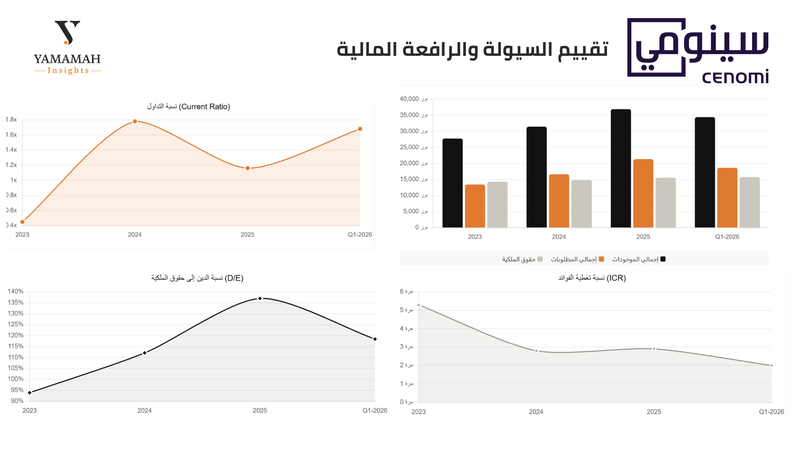
Student "Rana Alshamrani" @Rana Alshamrani commented from an operational and logistical perspective, saying: "After refinancing the 2026 sukuk, liquidity and financial leverage indicators improved, with the Current Ratio rising from 1.15x to 1.65x, and the D/E ratio decreasing from 137% to 120%.
Conversely, the Interest Coverage Ratio (ICR) continued to decline to 2x, indicating that the refinancing addressed only maturity risks, without a significant improvement in operational capacity to cover interest costs, and this may reflect an increase in the cost of debt service if the new sukuk were issued at a higher yield.
Therefore, Fitch's positive outlook reflects lower default risks associated with upcoming maturities more than it reflects an improvement in profit quality or operational cash flows.
If EBIT does not improve in the upcoming periods, the source of risk may shift from maturity risks to weak operating profitability, which is a more significant development than merely rescheduling debts.
Conversely, the market may react to the refinancing news as a Composite Positive Signal, although the improvement is concentrated in liquidity and capital structure without profitability, which is worth monitoring in upcoming results".
Sustainability of Financial Position and Cash Flows for Major Projects
Student "Ghadah Alwallan" @Ghadah Alwallan continued the discussion by focusing on commercial and pricing aspects, stating: "The most striking point in Fitch's report is not the outlook adjustment itself, but the reasons behind the decision.
In Sinomi, refinancing has mitigated the risk of near-term maturities, but Fitch still expects a decrease in leverage only if the Westfield Riyadh and Jeddah projects succeed in generating cash flows after their opening; this means that refinancing has bought the company time but has not fully resolved the issue.
Conversely, Tawuniya retained its A rating despite the outlook adjustment because profitability remains strong, but capital consumption due to growth has become faster than its generation, indicating that growth itself is not always positive news if it begins to pressure capital strength.
In my opinion, this shows that Fitch does not only evaluate current results but focuses on the sustainability of the financial position over the coming years".
Balancing Lender Confidence and Strong Financial Solvency
For her part, student @Shahad Al-Muhaysin provided an operational analysis balancing different activities, stating: "In my opinion, the adjustment of the outlook to 'Stable' in both cases carries different messages.
For Sinomi, it is a positive development because its success in refinancing the 2026 sukuk has mitigated one of the biggest risks it faced, which may reflect in the future on lower borrowing costs and improved confidence from lenders and investors.
As for Tawuniya, despite the outlook shifting from positive to stable, its retention of the A rating confirms that the company still enjoys strong financial solvency, but Fitch now expects performance stability more than continued rapid improvement.
I believe the market may have absorbed part of this news in advance, but the real impact will show with the upcoming financial results as they will be the key factor confirming whether this improvement or stability is sustainable".
Credit Rating and the Shift Towards Investment Appeal
Student Turki Al-Ashri concluded the analysis by pointing out the dimensions of expansion and market position development, saying: "Sinomi is trying to change the mental image previously associated with it as a speculative stock, to a company with investment appeal based on stability and long-term growth.
Its success in managing its financial obligations and improving its credit outlook to 'Stable' has enhanced investor confidence and increased its credibility in the market.
It is important to distinguish between the credit rating and the outlook; the company has not risen to a BBB rating, but its outlook has shifted from negative to stable while the rating remains at BB, reflecting lower credit risks compared to the previous period, but it does not mean that the company has yet reached investment grade.
Moreover, credit rating agencies like Fitch focus in their assessments on the company's ability to meet its obligations, the stability of its financial position, and liquidity management, rather than on expectations of rising stock prices.
As for Tawuniya, it has enjoyed a strong market position for years and is considered one of the largest insurance companies in the Kingdom, also holding a higher credit rating than Sinomi; therefore, the shift in its outlook from positive to stable does not indicate a decline in the company's strength, but rather suggests that the chances of a rating upgrade in the near future have decreased, while maintaining the strength of its financial position".
An Analytical View on the Financial Performance of "Sinomi" and "Tawuniya"
Professor Abdulaziz Khrais pointed out that the current financial situation of Sinomi may not be classified as excellent performance at this time, as it reflects the company's issuance of local sukuk about a year ago to enhance its financial position and inject the necessary cash flows for its operations, indicating a clear sign of its ongoing efforts to secure liquidity.
In this context, he addressed Tawuniya, clarifying that although it is a joint-stock company like others, the insurance sector is characterized by a highly specific operational and financial nature that fundamentally differs from other listed sectors, and based on that difference, it is not preferable to equate it in treatment or classification with other companies, but rather these standards and sector-specific characteristics should be carefully considered when evaluating financial performance and building the discussion.
Challenge of Operational Efficiency and Balancing Capital Consumption
In an analytical reading of the company's performance, financial and economic analyst "Hamad Alsaeed" @Hamad Alsaeed stated: Sinomi's management has succeeded in curbing the liquidity crisis by restructuring its debts through issuing sukuk worth 2.05 billion riyals and 500 million dollars to safely surpass the 2026 maturities. However, the biggest challenge on the numbers screen is financial leverage, which reached a concerning peak of 9.6 times operating profits. The investment bet is now linked to lowering this rate below 8 times by 2027, benefiting from similar revenue growth of 4.9 percent, and maintaining occupancy rates at 92.4%, reaching targeted leasing areas of 1.9 million square meters.
As for Tawuniya, the company is performing aggressively by increasing its premiums by 20 percent to reach 23.8 billion riyals. Despite the strength of the rating, the adjustment of the outlook to stable serves as an early warning bell for the fierce consumption of capital. Despite a strong return on equity of 22 percent, it has declined from the previously recorded levels of 25 percent, and borrowing 550 million riyals has jumped the financial leverage from zero to 9 percent, with the claims ratio stabilizing at 95 percent, placing the company under scrutiny for new solvency tests in 2027.
We are at a crossroads for both entities. Sinomi is closing the chapter on heavy capital spending, and the real test now is operational efficiency to free up cash flows and reduce debt. In contrast, Tawuniya is walking a tightrope between sales expansion and protecting capital adequacy.
Disclaimer: (This material has been prepared under the supervision of the “Yamamah Insights” editor and with the assistance of artificial intelligence tools for educational purposes, and does not constitute a recommendation to buy, sell, or hold any security, and it reflects the opinions of its authors and not the platform's opinion)


Comments (5)
No comments yet. Be the first to comment!