

The global investment landscape is undergoing a significant turning point driven by economic reports indicating the beginning of a migration of capital and cash flows from cryptocurrency markets and virtual speculation, coinciding with those markets facing a sharp downturn.
In contrast, billion of dollars have begun to flow towards the "real muscles" of artificial intelligence, represented by hard assets; such as data centers, high-performance graphics processing units (GPUs), and vast sustainable electrical power sources.
This structural comparison opens the investment discussion about the preference for productive tangible assets that meet a real and growing demand in the real economy, versus virtual assets that lack a physical productive nature, thereby reshaping concepts of risk and investment opportunities globally and locally, and raising fundamental questions about the ability of artificial intelligence infrastructure to compete with cryptocurrencies in attracting the interest of investment funds.
Students from Al-Yamamah University discussed the dimensions of this strategic shift and its causes as follows:
Meeting Operational Demand and Scalability
Student "Rimas Almashali" @Rimas Almashali opened the discussion by supporting the feasibility of this shift, stating: "The infrastructure of artificial intelligence has become a strong competitor to cryptocurrencies in attracting capital; due to its reliance on productive assets that meet an increasing operational demand from companies and governments, such as data centers and graphics processing units and energy infrastructure.
The main reason behind some investors' shift from the crypto sector to these assets lies in the search for investments linked to real economic activity, providing measurable income sources and cash flows, rather than relying excessively on price volatility and daily speculation. However, this movement does not reflect the end of cryptocurrencies, but rather indicates a temporary change in investor priorities; the future belongs to assets capable of creating sustainable economic value."
Value Shift and Strategic Positioning of Miners
For her part, student "Fay Aldossari" @Fay Aldossari provided an integrated analysis, stating: "The infrastructure of artificial intelligence has begun to significantly outperform cryptocurrencies in attracting smart money and institutional funds due to a radical shift in the concept of value; where cryptocurrencies rely on collective consensus and speculation and market liquidity (Speculative Value), while data centers and chips provide essential tangible services for the modern economy, driving major tech companies to compete for computing capabilities that ensure stable and sustainable cash flows (Cash Flow), which changes the risk appetite of institutional investors towards assets with a competitive moat linked to long-term guaranteed leases instead of the sharp fluctuations of crypto.
She clarified that the migration of cryptocurrency investors towards hard assets of artificial intelligence is not merely an escape from the downturn, but a strategic repositioning represented first in the transformation of major bitcoin mining companies into high-performance computing (HPC) providers to leverage their infrastructure represented by direct access to energy networks and cooling centers, after realizing that hosting artificial intelligence processors yields returns that double mining returns with lower risks.
The shift also highlights the search for tangible productivity as artificial intelligence is viewed as a productive capital asset (Productive Asset) that generates efficiency and reduces costs, in contrast to the non-productive nature of most cryptocurrencies, in addition to the close link to energy as the currency of the new century, where crypto investors understand the language of energy well as it is the basis for proof of work (Proof of Work), making their transition to energy assets directed towards data centers a natural extension of their experiences in a market supported by continuous commercial and governmental demand."
Liquidity Redistribution and Risk Appetite Level
In the same context, student @Shahad Al-Muhaysin reviewed the impact of redistributing investment shares, stating: "We are beginning to witness a clear shift in investor priorities; the infrastructure of artificial intelligence has become real assets generating actual revenues from the increasing demand for computing, storage, and energy supplies, while cryptocurrencies rely more on prevailing market sentiment and massive price fluctuations.
For this reason, part of the capital is directed towards companies that own data centers or develop electronic chips to directly benefit from the sector's growth.
This movement does not negate the role of cryptocurrencies, but represents a redistribution of liquidity towards more stable assets in the current phase, while crypto remains a viable option for portfolios that have a higher risk appetite."
Operational Integration and Sustainable Cash Flow Indicators
On the other hand, student "Ghadah Alwallan" @Ghadah Alwallan viewed the relationship between the two sectors as not entirely competitive, stating: "This shift reflects investors' desire to direct liquidity towards assets that generate clear cash flows and benefit from the current spending boom; every artificial intelligence model structurally requires data centers, processing units, and massive amounts of energy to operate, making them a foundation for growth and not just a passing investment story.
However, the relationship between the two may not be entirely competitive, as some cryptocurrency projects rely on this infrastructure, and thus both sectors may benefit together. The most important indicator to follow in the future is not just the amount of money flowing in, but the ability of data center and energy companies to convert this high demand into real profits and sustainable cash flows capable of creating tangible value for investors in the long term."
Asset Link to Actual Operational Demand
Student "Jumana Alshehri" @Jumana Alshehri concluded the discussion by focusing on risk diversification and portfolio management, stating: "The increasing trend among investors towards hard assets is linked to the existence of real operational demand supporting expanding artificial intelligence applications. These assets do not rely solely on future growth expectations, but represent the cornerstone for operating modern technologies, giving them clear and stable economic value.
In contrast, cryptocurrencies remain a standalone investment class but are characterized by higher price volatility, prompting a segment of investors in this specific economic phase to prefer assets with revenues supported by actual demand. Ultimately, it is not about one sector triumphing over another, but about changing investment priorities according to the phase and available opportunities while maintaining the principles of investment diversification and risk management."
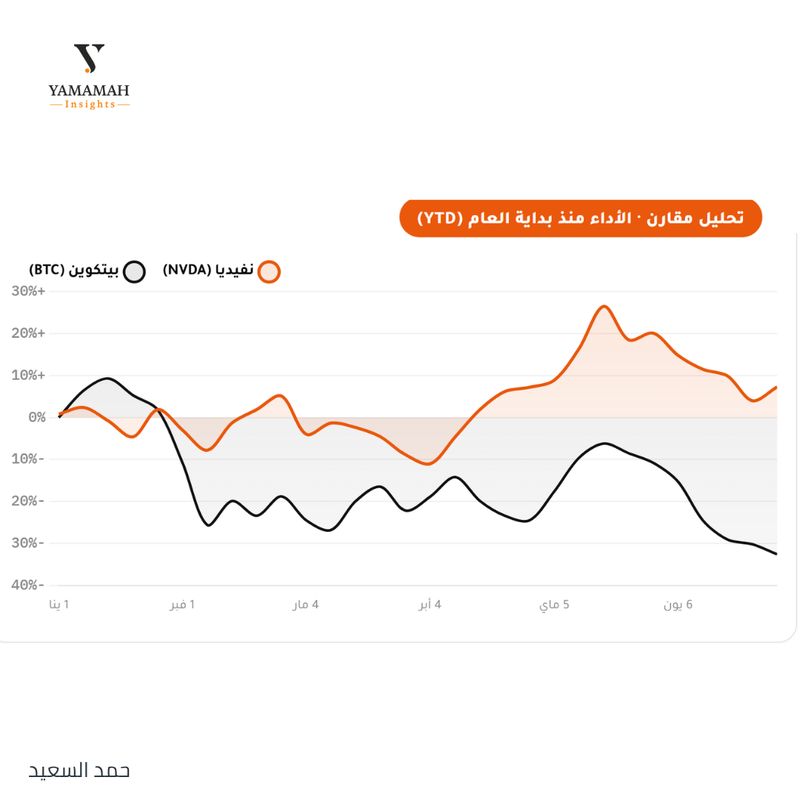
Financial and Economic Analyst "Hamad Alsaeed" @Hamad Alsaeed concluded the discussion with his comment:
The divergence in capital repositioning is accelerating as June 2026 data reveals a radical shift in risk from crypto to technology. Bitcoin's decline below $60,000, down 53% from its peak last October, coincides with a historic exit of some crypto funds in America nearing $1.3 billion weekly (4.5 billion in June) due to the liquidation of major institutional investors for the first time since 2022, causing its market value to drop below $2 trillion.
In contrast, a stock like Nvidia achieved a record valuation of $4.7 trillion, surpassing the entire crypto market, supported by operational momentum that pushed its annual revenues beyond $250 billion, with a record profit margin of 75%, and a price-to-earnings ratio between 30 to 47 times.
Despite the astronomical momentum, there is financial caution regarding the inflation of multiples and liquidity concentration. Only 5 companies account for 30% of the S&P 500 index. The structural exposure gap is evident in the AI boom in the sharp difference between debt-funded spending or circular flows, such as OpenAI's infrastructure commitments exceeding $1 trillion, against realized revenues of $13 billion and operational losses of $20.92 billion, putting the sustainability of this concentration to the test.

Comments (9)
No comments yet. Be the first to comment!