
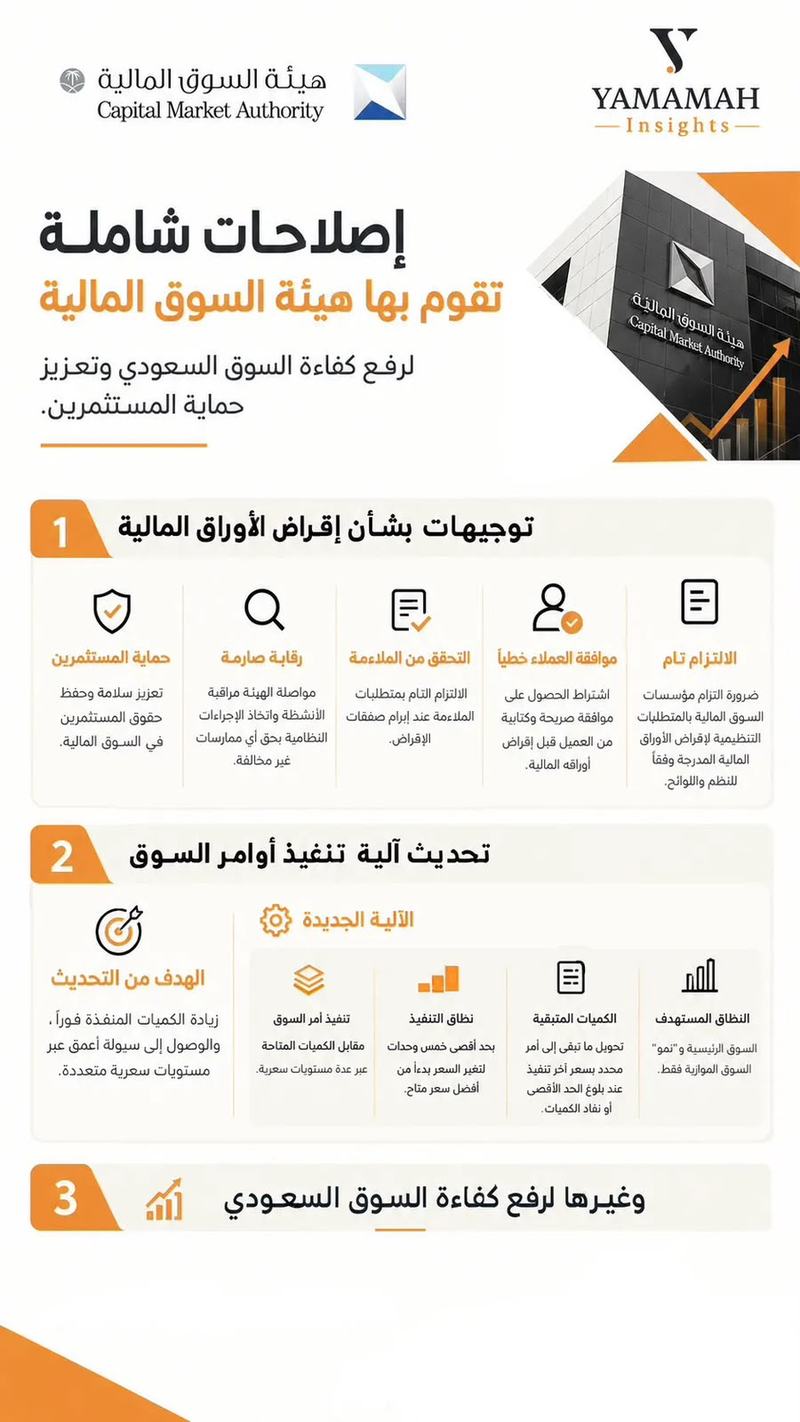
The Capital Market Authority issued a strict circular to all Capital Market Institutions, requiring them to comply with the regulatory requirements for lending listed securities. It emphasized the importance of obtaining the client’s explicit written consent before lending their securities and verifying suitability, with the aim of promoting sound practices and protecting investors’ rights.
In a related development aimed at improving trading efficiency, Saudi Exchange announced an update to the execution mechanism for market orders in the Main Market and Nomu – Parallel Market, effective October 4.
The new mechanism allows orders to be executed against available quantities across multiple price levels, within a maximum range of 5 price increments.
If this range is reached or no additional quantities are available, the remaining quantity is converted into a limit order at the price of the last execution. This helps access additional liquidity and increases the quantities executed immediately.
Students from Al Yamamah University discussed the regulatory and operational dimensions of these decisions and their implications for investor protection and improving the efficiency of the capital market, as follows:
Faster execution of large orders, with the importance of monitoring price volatility
Student Nouf Al Olayan @Nouf Alojayan shared her perspective, saying: "Allowing execution across 5 price levels may speed up the execution of large orders and increase trading flexibility. At the same time, however, it could result in trades being executed at prices different from those expected, particularly in fast-moving markets."
Protecting assets and market stability through ongoing updates
Student Zikra Abdulkarim @Zikra Abdulkareem shared her view, explaining: "I believe ongoing updates to the Saudi capital market reflect clear progress toward a more efficient and transparent market, strengthening investor confidence.
Allowing execution across 5 price levels may also help speed up large orders, while it is important for investors to understand the impact this may have on the final price.
Tightening governance of stock lending is an important step toward protecting investors’ assets and ensuring that consents and rights are clear, thereby supporting market stability."
Regulating practices and bringing short selling within a regulatory framework
Student Albatool Bedairi @Albatool Bedairi explained: "Explicit written consent from the client is important because it prevents an investor’s shares from being lent without their knowledge, giving them greater control over their assets.
Oversight is also important because stock lending may be used in transactions such as short selling. Suitability requirements and clear consent help reduce improper practices and protect investors, while allowing these instruments to exist within a regulated framework rather than leaving them without controls. This is precisely what the Capital Market Authority emphasized in its latest update."
Keeping pace with global practices by combining oversight with trading updates
Student Ahmed Al-Jadaan @ahmed aljadaan added: "Overall, these comprehensive reforms undertaken by the Capital Market Authority directly contribute to improving the efficiency of the Saudi market and strengthening investor protection.
Combining strict oversight with updates to trading mechanisms in the Main Market and Nomu reflects a high level of maturity in the market environment.
These updates make our market more attractive and trustworthy, while bringing it into line with global best practices for protecting the rights of market participants."
Improving market efficiency and avoiding the risks of asset misuse
Student Rabiah Almugait @Rabiah Almugait emphasized: "I believe that continuing to update regulations and procedures helps improve market efficiency and increase transparency, which positively affects investor confidence and enhances the appeal of the Saudi market.
As for the update to the market order, I believe execution across several price levels will speed up large orders, but investors need to pay attention to price movements because execution may occur at different prices.
Regarding stock lending and short selling, stronger governance and the requirement for client consent offer investors greater protection and reduce the risk of misuse."
Limits on price protection and building trust through the effective implementation of regulations
Student Shahad Alkhamees @Shahad Alkhamis noted: "Ongoing reforms are very positive and show that the Saudi market is keeping pace with global standards, but their success depends on actual implementation, not just written regulations.
The 5-level market order is highly practical because it speeds up execution and reduces pending orders. For those concerned about a higher price, there is a price-protection limit, so the order is not entirely open-ended and the risk is limited.
Governance of short selling is the most important point: explicit client consent protects ownership and prevents assets from being used without the client’s knowledge, building genuine trust in the market."
Understanding execution mechanisms and the need to be aware of the permissions granted
Student Jana Aljebali @Jana Aljebali shared her view, explaining: "I believe ongoing updates strengthen confidence, especially when they focus on clarifying rights. Requiring a client’s explicit written consent before lending their shares clearly protects their rights.
As for the market order, execution within a range of 5 price increments helps large quantities to be executed more quickly. These are price increments starting from the best available price, not fixed levels.
Investors should pay attention to the execution price. If the price matters to them, they should use a limit order."
Measuring market strength by how well it protects investors’ rights and money
Student Najd Faisal @Najd Faisal explained: "In my view, the strength of the capital market is measured not only by how quickly trades are executed, but also by how confident investors feel that their rights and money are protected.
That is why I believe the latest updates bring together two important aspects: improving trading efficiency and strengthening investor protection.
With these reforms continuing, I believe the market is moving toward a more mature and professional environment, which in itself strengthens investor confidence."
Deepening order-book liquidity and attracting institutional and foreign investors
Student Mohammad Alghaihab @Mohammad Alghaihab elaborated on his analysis, saying: "I believe the latest updates reflect the Saudi market’s transition to a more mature stage in terms of trading mechanisms. The focus is not only on increasing liquidity, but also on improving how it is formed and deployed while protecting investors at the same time.
Updating the market order to allow execution across multiple price levels will improve execution efficiency for large orders and reduce the likelihood that part of an order will remain unfilled. This reflects the depth of the order book and the liquidity actually available.
I also consider the regulation of securities lending very important as instruments such as short selling develop.
Requiring client consent gives clients clearer control and allows the lending market to develop in an orderly way, rather than expanding at the expense of the original owner’s rights.
The greatest value of these reforms lies in building a deeper, more efficient market infrastructure that can accommodate larger trading volumes in the future, making the market more attractive to institutional, domestic, and foreign investors."
Preventing price slippage and protecting retail investors from selling pressure
Student Fay Aldossari @Fay Aldossari noted: "Ongoing development gives us, as individual traders, a sense of security and confidence.
In my view, the update to the market order is an excellent protective measure. Previously, it could cause a price shock and execute at a price far from what was expected.
It is true that execution is faster now, but its most important advantage is that it limits random buying or selling and protects you from price slippage when liquidity is low.
Requiring explicit consent also protects the rights of all investors, large and small, and prevents manipulation or unjustified selling pressure on our shares.
These updates confirm that the market is continually moving toward higher levels of professionalism."
Strengthening stability through strict oversight of advanced trading instruments
Student Rand Alkhalaf @Rand Alkhalaf shared her view, saying: "In my view, the updates improve market efficiency and strengthen investor confidence.
Executing a market order across 5 levels speeds up large orders, but may result in an execution price higher than expected.
Tighter oversight of short selling also protects investors’ assets and enhances transparency and stability."
Supporting market transparency and balancing trading flexibility with asset protection
Student Dina Alarjani @Dina Alarjani explained: "I believe regulatory and operational updates contribute to the development of the capital market and strengthen investor confidence.
Executing a market order may speed up large orders, but it is important to be aware that the execution price may differ from the expected price.
Requiring a client’s explicit consent to lend their shares also strengthens the protection of their assets and rights, while supporting transparency and stability."
Reducing violations by strengthening oversight and governance mechanisms
Colleague Lujain Al-Qurashi @Lujain Algorashi added: "In my view, ongoing regulatory and operational updates reflect the development of the Saudi capital market and its commitment to improving efficiency.
Allowing execution across 5 price levels helps speed up large orders. Tighter governance of securities lending also raises the level of transparency and oversight, supporting market stability and participant confidence."
Building a more regulated market and reducing risks associated with lending transactions
Student Jumana Al-Shehri @Jumana Alshehri emphasized: "I believe these updates are generally positive because they improve market efficiency by making processes clearer.
The update to the market order is important, but investors need to pay attention to price changes.
Tighter oversight of stock lending and short selling also reduces risks and violations, helping build a more orderly and efficient market."
Addressing slow execution and laying the foundation for lending governance
Student Ryouf Al-Suwailem @Ryouf Alsewailim noted: "The latest updates reflect considerable maturity in the work of the Capital Market Authority and Saudi Exchange. On one hand, changing the market order mechanism addresses delays in executing large trades and provides greater liquidity depth, while setting a limit that protects traders from sharp fluctuations.
On the other hand, the Authority’s emphasis on obtaining client consent is a cornerstone of short-selling governance, as it ensures that client assets are not misused and reduces unjustified volatility."
Keeping pace with global practices while understanding price impact
Student Rahaf Al-Anazi @Rahaf Alanazi shared her view, explaining: "I believe these updates reflect the development of the Saudi capital market and its commitment to adopting global best practices.
Orders can now be executed more quickly, but investors need to understand the impact of different price levels before using this feature.
Governance of short selling is also important to prevent clients’ assets from being used without their knowledge."
Carefully balancing the facilitation of investment activities with the protection of rights
Student Thanaa Alshayib explained: "I believe the latest updates are a positive step because they focus on execution efficiency and investor protection.
The update to the market order offers greater flexibility, but it makes understanding how orders are executed more important than before, especially when liquidity is low.
In my view, the best thing about these reforms is that they seek to balance facilitating trading with protecting investors’ rights—and that is what truly builds trust."
Challenges in providing liquidity to the lending market amid strict consent requirements
Student Ghadah Alwallan @Ghadah Alwallan concluded the analyses by saying: "What caught my attention is that requiring the client’s explicit consent protects investors, but I wonder whether it will reduce the number of shares available for lending if many investors choose not to activate the service.
A reduced supply of shares available for lending could increase borrowing costs and limit short-selling activity.
I therefore believe the real challenge is finding a balance between protecting investors and maintaining an effective lending market that supports liquidity and pricing efficiency."
A strategic view of market performance and its true scale
The Saudi capital market has made significant progress in building its scale, and boosting liquidity has become a priority for the current phase. The Saudi market’s capitalization reached SAR 9.12 trillion at the end of September, while average daily trading stands at around SAR 3.77 billion. In this context, the Capital Market Authority’s circular on recent reforms, including the lending of listed securities, and Saudi Exchange’s update to the market-order mechanism represent steps toward restoring the market to its true scale.
I believe the first impact will be on liquidity: an order executed in a larger quantity within 5 price increments, together with shares available for lending, means more active trading. The impact also extends to the quality of IPOs. When the market can express its view of a stock by moving its price up or down, offering prices become more disciplined from the first day.
In terms of confidence, requiring written consent sends a clear message to domestic investors that their ownership is protected, strengthening confidence and credibility in the market. These measures also help attract both foreign and domestic investors, supporting market liquidity.
These measures serve the market’s priorities: the goal is for the market to be a destination for active trading, not just listings.

Comments (3)
No comments yet. Be the first to comment!