

The International Energy Agency’s (IEA) November 2026 oil market report pointed to tentative signs of a return to balance in global markets, after supply exceeded demand for the first time since the outbreak of war in Iran. Global supply rose by 2.3 million barrels per day in October to 105.4 million barrels per day, supported by a rebound in Gulf exports. This contributed to a 52-million-barrel increase in observed global inventories, the first rise since June. The improvement in supply was reflected in benchmark North Sea crude prices, which fell 32% from their early-October peak of $136 a barrel to settle at around $93 a barrel.
Looking ahead, the agency forecast that global oil demand would contract by 2.7 million barrels per day in 2026 to 102.3 million barrels per day, before rising by 2 million barrels per day in 2027. Petrochemical feedstocks are expected to drive 80% of that increase, while transport fuel demand growth slows amid expanding electrification and greater fuel efficiency. The agency also forecast a return to a supply surplus in the fourth quarter of 2026 and a rise in global supply to 108.1 million barrels per day in 2027. At the same time, it warned that severe tightness in diesel supplies, higher freight costs and maritime security threats remain key risks to market stability.

Against signs of a renewed oil surplus and falling crude prices, alongside continued refined-product supply challenges and maritime security risks, Al Yamamah University students discussed the implications of these developments for global energy markets and the regional economy:
Price pressures and cash flow monitoring
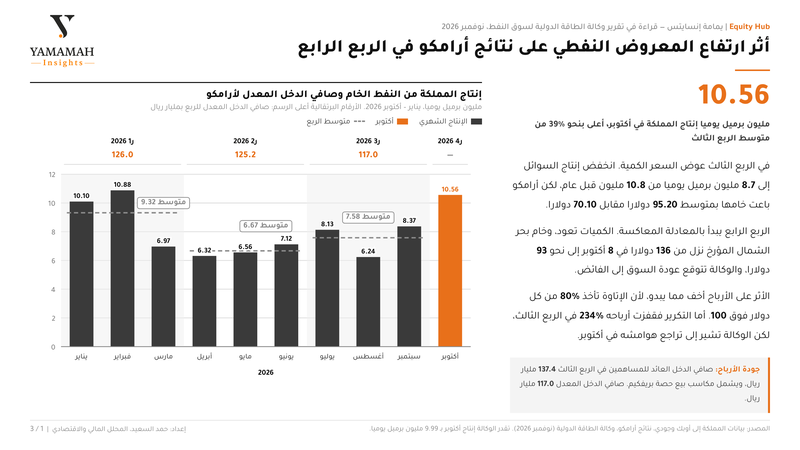
Student “Rabiah Almugait” @Rabiah Almugait began the analysis, saying: “I expect increased supply and lower oil prices could put pressure on Aramco’s revenue and profits in the fourth quarter, especially since a large part of its performance is linked to selling prices.
But strong production and sales volumes could soften the impact, so it’s important to look at cash flows, not just profits.”
Petrochemical margins and supply chain recovery
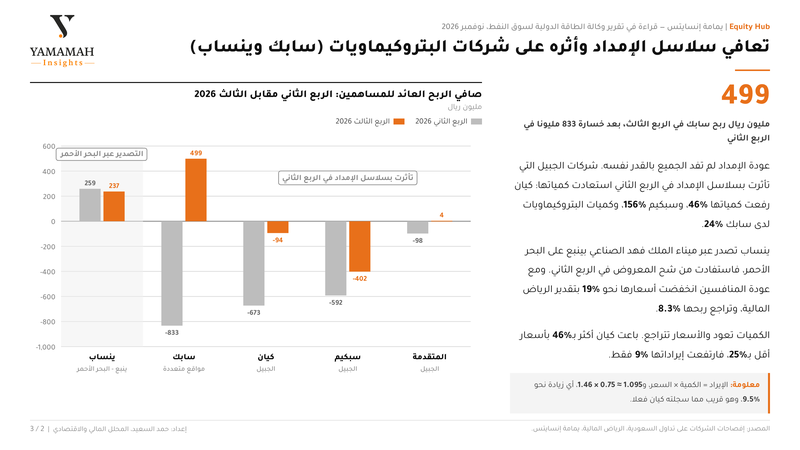
Student “Nouf Alojayan” @Nouf Alojayan discussed the effect of lower crude prices on manufacturing: “Supply chain recovery and lower oil prices could benefit petrochemical companies such as SABIC, because lower raw material and energy prices could help reduce production costs and improve profit margins, while cutting freight costs and delays.
With demand expected to grow in 2027, SABIC may regain healthier margins, but that still depends on global demand and prices for finished products.”
Uneven effects of prices and faster economic diversification
Student “Tala Alshabanat” @Tala Al shabanat analyzed how the impact varies by sector: “Higher oil supply could reduce Aramco’s profits by lowering prices, but its low costs help it maintain profitability.
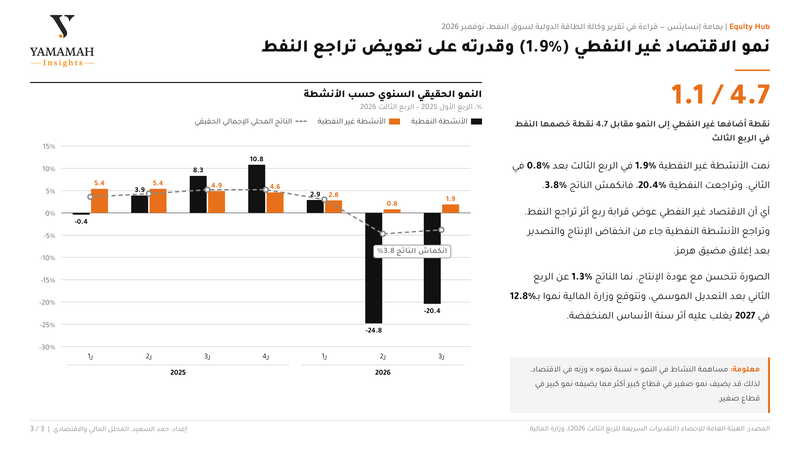
For SABIC and Yansab, better supply chains and lower raw material costs could boost margins. As for the non-oil economy, 1.9% growth is a positive sign of Saudi Arabia’s economic diversification, but it needs to grow faster to offset the decline in oil revenue.”
Economic stability and greater cost efficiency
Student “Jumanah Alshahri” @Jumana Alshehri commented on what the next phase will require: “Supply exceeding demand could affect Aramco’s fourth-quarter results, with revenue down from the third quarter, while SABIC and Yansab benefit from lower production costs.
Non-oil economic growth of 1.9% is a positive sign that diversification is working, but it alone cannot offset a major fall in oil revenue. The next phase depends on continued growth in non-oil sectors and companies managing costs more efficiently.”
Balancing profitability across energy and industry
Student “Dina Alarjani” @Dina Alarjani shared a brief view on the balance between sectors: “Lower oil prices could affect Aramco’s profits, while SABIC may benefit from lower costs.
I see non-oil sector growth as a positive sign, but it needs to grow faster to make up for declining oil revenue.”
Measuring economic resilience and creating added value
Student “Albatool Bedairi” @Albatool Bedairi highlighted the GDP figures: “Non-oil activity growth of 1.9% in the third quarter is a positive sign that economic activity continues, but it isn’t enough on its own to say the economy has made up for the decline in the oil sector, especially as real GDP fell 3.8% and oil activity contracted 20.4%.
Economic resilience is measured by the ability to create added value, jobs and sustainable revenue through expansion in industry, tourism and mining.”
The cost and selling-price gap in petrochemicals
Student @أناغي عطرجي discussed the equation behind margins: “Supply chain recovery and lower oil prices could ease raw material and freight costs for SABIC, but lower oil prices may also coincide with lower selling prices for petrochemical products.
The key is therefore the gap between production costs and selling prices, and how much SABIC can benefit from demand growth to increase sales volumes.”
Price pressures and reducing reliance on oil
Student “Rand Alkhalaf” @Rand Alkhalaf outlined the differing challenges: “Higher oil supply and lower prices could pressure Aramco’s fourth-quarter revenue, while lower raw material and freight costs could improve margins at SABIC and Yansab.
Non-oil economic growth of 1.9% is a positive sign of diversification and reduced reliance on oil, but it still needs to grow faster.”
Redistributing opportunities and government spending priorities
Student @ثناء الشايب offered an in-depth financial analysis: “Lower oil prices redistribute profit opportunities across sectors rather than threatening the entire economy; what pressures Aramco presents an opportunity for SABIC to improve its margins.
Non-oil sector growth of 1.9% also points to economic resilience. But diversifying GDP is not the same as diversifying government revenue. If oil prices remain low, it may prompt a reassessment of projects based on their investment returns and capital efficiency, improving the quality of investment.”
Testing free cash flow and the price spread
Student “Mohammed Almudbil” @Mohammed Almudbil outlined investment criteria: “I assess the impact of lower oil prices on Aramco by its ability to maintain free cash flow after capital spending and distributions.
For SABIC and Yansab, the key is the spread between production costs and petrochemical selling prices. Lower costs alone do not guarantee higher profitability if product prices fall as well.”
Economic resilience and offsetting export volumes
Student “Yazan Hamoud” @Yazan Hamoud discussed the impact of sales volumes: “Higher supply and lower oil prices could pressure Aramco’s fourth-quarter profits, but increased export volumes may offset some of the decline.
SABIC may benefit from lower freight and feedstock costs, provided selling prices hold. Meanwhile, non-oil sector growth signals resilience but will not fully make up for oil revenue.”
Identifying growth drivers and absorbing geopolitical shocks
Student “Ahmed Al Jadaan” @AHMED ALJADAAN examined the figures closely: “Non-oil activity growth of 1.9% amid war and the closure of the Strait of Hormuz, up from 0.8% in the second quarter, shows the domestic economy is resilient. But the figures show it is still far from fully offsetting oil shocks.
The non-oil sector added 1.1 percentage points to growth, while the oil sector’s 20.4% decline subtracted 4.7 points, leaving GDP down 3.8%. In other words, non-oil activity absorbed only a quarter of the shock.”
Resilient cash flows at $93 and feedstock driving demand
Student “Fahad Alruwaished” @Fahad Alruwaished detailed the report’s implications: “Brent’s 32% drop from $136 to $93 a barrel will pressure Aramco’s average selling prices in the fourth quarter, but $93 a barrel remains historically high and supports strong cash flows and stable distributions, thanks to record-low production costs.
For SABIC and Yansab, lower feedstock costs, alongside petrochemicals accounting for about 80% of demand growth in 2027, provide a double boost that should gradually lift margins.”
Generating sustainable revenue when crude prices fall
Student “Jana Alshahrani” @Jana Alshahrani emphasized how to measure real diversification: “Lower oil prices redistribute opportunities and risks. Aramco can ease the pressure by increasing sales and cutting costs, while SABIC will be watching the gap between production costs and selling prices.
In my view, the real measure of economic diversification is not simply growth in non-oil sectors, but their ability to generate sustainable revenue even when oil prices fall.”
Protecting margins and broadening the non-oil revenue base
Student “Nouf Alanazi” @Noof Alanazi commented on the path of economic expansion: “Higher oil supply may affect Aramco’s fourth-quarter revenue, while SABIC can benefit from lower oil prices and improved supply chains to reduce costs.
Meanwhile, non-oil economic growth reflects the ability of these activities to expand, but sustaining faster growth remains important to reducing reliance on oil.”
Companies’ ability to protect margins amid volatility
Colleague “Lujain Algorashi” @Lujain Algorashi summed up the market challenge: “Rising supply has varying effects: lower prices pressure Aramco, while SABIC and Yansab benefit from lower costs despite global competition.
In my view, the real challenge is not falling oil prices, but companies’ ability to protect profit margins and the economy’s ability to strengthen non-oil sources of income.”
The value of integrated refining, distribution and supply chains
Student @عمر الشيخ concluded the discussion with a broad perspective: “Brent’s fall to around $93 a barrel may pressure Aramco’s upstream business, but the impact also depends on production volumes and the performance of refining and distribution. A decline in profits does not necessarily mean weaker operating performance.
With ethane, naphtha and LPG expected to account for 80% of oil demand growth in 2027, petrochemicals are increasingly important. The 3.8% contraction in GDP also underscores the need to expand industry and tourism. Economic strength is measured by sectors’ ability to create added value and achieve sustainable growth.”
Higher oil exports support the government and Aramco, with mixed effects on other companies
Expert Abdulaziz Khrais says higher oil exports support the government in particular, as well as Aramco. He noted that, according to available data, oil exports have returned to pre-war levels, thanks to God and then the East-West Pipeline..
As for other companies, Khrais said it is difficult to equate higher oil prices with higher profits, especially since companies make different products and have at times experienced falling sales volumes despite higher selling prices. Some companies may also see costs rise, affecting profit margins.
Supply returning shifts the profit driver from price to volume
In an analysis, financial and economic analyst “Hamad Alsaeed” @Hamad Alsaeed adds:
“The IEA report, which announced that supply had exceeded demand for the first time since the war began, shifts the sector’s profit driver from price to volume. Aramco enters the fourth quarter with production approaching pre-crisis levels, while the rising rent absorbs most of the price decline above $100. Its $28.2 billion in free cash flow covers distributions with a comfortable margin.
In petrochemicals, the return of supply redistributes gains within the sector. Jubail-based companies are recovering volumes, as reflected in SABIC’s 24% increase in petrochemical volumes, while the price premium that benefited Yansab is shrinking.
At the macro level, the non-oil sector added 1.1 percentage points to growth, while oil subtracted 4.7 points. Expected growth in 2027 is tied mainly to a return in production, making cash flow quality—not price levels—the key measure for the next phase.”
 Ask Yamami
Comments (4)
No comments yet. Be the first to comment!