

The Saudi Ceramic Pipes Company announced the results of the extraordinary general assembly meeting (the third meeting) held on July 12, 2026 with an attendance rate of 14.383%, where shareholders decided to not approve the capital increase of the company by 80 million Saudi Riyals through the issuance of 8 million priority rights shares, and the consequent amendment of articles (7) and (8) of the company's bylaws.
The meeting also saw the rejection of amendments to articles (20) and (27) related to the powers of the board of directors and its additional powers, while the appointment of Mr. Saleh bin Badr Al-Sanai as an independent member of the board of directors was approved to complete the current council term, succeeding the previous member Dr. Muayad bin Issa Al-Qurtas.
Students from Al-Yamamah University discussed the implications of these results and the structural ramifications of costs as follows:
Implications of Funding Rejection and Governance Messages from Shareholders
Student @Shahad Al-Muhaysin opened the discussion with a structural analysis, stating: "In my opinion, the rejection of the capital increase despite the accumulated losses rising to 57% reflects that shareholders are not convinced that injecting new funds will solve the problem without a clear operational plan addressing the causes of the losses.
The council now has options such as restructuring the business, improving operational efficiency, selling non-core assets, or returning with a more convincing funding plan.
Moreover, making decisions of this magnitude with an attendance rate of 14.383% highlights the importance of shareholder participation in assemblies, as their decisions directly affect the future of the company.
The rejection of the capital increase along with the refusal to expand the board's powers is, in my view, a clear message from shareholders that there is a need to restore trust first through performance improvement and governance before requesting any funding or additional powers."
Operational Performance as a Prerequisite for Granting Powers and Funding
Student "Mohammad Alghaihab" @Mohammad Alghaihab commented from a temporal and investment perspective, saying: "I see that the rejection of the capital increase means that shareholders want to see actual improvement in the company before injecting any new funds.
In my view, the problem is not with the capital, but lies in the company's performance, so management is required to focus first on reducing losses and improving operations and presenting a clear plan that convinces shareholders.
As for the rejection of the amendment of the board's powers, I find it a clear message that shareholders are dissatisfied with the current situation and are looking to see results on the ground before granting management greater powers or approving critical decisions, and even if the attendance rate is low, as long as the assembly is legitimate, the decision remains binding."
The Impact of Structural Balances vs. Sustainable Growth Targets
Student @Fahad Al-Tayeb supported the analysis with a financial reading, stating: "From a solvency perspective, if the assembly had approved, then eliminating the accumulated losses by raising capital would have contributed to improving some financial indicators and alleviating pressures related to regulatory requirements, especially since the company is close to limits that necessitate regulatory actions.
It would also have given management a greater space to focus on growth and improving operations instead of being preoccupied with addressing the effects of previous losses.
Assuming the file of accumulated losses is closed, I believe the focus should have shifted directly to key operational indicators such as revenue growth, profit margins, operating cash flows, and cost management efficiency; these indicators reflect the real improvement in the company's performance and the sustainability of its results in the future.
For investors, if the step had been passed, it would have had a temporary positive psychological and moral effect by improving the appearance of the financial position, but investor confidence in the medium and long term will remain linked to the company's ability to achieve sustainable profits and improve its actual operational performance.
Therefore, I see that the success of this proposed path ultimately depends on what the upcoming financial results will show in terms of actual growth and profitability."
Regulatory Pressures and Company Continuity in the Market
Student "Ghada Al-Wallan" @Ghadah Alwallan analyzed the strategic and competitive dimension, stating: "In my opinion, the most important point here is that the rejection of the capital increase puts the company under time and regulatory pressure, as the accumulated losses exceeded 50% of the capital, which means that the issue is no longer just a funding decision but has become related to the company's continuity and market confidence in it.
What caught my attention is that the company was trying to address the losses through priority rights, but the shareholders' rejection may mean that the market needs a clearer plan before any new injection.
Therefore, in my opinion, the next phase must focus on two things: how will the company actually reduce its losses? And how will it convince shareholders that any future funding will not just cover previous losses, but will be the beginning of real operational improvement?"
Challenges of Funding Alternatives and Restoring Shareholder Confidence
Student "Rimas Al-Mashali" @Rimas Almashali concluded the analysis by stating the future dimensions, saying: "In my opinion, the rejection of the capital increase reflects that shareholders are not convinced that issuing priority rights is the best solution at this time, especially with accumulated losses exceeding 57% of the capital.
The challenge now is not only to provide liquidity but to present a convincing operational and financial plan that addresses the causes of the losses and restores shareholder confidence, otherwise the company may have to look for alternative funding or a different restructuring in the coming period."
A Reading of the Implications of the General Assembly's Rejection of the Capital Increase
In an analytical reading of the company's performance, financial and economic analyst "Hamad Al-Saeed" @Hamad Alsaeed stated: The rejection of the extraordinary general assembly held on July 12, 2026, for the proposed capital increase of 80 million Riyals through priority rights (despite the prior approval of the Capital Market Authority in April) represents a significant negative development that restricts the restructuring options available to the board of directors.
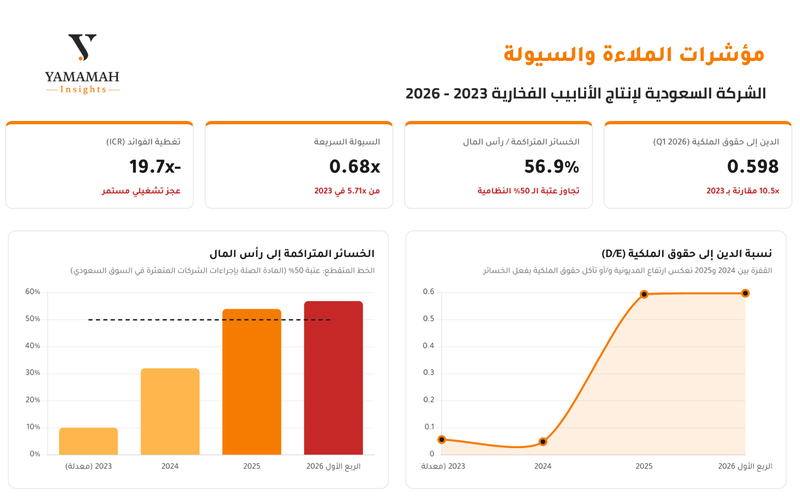
From a regulatory perspective, the company is now subject to the provisions of Article (132) of the Companies Law, after reaching accumulated losses of 85.3 million Riyals, equivalent to 56.9% of the capital, exceeding the regulatory threshold of 50%.
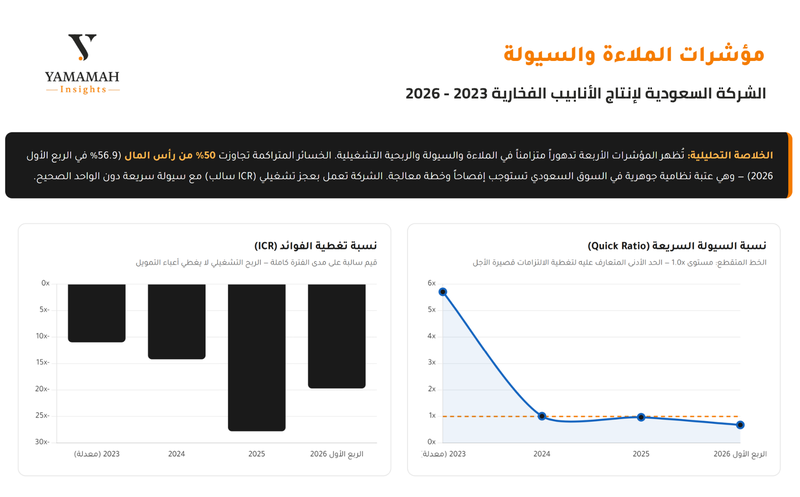
On the credit level, first-quarter 2026 data shows a structural shift in funding sources. The company moved from a debt-free balance sheet in 2023 to a bank debt of 38.7 million Riyals, raising the debt-to-equity ratio to 59.8% with equity eroding to 64.7 million Riyals. We note that this expansion in borrowing coincides with a quarterly operating loss of 3.9 million Riyals and negative interest coverage, indicating that funding is directed to cover operational deficits rather than to finance growth.
Liquidity indicators also reflect similar pressures. The quick ratio at 0.68 times with inventory valued at 31.7 million Riyals indicates a slowdown in the operating cycle and its transformation into a cash drain.
We read in the weak quorum (14.38%) an indication of the shareholders' caution regarding injecting additional capital in light of the current operational model.
Therefore, the board may consider reducing capital to extinguish losses, which is an accounting procedure that addresses the regulatory situation without providing the necessary liquidity, leaving the operational financing dilemma as the fundamental question facing the company.
Disclaimer: (This material was prepared under the supervision of the “Yamamah Insights” editor and with the assistance of artificial intelligence tools for financial education purposes, and does not constitute a recommendation to buy, sell, or hold any security, and it reflects the opinions of its authors and not the platform's opinion).


Comments (8)
No comments yet. Be the first to comment!