

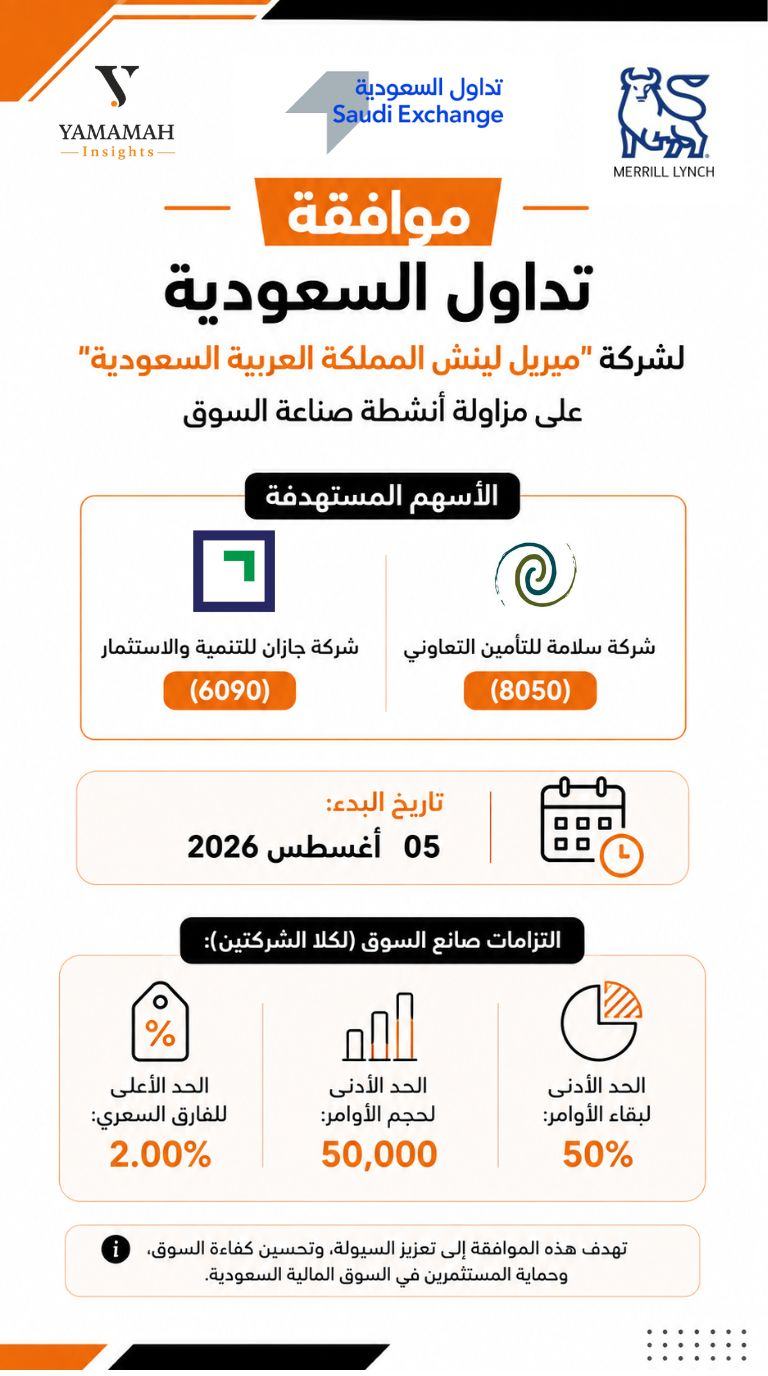
Saudi Exchange announced that it had approved Merrill Lynch Saudi Arabia to conduct market-making activities for the shares of Jazan Development and Investment Company (6090) and Salama Cooperative Insurance Company (8050), effective August 5, 2026.
According to the published information, "Merrill Lynch," as the market maker for both companies, is required to maintain a minimum order resting time of 50%, provide a minimum order size of SAR 50,000, and ensure that the maximum spread does not exceed 2.00%, with the aim of enhancing liquidity, improving market efficiency, and protecting investors.
The role of a market maker serves as the first safeguard for the stability and balance of stock movements on the trading screen. It intervenes to narrow the gap between buy and sell orders by providing continuous bids and offers at reasonable prices, preventing sharp price gaps in anticipation of any severe volatility.
This mechanism helps stimulate trading and gives investors confidence that they can execute their transactions immediately. Market-making firms, meanwhile, benefit from reductions in trading commissions as an incentive for their strict daily commitment to injecting liquidity and controlling prices.
Students at Al Yamamah University discussed the strategic implications of a market maker entering these two stocks and its impact on trading activity, as follows:
Improving the movement of less-liquid stocks depends on compliance with regulations
Student Rimas Almashali @Rimas Almashali explained her view, saying: "In my opinion, having a market maker helps improve stock movement by providing buy and sell orders and narrowing the spread between the bid and ask prices.
This makes it easier for investors to enter and exit the stock, particularly in less-liquid stocks.
However, its impact depends on the extent of order continuity and the market maker's compliance with the specified regulations."
A real test of the market-making model for small-cap stocks
Student Rana Alshamrani @Rana Alshamrani shared her view, stating: "The presence of a market maker for Jazan Development and Salama Insurance is an important step toward stimulating two stocks that suffer from relatively low liquidity. The maximum spread of 2% and the minimum order size of SAR 50,000 will help deepen the order book and reduce investors' entry and exit costs.
But the more important question is how effective this model will be with small-cap stocks in terms of market capitalization. Expanding market-making experience from large stocks, such as Aramco, to smaller stocks represents a clearer test of the market maker's ability to improve liquidity quality and pricing efficiency, rather than merely increasing trading volume."
Enhancing confidence and reducing volatility as a foundation for developing market efficiency
Student Jumana Alshehri @Jumana Alshehri noted: "In my view, a market maker plays an important role in improving trading activity because it continuously provides buy and sell orders. This increases stock liquidity and narrows the gap between the bid and ask prices. It also makes it easier for investors to enter and exit the stock more quickly and gives them greater confidence in their ability to execute their trades. The presence of a market maker also helps reduce volatility resulting from low liquidity, making the stock more attractive to investors.
In its absence, liquidity may decline and the gap between selling and buying prices may widen, making trading more difficult and potentially increasing speculation.
Therefore, I believe that expanding market making is a positive step toward developing the market and improving trading efficiency."
Fairer pricing and greater appeal aimed at institutional investors
Student @شهد المحيسن added: "In my opinion, a market maker plays an important role in enhancing trading efficiency because it continuously provides buy and sell orders and narrows the gap between supply and demand, making it easier for investors to enter and exit. Its presence also helps reduce volatility resulting from low liquidity and provides fairer pricing for the stock. I believe its greatest impact is seen in less-traded stocks, because increased liquidity makes them more attractive and boosts investor confidence, particularly that of the institutional investor."
Broader implications of a market maker entering stocks beyond the blue chips
In a deeper reading of the dimensions of this regulatory measure and its implications for the market mechanism, financial and economic analyst "Hamad Alsaeed" @Hamad Alsaeed explains: The news itself is a routine regulatory measure under the market-making framework in force at the Saudi Exchange for some time, but it carries significance that merits consideration in a broader context.
A market maker is contractually obligated to continuously display bid and ask prices within a maximum spread set by the Saudi Exchange. It is compensated through spread income and a commission discount ranging from 10% for highly liquid stocks to 100% for thinly traded stocks, according to each stock's classification among five liquidity categories. In other words, its financial incentive is tied to controlling the spread, not to the direction of the price, and it is not authorized to take directional positions or engage in speculation.
The broader significance concerns how this activity is distributed across stocks. It is worth noting that the number of licensed entities had been limited to only four institutions since the system was approved, with most concentrated in large, already highly liquid stocks such as Aramco, Al Rajhi, Alahli, and SABIC. Meanwhile, stocks with daily trading volumes below one million shares—the category that most genuinely needs narrower spreads—remained largely uncovered. Jazan Development and Salama Insurance fall outside the category of major blue-chip stocks, making this approval an additional data point worth monitoring rather than judging prematurely.
The real test will be the development of the spread and the turnover rates of the two stocks in the months after the market maker begins operating, compared with their levels before the approval—not the announcement itself.
Disclaimer: This material was prepared under the supervision of a “Yamama Insights” editor with the assistance of artificial intelligence tools for financial education purposes. It does not constitute a recommendation to buy, sell, or hold any security, and expresses the views of its authors, not those of the platform.


Comments (6)
No comments yet. Be the first to comment!