

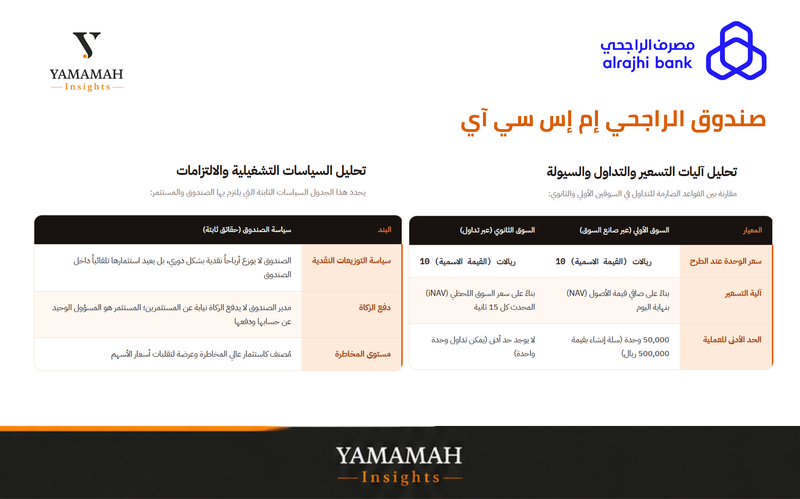
Saudi Exchange announced the listing and commencement of trading in units of the "Al Rajhi MSCI Saudi Equity ETF" as an exchange-traded index fund (ETF) on the Main Market, effective Monday, August 10, 2026.
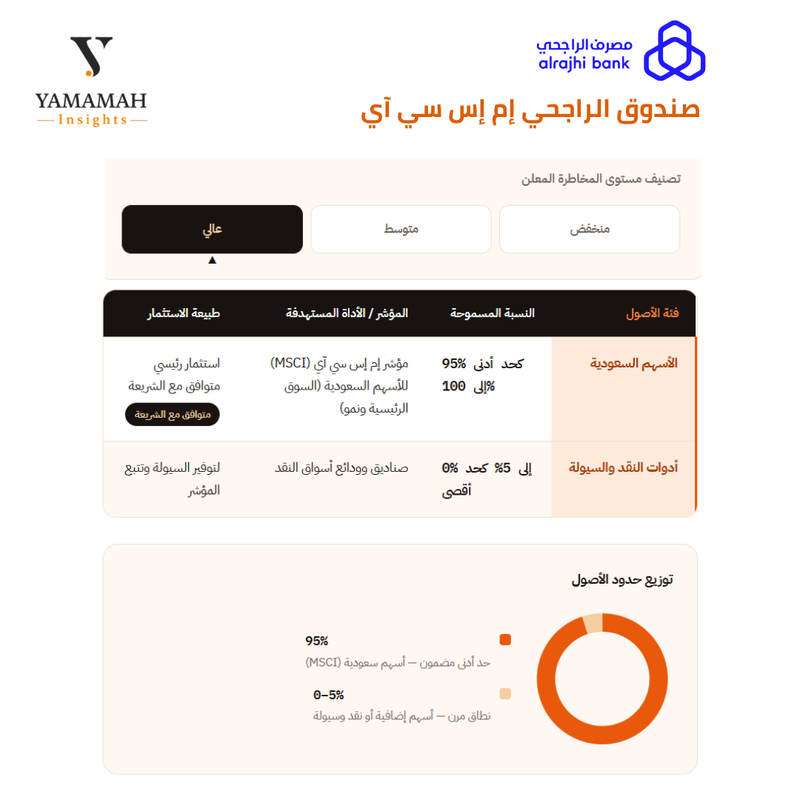
Al Rajhi Capital explained that the fund aims to track and replicate the performance of the "MSCI" (MSCI) index for Saudi equities that comply with Shariah standards, under ticker (9413) and with daily price fluctuation limits of +/- 10%.
The details indicated that the initial offering price was set at SAR 10, with a management fee of 0.25% annually deducted from net assets. A distinctive feature of the fund’s structure is that it uses passive management and has an accumulating structure; it automatically reinvests dividends distributed by companies within the fund instead of paying them out in cash, supporting capital growth.
The Capital Market Authority’s approval of the fund’s offering does not constitute an investment recommendation; investors must read the terms and conditions and understand the risks before making a decision.
In general, exchange-traded funds (ETFs) are a flexible investment tool that allows investors to purchase a diversified basket of stocks through a single trade, effectively helping to spread risk and reduce costs compared with buying individual stocks directly.
Students from Al Yamamah University discussed the implications of listing this fund and its impact on expanding investors’ options and mitigating risk through ETFs, as follows:
Diversification and reducing volatility
Our colleague "Abeer Altuwaijri" @Abeer Altuwaijri shared her view, saying: "I believe exchange-traded equity funds (ETFs) are a suitable option for new investors because they allow them to invest in a group of companies through a single fund rather than selecting each stock individually.
Diversification across several companies and sectors also helps spread risk, so that portfolio performance is not tied to a single company.
On the other hand, fund volatility may be less severe than that of some individual stocks, helping investors deal with market fluctuations more calmly and avoid hasty decisions driven by fear or anxiety."
The importance of understanding the index and reducing emotional decisions
Student "Mohammad Alghaihab" @Mohammad Alghaihab commented from an investment perspective, saying: "In my view, exchange-traded equity funds are suitable tools for investors who want to enter the market in a simpler and more diversified way, particularly beginners who lack the time or sufficient experience to analyze companies and select stocks individually.
However, diversification does not mean that the fund is risk-free; when the index declines, the fund will be affected, although the investor is less exposed to the risks of a single company.
With regard to the Al Rajhi MSCI fund, I believe the most important step before investing is to understand the index tracked by the fund, its components, the fees associated with it, and how well it aligns with the investor’s investment objective and risk tolerance."
Ease of trading and the challenge of investment discipline
In a related context, student "Arwa Alhuwaiti" @Arwa Alhuwaiti explained: "One of the key advantages of (ETFs) is that they give investors the opportunity to diversify across more than one company and sector through a single investment, which is particularly suitable for new investors who lack the time and experience to analyze companies separately.
At the same time, however, the ease of buying and selling may lead some investors to make hasty decisions when the market declines instead of benefiting from the idea of long-term investing. This is where investor awareness and understanding of their investment objective before choosing a fund become important."
Automatic reinvestment and understanding weighting concentration
Student "Rana Alshamrani" @Rana Alshamrani analyzed the fund’s structure, saying: "According to the official announcement, the fund has an accumulating structure; it automatically reinvests dividends distributed by companies within the fund instead of paying them out in cash. This supports the concept of long-term investing and reinforces investment discipline.
Although the fund simplifies execution and has an annual management fee of 0.25%, with no subscription or redemption fees, it does not eliminate the need for analysis. The index is market-cap weighted, meaning larger companies have higher weightings; consequently, the basket of stocks is not equally distributed. This requires investors to understand the index composition and its degree of sector concentration precisely."
Inclusiveness and dividend accumulation versus market risk
Student "Ghadah Alwallan" @Ghadah Alwallan highlighted the fund’s broad coverage, saying: "What stood out to me most about the listing of the Al Rajhi (MSCI) fund is that it gives investors exposure to a broad segment of the Saudi market through a single instrument covering large-, mid-, and small-cap companies, rather than requiring them to select each stock individually.
I believe that automatically reinvesting dividends is a strategic advantage for long-term investors, as it means returns are not limited to stock price movements but also benefit from the power of compounding returns.
At the same time, the fund’s performance remains linked to market performance and the index it tracks. Diversification reduces the risks associated with individual companies, but it certainly does not eliminate market risk."
Practicality and gradual investing for beginners
Student @شهد المحيسن shared her view, saying: "ETFs (ETFs) are an ideal option for new investors who lack the time or experience to analyze each company separately.
The idea of buying a diversified basket with the press of a button reduces reliance on a single stock, limiting the impact of any one company’s decline on the portfolio as a whole.
Long-term investing also helps investors look beyond daily fluctuations and avoid emotional decisions during downturns. In general, combining diversification, ease of trading, and low costs makes these funds a practical option for building a portfolio gradually, while recognizing that market risks remain and a fixed return is not guaranteed."
Ease of investing and staying free from emotion
Student "Jumana Alshehri" @Jumana Alshehri added: "I believe (ETFs) are highly suitable for new investors because they provide investment diversification instead of relying on a single stock, which effectively helps reduce risk.
They also track an index and trade just like stocks, combining ease of investing and diversification. By adopting a long-term investment approach, daily market fluctuations become less important, making it easier to make decisions free from emotion."
Broad-based investing and betting on market growth
Student "Rimas Almashali" @Rimas Almashali commented: "I believe the importance of listing the Al Rajhi (MSCI) fund lies not only in providing diversification, but also in making it easier to invest in a broader segment of Saudi companies.
This approach is particularly suitable for investors who believe in the long-term growth of the Saudi market but lack the time or expertise needed to select companies individually.
Ultimately, the success of investing in the fund will remain dependent on the performance of the companies that make up the index and the Saudi market’s ability to achieve sustainable growth."
A shift in behavior and deeper liquidity
In an analytical reading of the company’s performance, financial and economic analyst "Hamad Alsaeed" @Hamad Alsaeed explains: The ETF segment in the Saudi market is expanding at a noticeable pace, most recently with the listing of the Al Rajhi MSCI Saudi Equity ETF.
In my view, more important than the listing itself is how this expansion serves the objectives of the Financial Sector Development Program under Vision 2030. Funds improve investment efficiency by giving individuals the opportunity to gain exposure to a broad basket of companies of varying sizes through a single decision, reducing concentration risk in one or two stocks.
Funds also support market liquidity and depth through market-maker obligations, which require the presence of orders within a limited spread. This adds continuous trading activity to the fund units and their underlying stocks.
The most important aspect here is strengthening investment awareness. These products gradually shift individual investors from a culture of daily speculation toward thinking in terms of indices, sectors, and long-term investing—a behavioral and savings-oriented transition no less important than the return itself.
We believe the expansion of these financial products will create positive competition, which will eventually be reflected in lower fees and a wider range of investment options. It will also support market liquidity and reduce unsystematic risk. This does not mean that they are risk-free, as the market remains significantly exposed to systematic risks.
Disclaimer: This material was prepared under the supervision of a “Yamamah Insights” editor and with the assistance of artificial intelligence tools for financial education purposes. It does not constitute a recommendation to buy, sell, or hold any security, and it reflects the views of its contributors rather than those of the platform.


Comments (0)
No comments yet. Be the first to comment!