

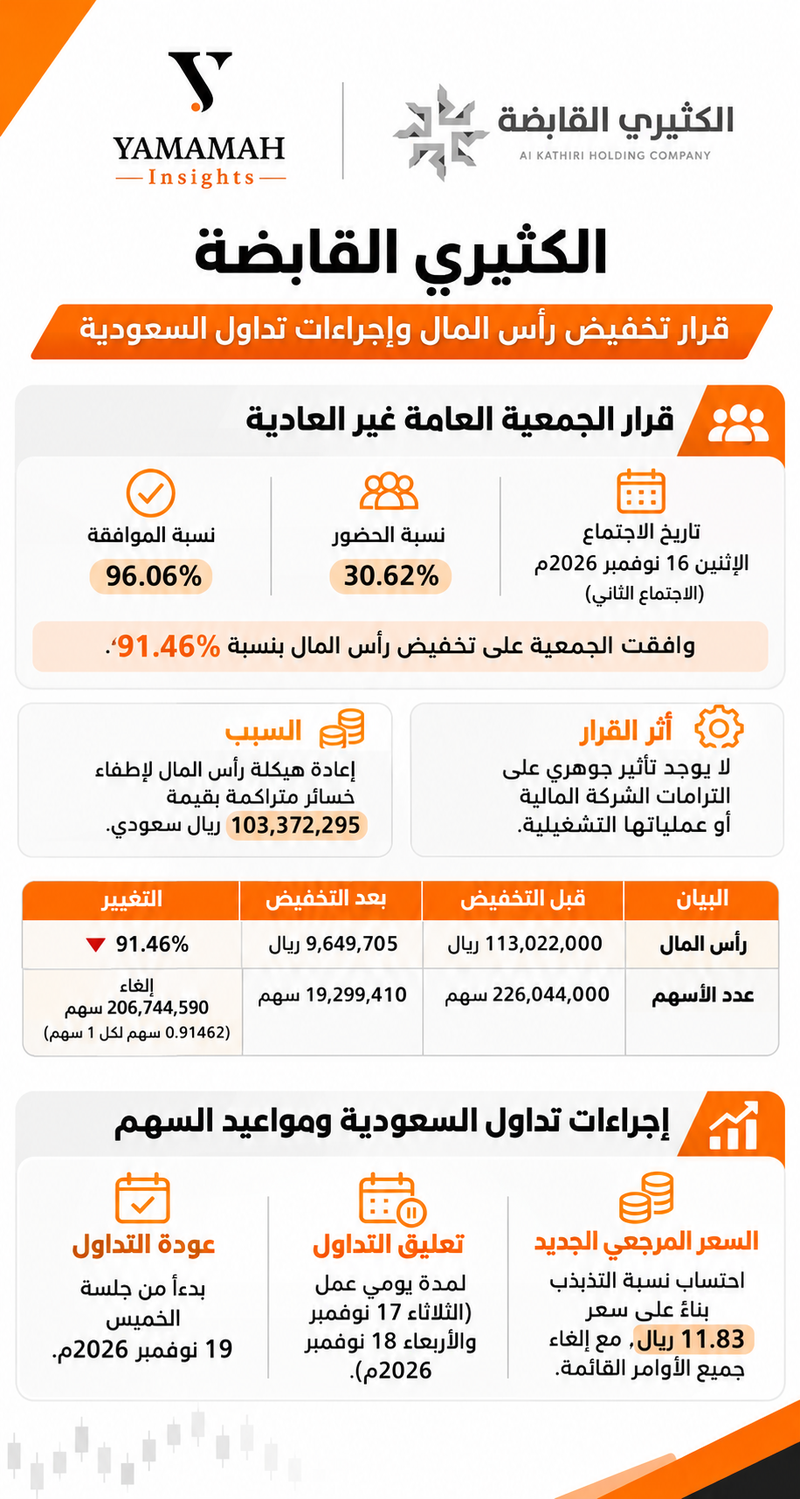
Al Kathiri Holding Company announced that shareholders at an extraordinary general assembly approved a 91.46% reduction in the company’s capital, as part of a strategic financial restructuring.
Under the decision, capital will fall from SAR 113.02 million to about SAR 9.64 million by canceling 206.74 million shares, reducing the total number of shares to 19.29 million.
The key aim is to write off accumulated losses of SAR 103.37 million, with no effect on the company’s financial obligations or operations.
In response, Saudi Exchange (Tadawul) announced that the share’s price fluctuation limit would be calculated using a price of SAR 11.83, and all outstanding orders would be canceled.
Trading in the share will also be suspended for two business days starting Tuesday, November 17, 2026, while the Securities Depository Center Company (Edaa) implements the reduction in shareholders’ portfolios. Trading is scheduled to resume at the close of Wednesday, November 18, 2026.
Students from Al Yamamah University discussed the financial implications of the restructuring, and how the capital reduction and reference-price adjustment could affect the company’s stability and shareholders’ future prospects:
Identify the causes of losses before addressing their accounting impact
Student Dina Alarjani @Dina Alarjani shared her view: "In my opinion, reducing capital helps the company eliminate accumulated losses, but that does not mean its financial position has actually improved.
I believe the reduction is very large and reflects the scale of the losses the company has faced.
The priority, then, is to identify what caused these losses and improve operating performance so they do not recur."
Restoring financial balance depends on higher revenue and tighter cost control
Student Nouf Alojayan @Nouf Alojayan offered her perspective: "Writing off losses for accounting purposes means restructuring capital to cover accumulated losses without injecting new funds. The aim is to improve the appearance of the financial statements and restore balance to shareholders’ equity.
Companies take this step when losses build up significantly and affect their financial position. It also clears past book losses and prepares the company for a new phase.
But it is important to clarify that reducing capital does not bring new cash into the company or actually improve its performance; it is an accounting and regulatory measure.
The success of this step therefore depends on the company’s ability to address the causes of its losses, increase revenue and control operating expenses, so losses do not recur and the company can achieve sustainable growth and regain investor confidence."
Shareholders’ equity structure and cash returns after the reduction
Student Mohammed Almudbil @Mohammed Almudbil said: "In my view, the key issue with a capital reduction is not just writing off accumulated losses, but how shareholders’ equity will change afterward and whether the company can finance itself in the future.
A major reduction lowers the number of shares and reorganizes the balance sheet, but does not create new economic value by itself.
As an investor, I would watch whether the company can improve cash flows and stop eroding its equity after the reduction, or whether it may later need a capital increase and additional funding if losses continue.
In my opinion, the real test of the restructuring will come after several financial periods: have operations returned to generating sustainable profits and cash flows? Is the new capital appropriate for the size of the business? Without operational improvement, losses could build up again even after being written off."
Accounting restructuring is only a start; efficiency and profitability must improve
Student Halah Alalsheikh @Halah Alalsheikh added: "I believe writing off losses is the start of restructuring, not the final solution.
Real success depends on improving operations, managing resources more efficiently and increasing profitability.
A company may clear its losses on paper, but it will incur new ones if it does not address the causes of the problem."
Price-and-share adjustment and the challenge of sustainability after losses are cleared
Student Rabiah Almugait @Rabiah Almugait said: "A capital reduction helps the company write off accumulated losses and reorganize shareholders’ equity for accounting purposes. But, by itself, it does not mean the financial position has improved or that the company has returned to profitability.
For shareholders, the reduction in the number of shares is matched by an adjustment to the share price, leaving the portfolio’s total value unchanged at the time of implementation.
In my view, Al Kathiri’s biggest challenge is improving operating performance and addressing the causes of past losses.
The success of the restructuring depends on the company’s ability to earn sustainable profits in the future, not simply to clear book losses."
Real recovery requires addressing the root causes of losses, not just the figures
Colleague Lujain Algorashi @Lujain Algorashi said: "In my view, reducing Al Kathiri’s capital is an accounting measure to address accumulated losses and reorganize equity, but it does not bring new cash into the company.
For shareholders, the number of shares in their portfolios will fall, matched by a higher share price, so the total portfolio value theoretically remains the same when the adjustment is implemented.
What matters most to me is what happens after the reduction: addressing losses on paper alone is not enough for recovery.
The company must address the causes of its losses, improve operating performance and turn this starting point into better, more sustainable financial results."
A steep reduction signals the need to review root causes
Student @Thanaa Alshaib shared her view: "In my opinion, Al Kathiri Holding Company’s 91.46% capital reduction raises questions about how accumulated losses reached this level.
The reduction is more of an accounting adjustment than a solution to the underlying problem. It may help the company reorganize its financial position, but what matters most is whether it can address the causes of these losses.
I believe investor confidence will not be restored simply by writing off losses; the company needs to show a clear improvement in operating performance and results in the coming periods."
Reference-price adjustment and its effect on portfolios’ theoretical value
Student Jana Alshahrani @Jana Alshahrani said: "I believe reducing Al Kathiri’s capital addresses losses for accounting purposes, but does not add cash or mean the company has actually recovered.
For shareholders, the number of shares falls and the reference price is adjusted, so the theoretical value of their holdings remains the same at the moment of adjustment. A higher price is not, in itself, a profit.
In my view, the large reduction underscores the need for a plan to address the causes of the losses. Its success will be evident in improved profits and cash flows in the coming periods; writing off past losses will not prevent them from recurring if the same problems persist."
Cash-flow pressures and the erosion of shareholders’ equity
Student Haifa Almutairi @Haifa Almutairi added: "In my view, Al Kathiri Holding Company’s 91.46% capital reduction is merely an ‘accounting makeover’ to write off more than SAR 103 million in accumulated losses, without injecting real cash into the company.
Although this measure restructures shareholders’ equity and keeps portfolio value unchanged at implementation by reducing the number of shares while raising the reference share price to SAR 11.83, it does not resolve the severe cash-flow crisis or falling revenue.
Clearing book losses alone is not enough to start afresh, especially as further losses in the third quarter again eroded shareholders’ equity.
The real challenge—and what will determine the company’s survival—is fixing troubled operations and stopping the root causes of losses, not merely erasing figures on paper.
Investors should therefore remain cautious about the share until management proves it can deliver sustainable operating profits or complete a rights issue to strengthen the company’s financial position."
Avoiding regulatory warnings and the challenge of a reduced capital base
Student Fay Aldossari @Fay Aldossari said: "Writing off losses (a book clean-up): accumulated losses of SAR 103 million are written off by reducing capital, with no cash flow. The aim is to keep the company clear of warning procedures under Article 132 and prepare its balance sheet to attract financing or distribute profits in the future.
Effect of canceling shares (price neutrality): canceling 91.46% of the shares leaves you with only 8.54% of your shares, but the share price automatically rises to SAR 11.83. Your portfolio’s total value and ownership percentage therefore remain unchanged at the time of implementation.
Assessing the move (91.46%): the massive reduction addresses only the ‘accounting symptoms’ and does not solve the problem. With a new, smaller capital base of SAR 9.65 million, any future loss could send the company back into the same cycle unless it fixes operations and controls costs to achieve sustainable profits."
Cost control and profitability are the real measures of success
Student Rahaf Alanazi @Rahaf Alanazi said: "I believe reducing Al Kathiri’s capital is an important step in addressing its financial position. Writing off accumulated losses helps improve the company’s financial position for accounting purposes and present clearer financial statements, but does not necessarily mean the company has become profitable.
For shareholders, the lower number of shares is matched by a roughly equivalent rise in the share price, leaving the portfolio’s total value unchanged when the reduction is implemented. This does not mean shareholders have made an actual profit.
In my view, the company’s biggest challenge is not just clearing book losses, but improving operating performance, increasing revenue and controlling expenses.
The company’s real success will be measured by its ability to achieve sustainable profits and avoid future losses."
Cash-flow drain and the impact of weaker core operating segments
Student Ahmed Al Jadaan @AHMED ALJADAAN shared his view: "Reducing 91.46% of capital is an extremely large cut and reflects the severe financial drain the company has faced in recent years.
Although the write-off cleaned up the balance sheet for accounting purposes and temporarily raised the share price, it does not solve the ‘root problem.’
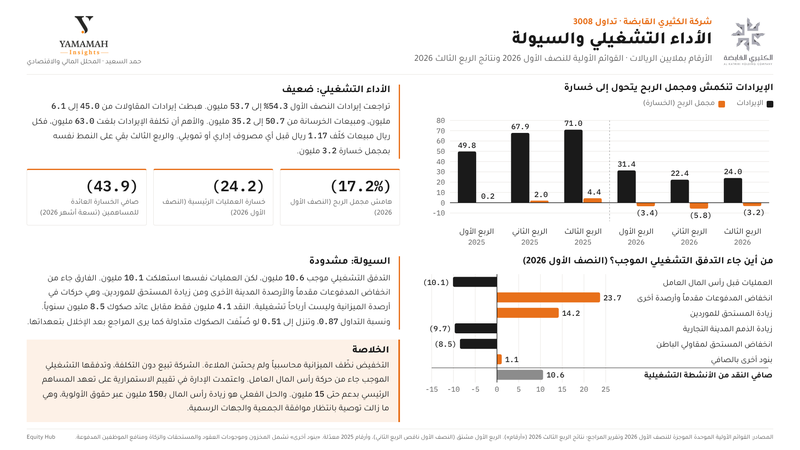
Al Kathiri’s real challenge now is not its book figures but its ‘operating performance.’ The company is seeing lower revenue from contracting and ready-mix concrete sales, and is posting consecutive operating losses.
Cleaning up the balance sheet without boosting sales and stopping the cash drain means losses could build up again."
Offsetting negative balances improves the financial position without real cash inflows
Student @Anaghi Atarji said: "I believe reducing Al Kathiri’s capital from SAR 113 million to SAR 9.65 million is intended to write off accumulated losses for accounting purposes by reducing capital against the loss balance in shareholders’ equity.
This step helps the company reorganize its financial position, but it adds no cash and does not address the causes of the losses.
In my opinion, the real challenge is improving operating performance and achieving sustainable profits to prevent the same problem from recurring."
Balancing the books and raising revenue to prevent losses from returning
Student Jumana Alshehri @Jumana Alshehri added: "Al Kathiri’s capital reduction was intended to write off accumulated losses and restructure its financial position. Writing off losses for accounting purposes means reducing capital to offset losses; it does not mean new money enters the company.
For shareholders, the lower number of shares is matched by a rise in the share price to SAR 11.83, leaving the total portfolio value unchanged when the reduction is implemented.
In my opinion, although reducing capital is an important step toward improving the financial position, it is not enough by itself. The company must improve operating performance, increase revenue and control expenses to prevent future losses."
Financial neutrality and the automatic rise in the reference price
Student Dana Alsadoun @Dana Alsadoun said: "In my view, canceling shares and adjusting their price does not affect shareholders’ wealth or reduce their portfolios at the time of implementation, because the process follows the principle of financial neutrality.
For example, if my portfolio held 1,000 shares at SAR 1.01 each, worth a total of SAR 1,010, canceling about 91.46% of the shares would leave me with only about 85 shares.
But Tadawul will automatically raise the share’s reference price to SAR 11.83. As a result, my portfolio’s total value will remain exactly SAR 1,010 at the moment the change takes effect. The real challenge will be how the share performs in the market after trading resumes."
Preparing for a capital increase by clearing the accumulated-loss balance Student Fahad Alruwaished said: "In my opinion, Al Kathiri Holding Company’s decision to reduce capital by 91.46%, from SAR 113.02 million to SAR 9.64 million, to write off SAR 103.37 million in accumulated losses is an accounting measure to clean up the balance sheet and clear the loss balance, preparing the company for a new phase or a future capital increase without regulatory restrictions.
For shareholders, canceling 206.74 million shares (about 0.91462 shares per share) is matched by an automatic adjustment of the reference price to SAR 11.83, keeping the portfolio’s total market value unchanged at implementation because the higher price offsets the lower share count.
Given that the reduction exceeds nine-tenths of capital, it remains a book restructuring and does not materially affect financial obligations. The fundamental challenge is to fix operations and improve efficiency to prevent losses from recurring."
Rising costs and falling revenue point to ongoing challenges
Student Albatool Bedairi @Albatool Bedairi shared her view: "I believe such a large capital reduction reflects the scale of the company’s financial challenges, but it is not enough to signal the start of a recovery.
In particular, accumulated losses continued to rise through September 2026, exceeding SAR 113 million.
In my view, the real challenge is not writing off losses for accounting purposes, but addressing their causes, including lower revenue and higher costs. As an investor, I will focus on improvements in profit margins and cash flows, and on the company’s ability to return to sustainable profitability before considering the restructuring a success."
The gap between liabilities and equity and the need for rights-issue financing
Student Mohammad Alghaihab @Mohammad Alghaihab said: "I believe Al Kathiri’s 91.46% capital reduction reflects the scale of the financial challenges it has faced, especially as accumulated losses reached SAR 103.4 million.
But it is important to understand that writing off these losses is only an accounting measure. The decision itself brings no new cash into the company and does not improve operating performance.
For shareholders, the reference price rising to SAR 11.83 after the reduction does not mean they have made a profit, because the number of shares in their portfolios has fallen by roughly the same proportion. The investment’s total theoretical value therefore remains unchanged when the measure is implemented, before any subsequent price movements.
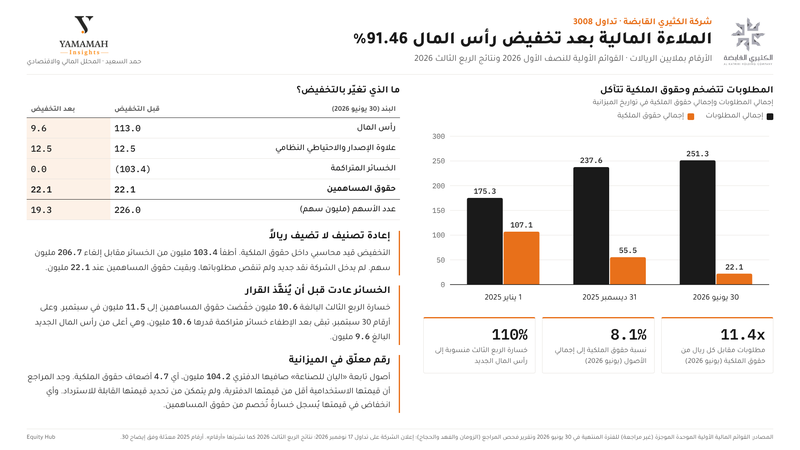
What caught my attention most was the company’s operating position: first-half 2026 revenue fell by 54.3%, and shareholders’ equity stood at just SAR 22.1 million, compared with liabilities of SAR 251.3 million at the end of June.
I believe the problem goes beyond accumulated losses. The company needs to address weak revenue, profitability and liquidity, not merely adjust balance-sheet figures.
In my view, the real test for Al Kathiri begins after the capital reduction, not before. The company has indicated a possible SAR 150 million capital increase through a rights issue. If completed, this could provide new funding, but it also means the company needs additional capital support.
For me, restructuring success is not measured by the amount of losses written off, but by the company’s ability to stop losses, improve cash flows and return to sustainable operating profits."
Repricing supply and demand and resolving operating bottlenecks
Student Omar Al Sheikh @Omar Al Sheikh concluded the analysis: "Some of a shareholder’s shares are canceled, and the reference share price is adjusted to reflect the reduction. In Al Kathiri’s case, about 91.46% of the shares will be canceled and the reference price adjusted to SAR 11.83.
The portfolio’s total value is theoretically unchanged at the moment of adjustment, as the lower number of shares is offset by a higher reference price. But this does not guarantee that market value will remain stable after trading resumes, since the price will be affected by supply and demand.
I therefore do not believe writing off losses alone is enough: it addresses the accounting impact, not the operational cause. The company needs to increase revenue, control costs, and improve project execution and resource utilization.
From an industrial engineering perspective, resolving operational bottlenecks, improving productivity and monitoring costs may matter more in the long run than merely restructuring capital."
Solvency and equity: book figures versus the need for additional financing
In an analytical assessment, financial and economic analyst "Hamad Alsaeed" @Hamad Alsaeed added: Many companies emerge from a capital reduction with a cleaner balance sheet; few emerge with a stronger operating model. Al Kathiri Holding’s 91.46% capital reduction rearranged shareholders’ equity on paper without changing its value of SAR 22.1 million at the end of June, against liabilities exceeding SAR 251 million.
The pressure lies in operations: revenue costs exceeded sales in the first half amid a sharp decline in contracting revenue, while positive operating cash flow came from working-capital movements rather than profitability. Notably, the third-quarter loss has already exceeded the new capital. This makes the proposed SAR 150 million rights issue crucial to strengthening solvency, alongside the results of the strategic review the company commissioned and a return to a positive gross profit margin—both necessary for sustainable recovery.
 Ask Yamami
Comments (7)
No comments yet. Be the first to comment!