

The Dilemma of Sustainable Urban Development
Major global cities face a continuous challenge of balancing capital-driven urban expansion with preservation of the urban environment and historical heritage. This dilemma stands out clearly in recent news reports, most recently when the City of London approved the investment project "One Silk Street", which involves demolishing an old building and constructing two towers at heights of (20 and 16 stories) to increase office and commercial space, despite recording over 1,000 formal objections from local residents and heritage protection organizations.
For us in the environmental economics department at Al Yamamah University, this news does not represent merely a planning event in a foggy capital, but rather a living "case study" that embodies the economic concepts and theories we study, and reveals how decision-makers make their choices when investment benefits collide with social and environmental costs to the public.
What is the Urban Environment in Environmental Economics?
The environment in our economic concept is not limited to forests and rivers; it includes the "built environment" within cities. Natural light, sound tranquility, visual coherence, and the preservation of archaeological and heritage sites (such as the nearby Barbican complex, classified as a Grade II listed site) are all environmental assets and public benefits with non-tangible economic and social value.
Theoretical Analysis of the Case: Negative Externalities
The concept of externalities is the cornerstone in explaining the dispute over the "One Silk Street" project. When development companies construct towering buildings, they achieve private investment and economic returns. In return, residents of the adjacent "Barbican" complex bear uncompensated costs (negative externalities) such as: blocking light and sunshine, increasing visual and noise pollution during construction and operation, and distorting the historical architectural identity of their area.
In the absence of regulatory intervention, this situation leads to market failure; because the marginal private cost to the developer is less than the marginal social cost, expressed mathematically as follows:
Social Cost (SMC) > Private Cost (PMC)
This difference represents the "external cost" that the project imposes on society without the developer paying for it, explaining the flood of over 1,000 objections from affected citizens defending their environmental and living rights.
Decision-Making Tool: Social Cost-Benefit Analysis
The report issued by municipal officials, totaling 571 pages, demonstrates explicit use of the cost-benefit analysis (CBA) tool. The report concluded with a decisive balance that justified approval of the project:
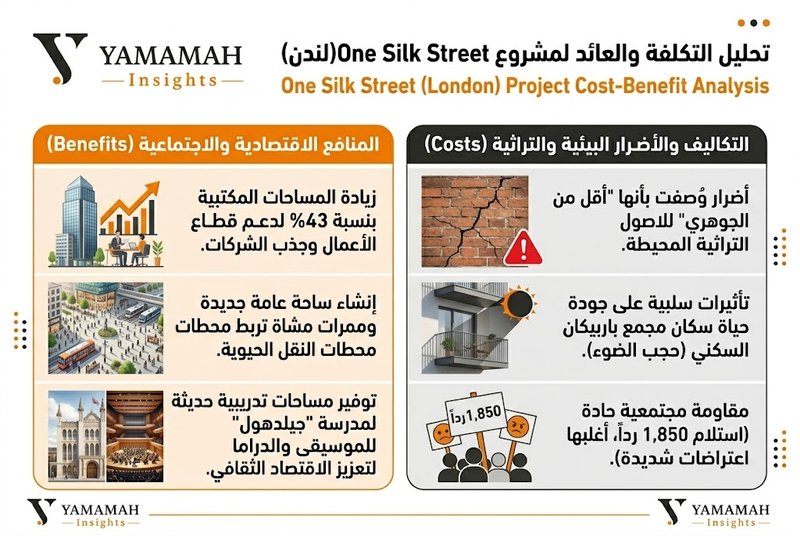
From the environmental economics perspective, authorities approved it because they considered "total expected benefits exceed marginal harms", an application of the Kaldor-Hicks efficiency principle, where economic gains can theoretically cover environmental and social harms, even if affected parties are not directly compensated.
Design Flexibility as a Mechanism to Reach the Optimal Solution (Optimal Level of Degradation)
Environmental economics focuses on the idea that "zero pollution" or "zero harm" cannot be achieved if we want development to continue, but the goal is to reach the environmentally and economically optimal level.
Developers backed away from the original design (which required building two 20-story towers) to become (a 20-story tower and a 16-story tower) in response to protests. This retreat represents an attempt to reduce the marginal benefit lost to society while maintaining project investment viability. However, neighborhood representatives believe the current design still represents a "troublesome neighbor", meaning the balance has not yet reached full community satisfaction, and municipal regulatory power determined the outcome in favor of investment.
As future environmental economists and decision-makers in the Kingdom of Saudi Arabia, the "One Silk Street" case grants us important analytical dimensions that can be applied to our accelerated development reality within Saudi Vision 2030:
- Valuing Non-Market Assets: How can we measure the economic value of the visual appearance and heritage of a historic neighborhood? (such as Jeddah's old town development or Al Diriyah's gateway projects), and what modern economic tools (such as Contingent Valuation surveys or Hedonic Pricing) are suitable for valuing these assets?
- Vertical Development and Resource Efficiency: Vertical construction saves land and limits horizontal urban sprawl (reducing transportation emissions and protecting open environment), but simultaneously creates environmental and visual density and pressure on infrastructure at a single point. How do we economically balance these two advantages?
- Importance of Environmental Governance and Community Participation: The British model demonstrates how organized objections can force major investment developers to modify their designs, lower heights, and provide public and cultural spaces as a form of "environmental and community compensation".

Comments (8)
No comments yet. Be the first to comment!