

Every morning, millions around the world, perhaps including you, pass by to buy a cup of coffee and a donut from Dunkin', or grab a quick meal from Arby's. To the average consumer, it's just a moment of daily enjoyment; but behind the scenes of the world of finance and business, these accumulated moments represent the engine of a massive financial empire preparing now to make one of the biggest jumps in the history of the American stock market.
Here is the complete story behind the company that owns Dunkin' seeking to list its shares publicly, and what that means in simplified economic language.
News Details: A Secret Step Toward Public Markets
'Inspire Brands' — the large umbrella under which a group of the world's most famous fast-food restaurant chains operate — announced that it has filed a 'confidential' application with the US Securities and Exchange Commission for an Initial Public Offering (IPO).
Strategic objective: Roark Capital, the private equity firm backing Inspire, is seeking to reach a company valuation of approximately $20 billion when its shares begin trading.
The Shadow Empire: What Is Inspire Brands?
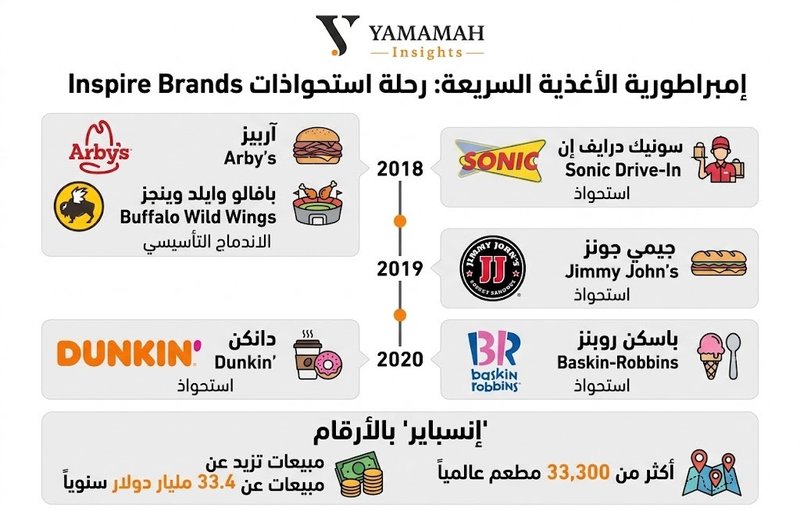
The name 'Inspire Brands' may not be familiar to the average person, but its brands are present in every corner. This company was founded as a holding entity in 2018 and began devouring major brands one after another.
A look at the empire's size today:
- Annual sales volume: More than $33.4 billion.
- Number of locations: More than 33,300 locations worldwide.
Why an IPO? And why 'confidentially'?
To read this news with the mindset of an economic analyst, we must break down the three main dimensions of this move:
The 'Confidential Filing' Tactic
Why did the company file the application confidentially? In the corporate world, confidential filing is a legal procedure that allows a company to submit its financial documents and plans to regulatory bodies for review, without having to disclose these details to the media or competitors (like Starbucks or McDonald's) until a few weeks before the actual share sale begins. This gives the company greater flexibility to withdraw if market conditions deteriorate without making a fuss.
The Lifecycle of 'Private Equity'
The story of Inspire is a classic example of how money giants (private equity firms) work. In 2020, Roark Capital bought the Dunkin' chain and its sister company Baskin Robbins for $11 billion, transforming it from a 'public' company (whose shares are sold to the public) to a 'private' company (owned by a limited number of investors).
Over the past years, it restructured the company, merged it with other restaurants to reduce costs and increase profits, and now is relisting it to the public at a combined value that could reach $20 billion, reaping enormous profits from the development spread.
Debt Repayment
The statement was clear: the money raised from selling shares to the public will be used primarily for 'debt repayment.' The massive acquisitions the company made over the past years were largely financed through multi-billion-dollar loans (Term Loans). An IPO is the smartest way to use new investor money to clean the company's balance sheet from the burden of interest and debt.
Impact and Implications: What Does This Mean for the General Market?
This announcement comes at a critical time for global capital markets.
- Breaking the ice: The US IPO market has suffered from stagnation in recent periods due to economic fluctuations and concerns about inflation, in addition to poor performance of some recently listed companies.
- Return of confidence: Inspire Brands' move — coinciding with preparations by other major companies such as Jersey Mike's and even SpaceX — is a strong signal that investor appetite has returned, and the market is beginning to emerge from a cautious phase into a new phase of money injection.
The next time you stand in line at Dunkin', remember that you are not just a customer buying coffee; you are a gear in a giant economic machine, contributing billions in revenue, and playing a role in determining the value of shares that will soon be traded on Wall Street screens. This is the magic of economics; it connects our simplest daily habits with the biggest financial decisions in the world.

Comments (4)
No comments yet. Be the first to comment!