

As Generation Z (Gen Z) continues to flow into the job market, Human Resources departments find themselves facing an unprecedented challenge: the old rules for attracting and retaining talent no longer work. This generation, which grew up amid consecutive economic crises and a global pandemic, is reshaping the "psychological contract" in the work environment, shifting focus from "absolute company loyalty" to "strict work-life balance".
A Generation of "Working to Live": The End of Job Burnout
For decades, talent retention strategies relied on a simple equation: a salary increase in exchange for an increase in tasks and responsibilities. Today, Generation Z categorically rejects this equation.
The SHRM report indicates that this generation evaluates the return on investment (ROI) of its personal effort with strict precision. Luke Gueiting explains this mentality by saying: "The young employee will evaluate a promotion opportunity and say: a 10% to 20% increase looks good, but in exchange for an increase in workload of 50% to 100%? No thanks, I'll stay put".
This behavioral shift does not stem from laziness, but from a harsh economic legacy. This generation witnessed the aftermath of the 2008 financial crisis, saw how previous generations lost their jobs after decades of loyalty, and how compensation and benefits were cut. The result? A loss of trust in the idea of traditional "job security", and a shift toward protecting employee mental health as a non-negotiable priority.
Beyond the Paycheck: How Does Gen Z Redefine "Total Rewards"?
To understand how to attract this generation, leaders of organizational design and change management must realize that salary is just the starting line, not the end point. New aspirations can be summarized in three main axes:
- Absolute Flexibility (Hybrid Work): Physical presence at the office is no longer evidence of productivity. The absence of major financial commitments (such as mortgage loans) gives Generation Z high flexibility to leave strict work environments and move toward freelancing to diversify income sources.
- Mental Health as a Fundamental Right: This generation enters the job market with the lowest mental health indicators compared to previous generations. Therefore, mental health support programs are no longer an "added perk", but are fundamental infrastructure in human resources strategy.
- Value Alignment (Person-Organization Fit): Generation Z does not just seek profitable companies, but organizations that align with their principles (Purpose-Driven). They scrutinize company policies regarding environmental sustainability, worker rights, and diversity and inclusion (DEI) initiatives.
Empirical Leadership Guide: How Can Human Resources Keep Pace With This Change?
To maintain competitive advantage in the job market, experts recommend restructuring talent management through the following steps:
- Digitizing Recruitment and Hiring: Get rid of long, boring job descriptions. Adopt short visual content (Micro-Video Content) similar to TikTok platforms to reflect the company's real culture in 30 seconds.
- Reengineering Promotions: Promotions must be aligned with employee capabilities to avoid job burnout. Salary increases must be proportional to increases in tasks without compromising employee quality of life.
- Bridging the "Soft Skills" Gap: Due to the pandemic's impact and heavy reliance on technology, some Gen Z youth lack direct communication skills. Training and development departments (L&D) are tasked with providing programs to promote "power skills" such as emotional intelligence, workplace etiquette, and conflict resolution.
By the Numbers: Where Does Generation Z Diverge From Millennials?
To understand the scale of the gap facing human resources departments, we must look at numbers. Despite the generations' temporal proximity, their response to work incentives differs drastically. While "Millennials" tried to adapt to hustle culture to achieve financial stability, "Generation Z" seeks to dismantle this culture entirely.
The following table illustrates the most significant differences in job motivation based on modern labor market trend analysis:
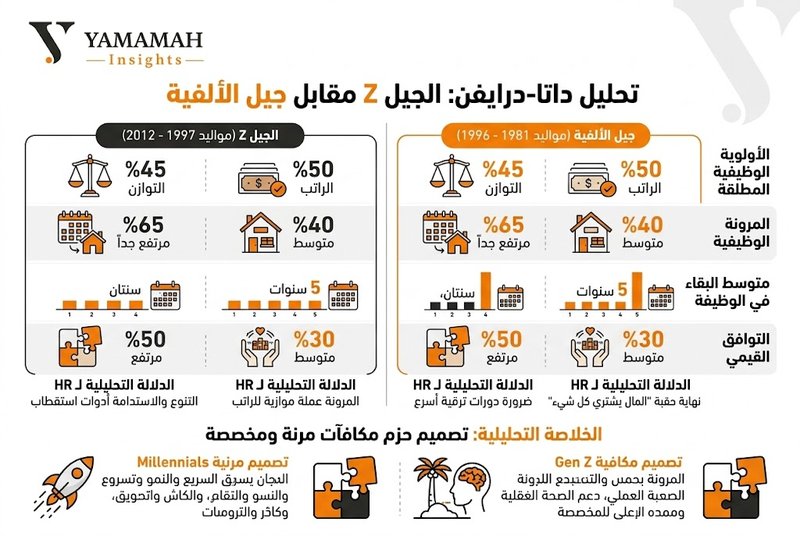
These indicators show that "one size fits all" policies in compensation design have become obsolete. Human resources managers must design "modular reward packages" that allow Millennials to choose paths focused on financial growth, while enabling Generation Z to choose paths focused on additional vacation time, flexible work hours, and mental health support.

Comments (5)
No comments yet. Be the first to comment!