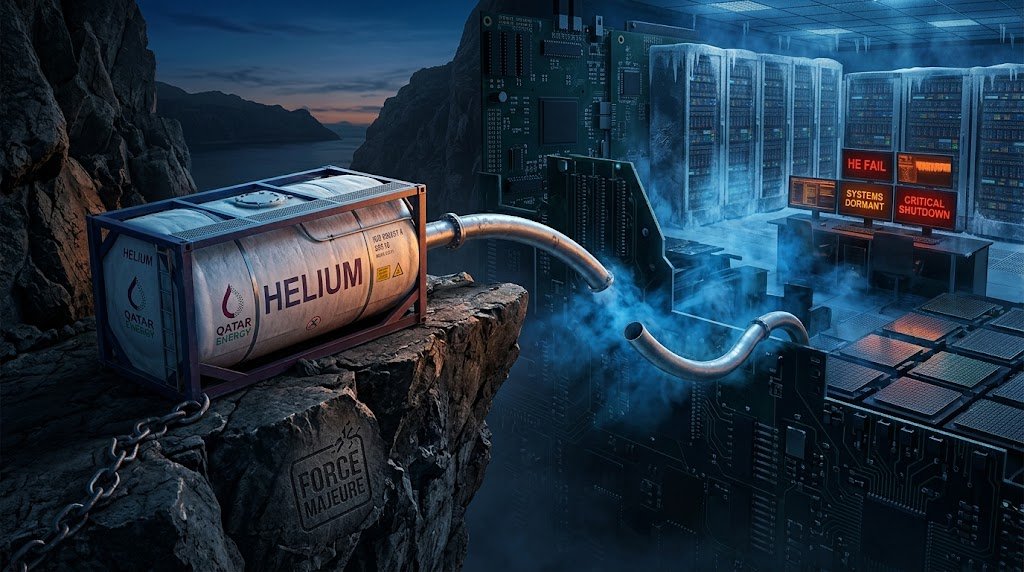

In the crowded emergency rooms of Tokyo hospitals, in the ultra-sterile laboratories of Silicon Valley, and on rocket launch pads in Texas, there was an invisible thread connecting these complex worlds.. A thread that was suddenly severed in the waters of the Arabian Gulf.
We are in April 2026; geopolitical tensions in the Middle East are at their peak, and the Strait of Hormuz, the world's most important waterway, has become a hotbed of conflict. As usual, the world's attention and trading screens turned to oil prices that began to soar. But in the halls of the "Financial Times" and the editorial offices of "Bloomberg", economic journalists were monitoring another, quieter disaster, one that was far more lethal to the modern economy.
In the Qatari capital of Doha, "Qatar Energy" issued a brief statement that carried the weight of an economic earthquake: the declaration of "force majeure" at the giant Ras Laffan complex. This announcement not only meant the halt of liquefied natural gas supplies but was akin to turning off the tap that flows about one-third of the world's production of a substance that the modern world cannot operate without: helium gas.
The Balloon Myth: What is Helium Really?
When "helium" is mentioned, the first thing that likely comes to mind is colorful birthday balloons or the amusing trick of inhaling it for a high-pitched, funny voice. But let's set that image aside; helium in the world of economics and industry is the "invisible gold".
To simplify, imagine that helium is the second element in the periodic table, and it is the second most abundant element in the entire universe (after hydrogen). But the ironic paradox that "The Economist" has often pointed out is that this gas, abundant in stars, is extremely rare on Earth.
Why is it rare? Because it is a very light gas, so light that Earth's gravity cannot hold onto it. Once it leaks into the air, it rises directly to escape the atmosphere into outer space forever. The only way we obtain it is by extracting it as a "byproduct" while drilling and extracting natural gas from deep within the Earth, where it has been trapped under rocks for millions of years. And Qatar, thanks to its giant gas fields, possesses one of the largest reservoirs of this gas in the world.
Deadly Cold: Why Can’t We Do Without It?
The superpower of helium lies in one property: It is the coldest substance on Earth.
Helium never freezes and remains in a liquid state at temperatures approaching absolute zero (around -269 degrees Celsius). This extreme cold is not a luxury; it is a necessity for the survival of modern technologies:
- Modern Medicine (MRI Machines): These machines rely on giant magnets that must be continuously cooled using liquid helium to operate efficiently. Without helium, these machines stop immediately, disrupting the diagnosis of critical illnesses worldwide.
- The Brain of Technology (Semiconductors): Smartphones, computers, and artificial intelligence systems.. all operate on electronic chips. The manufacturing of these chips requires an airless vacuum environment cooled by gases that do not chemically react with other materials, and no gas performs this task as brilliantly as helium.
- Space Exploration and Fiber Optics: Agencies like "NASA" use it to clean rocket fuel tanks, and it is essential in the production of fiber optic cables that deliver high-speed internet to your home.
2026 Nightmare: The Bottleneck Breaks
When the Ras Laffan complex stopped pumping one-third of the world's need for this magical gas, the problem was not just the absence of production, but the "half-life" of this resource.
Unlike oil, which can be stored in massive tanks for years, helium is a rebellious substance. To store and transport it, it must be cooled to become liquid and placed in specialized, expensive containers. But even in these containers, helium begins to slowly evaporate and return to its gaseous state over time. This means that the containers stuck in Qatari ports due to the closure of the Strait of Hormuz were literally "evaporating" into the open air with each passing day of the blockade.
Within days, major medical technology companies in Europe sent "rationing" letters to hospitals, and microchip factories suspended their expansion plans. Helium prices in the spot market skyrocketed.
Silicon Valley Shock: AI Winter
The bloody red screens on the NASDAQ were not due to a financial bubble bursting, but because of this tiny gas molecule. On Wall Street, investors realized a harsh truth: There is no artificial intelligence without computing power, there is no computing without chips, and there are no chips without helium.
- Collapse of Chip Giants: Major semiconductor factories like Taiwan's "TSMC" and "NVIDIA" had to slow their production lines to preserve their dwindling helium stock, causing their shares to lose hundreds of billions in value.
- Cloud Computing Chokehold: Tech giants (Microsoft, Amazon, Google) found themselves unable to purchase new chips to expand their data centers, raising their cloud service prices exorbitantly, which choked AI-dependent startups and plunged the sector into an "investment winter".
The Geopolitical Chessboard: Bitter Choices
"Regional players have realized that they do not need to hack Western servers or possess nuclear weapons to bring it to its knees; simply closing a hidden gas valve that most people are unaware of is enough to halt the global technology industry."
In the halls of the "Pentagon" and NATO, screens turned into thermal maps tracking the movements of fast boats in the Strait of Hormuz. Military intervention to break the blockade was not an easy decision; the strait is no more than 33 kilometers wide at its narrowest points, making warships easy targets for asymmetric weapons.
The options were all fraught with risk:
- The Heavy Hammer: Preemptive strikes and armed escorts for ships, but this threatens to ignite a full-scale war that could destroy the vital facilities the world is trying to save.
- The Slow Drain: Using mine sweepers to clear narrow paths, a slow process that would lead insurance companies to refuse coverage for tankers, allowing the economy to continue bleeding.
- Asian Intervention: Countries like China and India (the biggest victims) taking over the protection of ships, signaling the end of American dominance in the Middle East.
The helium crisis in April 2026 redefined the meaning of "national security" in the 21st century. The crisis revealed that the fast-paced digital economy, with all its artificial intelligence and cloud computing, is still shackled by chains of natural gas and narrow maritime routes in the physical world. It proved that the absence of a colorless, odorless gas can set humanity back decades in just weeks.

Comments (5)
No comments yet. Be the first to comment!