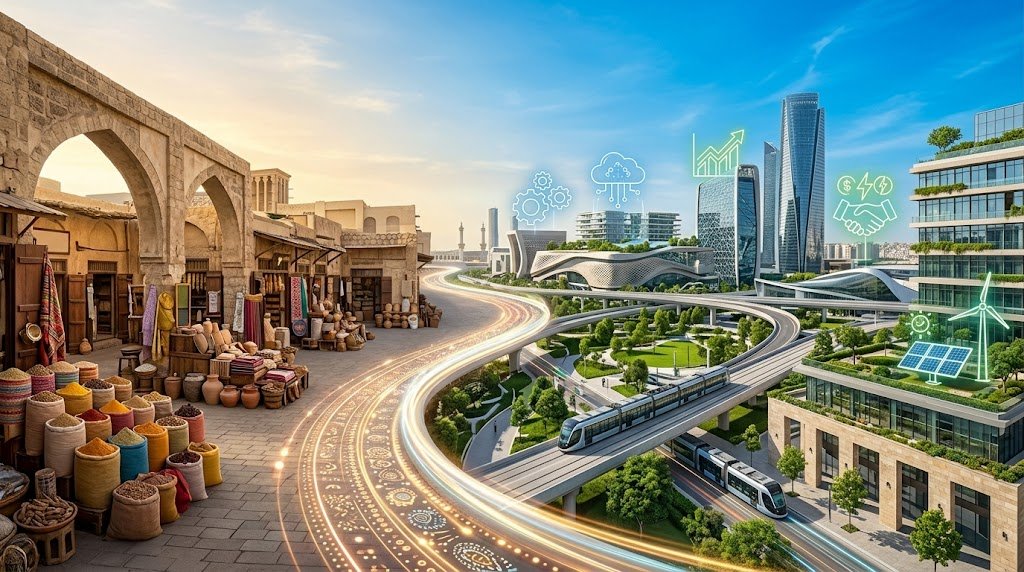

For decades, many viewed the Meccan economy as an hourglass; filled with movement and commercial bustle during pilgrimage and Umrah seasons, then slowing down and nearly stopping for the rest of the year. This pattern, which economists call the "seasonal economy," presented a major challenge: how could a city build sustainable growth if its commercial arteries only pulsed for a few months?
But if we observe the scene today, we'll find that this historical rule has been broken. The latest report from the Mecca Chamber of Commerce revealed an exceptional figure: private sector enterprises in Mecca grew by over 129% since 2020. In economic terms, this isn't just a fleeting rise; it's a "positive earthquake" announcing the birth of a new economic model in the Holy City. What happened behind the scenes of this figure?
The Tree of Multiple Roots: What Does "Structural Transformation" Mean?
To understand what's happening simply, imagine Mecca's old economy was like a tree depending on a "single root" to absorb water (pilgrimage season). If that root was affected, the tree would wither. What happened recently, aligned with Saudi Vision 2030, was planting "new roots" to ensure the tree received nourishment year-round. This is what we call in economic knowledge the term "structural transformation."
Today, investment in Mecca is no longer limited to renting hotel rooms or selling souvenirs. New sectors have emerged that operate around the clock, such as:
- Logistics services and supply chains: Transportation and storage networks that ensure efficient flow of goods for millions of visitors and residents.
- Digital economy and technology: Companies that innovate applications for crowd management, order delivery, and smart facility management.
- Comprehensive hospitality industry: Transforming a Mecca visit from merely performing rituals to a "complete experience" encompassing luxury catering, innovative accommodation, and easy transportation.
The 129% Leap: Why Small Enterprises Are the "Hero of the Story"?
When we hear about massive economic growth, we immediately think of giant corporations. But the economic report whispers a different truth to us: small and medium enterprises are the backbone of this growth.
Why? Because small businesses possess "flexibility" as an advantage. The young Meccan opening a new café, or founding a tech startup, or launching a smart transportation service, can adapt to market needs faster than large corporations. These enterprises didn't just double the numbers; they created quality permanent job opportunities, and transformed youth from seekers of seasonal jobs into entrepreneurs creating jobs themselves.
The Secret of "Sustainable Demand".. An Inexhaustible Advantage
In the world of money and business, any investor searches for a place guaranteeing them a "permanent customer." Mecca possesses what's economically known as "sustainable demand"; it's a global destination not affected by global economic recession in the same way other cities are.
Receiving millions of people annually, of different languages and purchasing power, creates an endless stream of daily needs (food, medicine, transportation, communications). This human movement makes Mecca a fertile investment environment, capable of absorbing crises and generating steady profits.
From Paper to Cloud: How Did the Business Environment Become Attractive?
This growth wouldn't have materialized without fertile "soil" paving the way. The government realized that capital is "cowardly" and needs reassurance. Therefore, this reassurance was embodied in what we call "economic enablers":
- Bureaucratic guillotine: Converting company registration procedures from complex paperwork taking weeks into electronic services completed in minutes through transparent digital portals.
- Partnership not competition: Deep integration between public and private sectors; where government builds massive infrastructure (like the Haramain Train and central area development), then the private sector enters and builds its projects on this ready infrastructure, reducing operational costs and increasing investment attractiveness.
Summary: Mecca's Economic Lesson
Reading the "Meccan Economy" report doesn't just tell us about numerical success, but offers a knowledge lesson for every city trying to diversify its economy. The 129% leap is an official announcement that Mecca is no longer just a "religious capital" dormant after seasons end, but has transformed into a "global economic engine" combining the sanctity of place with market vitality, opening its arms to every investor who reads the future well.

Comments (5)
No comments yet. Be the first to comment!