

The food retail and fast-moving consumer goods (FMCG) sector in the contemporary Saudi economic environment is facing structural transformations that go beyond normal business cycles (Cyclical Changes).
This paper relies on two explanatory theoretical frameworks:
- Downward Retail Dynamics Model (Wheel of Retailing):
which explains how the advantage of large stores changes when their operating costs rise and they lose price efficiency. - Transaction Costs Theory by Nathaniel Leves:
to explain the consumer's shift from "shopping aggregation" to "immediate logistical fit".
The thesis starts from a fundamental hypothesis:
"The closure of Al-Sadhan's 28 branches is not an operational failure, but a rational response to end the conflict of returns between heavy real estate assets and the shrinking cash margins of the traditional retail sector".
Historical Development and Primitive Capital Accumulation (1928 - 1995)
1. Logistics Distribution Geography and "Hadrat" Caravans
In the time frame from the founder's birth (1928), commercial movement relied on "livelihood trade" (dates) through "Hadrat" caravans originating from the Al-Washm region (Shuqra) towards multiple geographical hubs.
Analytically, this model represents "Extreme Logistical Risk Economy", where transportation and natural storage costs account for more than 70% of the product's added value, with the market subjected to a natural oligopoly mechanism imposed by the ability to bear travel costs and cross geographical spaces.
2. Technology Shock and Knowledge Spillover
The founder's meeting with American oil exploration missions (Aramco in its early days) represents an external innovation shock (Exogenous Innovation):
- Introduction of Canned Goods and Tomato Juice (V8):
Economically, this represents the transition from "zero shelf-life goods" to "extended shelf-life goods" (Shelf-life Extension).
This innovation mathematically led to zeroing direct perishability costs and allowed for the emergence of inventory hedging strategies. - Establishment of Import Lines:
Shifting the commercial weight from local production to maritime and air import lines through the ports of Kuwait and the Red Sea, reducing marginal import costs.
3. Institutionalization of the Supermarket Sector: License No. (1) and Efficiency Mechanisms
On the 23rd of Ramadan 1381 AH (corresponding to 1971 as an extended commercial registration), and with the issuance of supermarket license No. (1) in the capital Riyadh (Al-Batha), three variables were introduced that led to the institutionalization of the market:
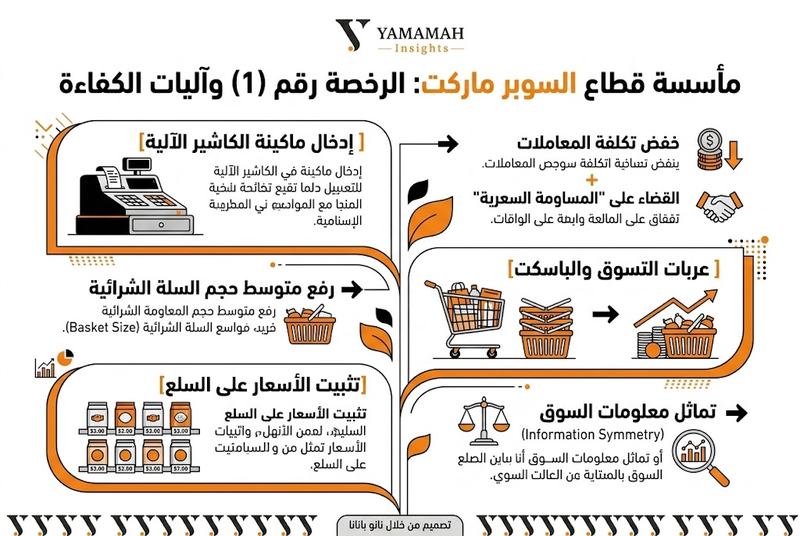
These tools shifted the store from a "corner shop" based on personal relationships and bargaining monopoly to a "central supermarket" based on complete price transparency and financial turnover efficiency.
Dynamics of Real Estate Expansion and the Ownership Asset Paradox (1980 - 2004)
1. The "Monopolistic Location" Theory and Early Expansion
The company expanded geographically with the growth of the capital Riyadh (60th Street at Abu Makhruq Mountain, then Omar bin Abdulaziz Road in Al-Rabwa 1980, Al-Mughrazat/Al-Wurood 1984, and Al-Rawda 1990).
The company adopted an "Asset-Heavy Strategy"; it purchased the land for the Al-Mughrazat branch (7,300 square meters) and Omar bin Abdulaziz (14,000 square meters) with all available liquidity at that time.
The economic impact of this strategy:
- Positively:
Created strong financial buffers against real estate inflation, zeroed operational rental costs, and benefited from positive externalities resulting from urban development surrounding the branches built in areas that were considered isolated at the time. - Negatively:
Immobilized working capital in illiquid fixed real estate assets, limiting the company's geographic expansion speed compared to competitors who adopted an asset-light strategy through long-term leasing and rapid horizontal expansion.
2. The "Retailtainment" Model
The year 2002 witnessed a qualitative leap with the opening of the massive Al-Rabwa branch designed in a complete American style, supported by an indoor entertainment center (Fantasy Factory) of 3,000 square meters, an in-house bakery, and external rented shops (banks, pharmacies).
Economically, the company was redefining food products from "ordinary goods" (Convenience Goods) to "experience goods" (Experience Goods), maximizing consumer marginal utility by integrating family entertainment with shopping, thereby increasing "Dwell Time" which is directly proportional to unplanned impulse buying.
Financial Maturity Mismatch and Funding Crisis (2004 - 2009)
1. Shock of Foreign Giants' Entry (Foreign Direct Investment Shock)
During the period (2004 - 2005), major international alliances (Carrefour, Giant, and Tesco attempts) entered the Saudi market through local partnerships.
These companies were characterized by immense negotiating power with international suppliers and massive purchasing economies of scale.
2. Financial Trap: Maturity Mismatch
In response to competitive threats, Al-Sadhan's management decided to double its sales area by signing 4 major locations in one year (Kharis, Al-Sahafa, Exit 25, Al-Sulaymaniyah) with areas exceeding 40,000 square meters.
This capital-intensive expansion was financed through short-term bank loans (3 years) as management believed in its ability to repay quickly from operational cash flows. The crisis manifests financially through the following equation:
Liquidity Gap=Short-term Debt Obligations−Long-term Asset Returns (Real Estate Construction)
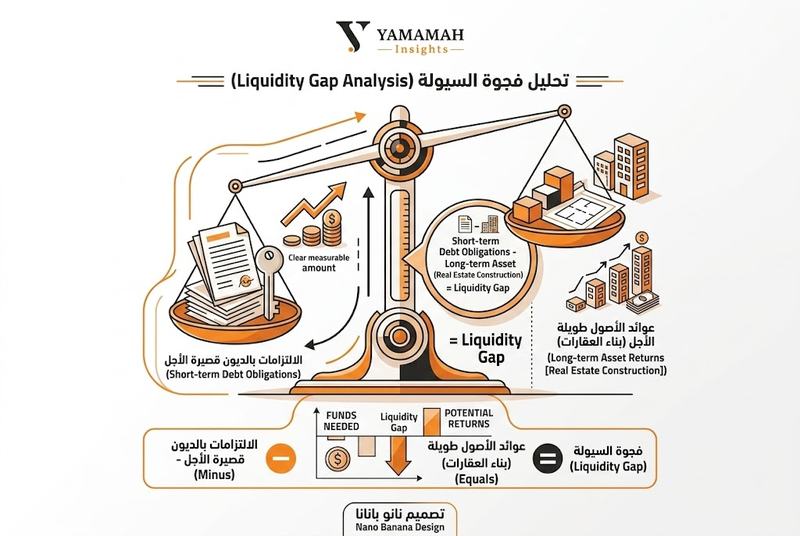
Real estate construction projects require a payback period ranging from 7 to 10 years. When the global credit crisis hit in 2008, local banks' lending flexibility dried up, and installments coincided with the company's declining free liquidity.
3. The Impact of Liquidity and Stockouts
Directing operational cash to pay short-term bank installments led to the drying up of working capital allocated for purchases. The company defaulted on supplier payments (30-60 day terms), prompting suppliers to cut their supplies by up to 90%. The crisis was financially addressed through a decisive strategic decision to cut "the real estate arm to protect the operational arm"; where massive strategic real estate assets (Al-Hamra Mall land on King Abdullah Road) were sold to inject immediate liquidity, pay suppliers, and clean up the financial statements.
Pivotal Transformation and Margin Disassembly and the 2018 Factors Explosion
The year 2018 represented a three-dimensional structural shock that changed the behavioral and commercial landscape in the Kingdom of Saudi Arabia:
Pivotal Transformation and Margin Disassembly and the 2018 Factors Explosion
| Structural Factor | Direct Impact on Traditional Retail | Affected Economic Mechanism |
|---|---|---|
| Women's Empowerment and Employment | The planning power for groceries has moved outside the home for long periods. | Reduced time available for home production (cooking). |
| Women's Driving | Fragmentation of the "large family basket" that was transported by the "family SUV". | Dispersed purchasing power shifting to immediate individual choices. |
| Value Added Tax ($VAT$) | Direct price shock on the total consumer basket. | Reduced disposable income. |
1. The Kitchen-to-Restaurant Substitution Dilemma
The most serious outcome of these changes is a structural shift in consumer substitution elasticity: Emerging Saudi families have replaced home cooking (the largest consumer of supermarket goods) with restaurants and ready delivery applications. Consequently, the meal has shifted from an intermediate good made at home to a final good purchased externally, leading to a sharp and sustained contraction in traditional retail's core sales (Top-Line Contraction).
2. Financial Disassembly of Retail Profit Margins
The unloading reveals the critical financial structure of the traditional retail sector, illustrated by the following mathematical analysis of 100 SAR paid by the consumer:
100 SAR (Sales)−(70 to 80 SAR [COGS])=20 to 30 SAR (Gross Profit)
This gross margin ranges from 20% to 30% at most. This margin faces rising operating expenses (OPEX) including:
- Payroll Expenses: the heaviest and most inflated item, plus the costs of expatriate labor and turnover costs.
- Energy, fuel, and electricity costs.
- Rental and maintenance costs.
The final result is a net profit margin that ranges between 2% to 5% only. This slim margin inevitably requires a very high asset turnover rate; if the number of customers declines, the store directly turns to operational loss.
Analysis of the Failure of Intermediate Models (SPAR and Mini-Market)
1. Failure to Target the Premium Segment (Premium Segment Paradox)
In 2017, the company attempted to escape the red ocean of price competition by partnering with the international SPAR brand to target the (A/B+) segment through imported products and private labels with high book profit margins.
The model failed economically due to: low turnover rate; the consumer, despite financial capability, has high price elasticity towards basic goods, refusing to buy an imported product for 25 SAR while a local alternative is available for 8 SAR. The critical mass of the market for this segment was insufficient to cover the high operating costs of the stores (3,000 square meters).
2. Shock of Expectations and Brand Equity Mismatch
When the company experimented with "mini-market" stores (400 square meters) under the name "Al-Sadhan", a clash occurred with the stored mental image in the consumer's mind (Cognitive Dissonance). The customer entered the small store looking for (butcher, fresh vegetables, weekly discount magazine, vast variety), and when they found only two types of oil and two types of rice, they refrained from purchasing. The brand name "Al-Sadhan" was designed for an "everything under one roof" model, and injecting it into small spaces led to counterproductive results.
Strategic Engineering for Total Exit and Transition to the Fit Model (2024 - 2026)
1. Rationality of the Closure Decision and Smart Exit
In 2024, the board of directors decided to close all hypermarket and traditional supermarket branches (28 branches). Financially and operationally, the exit was executed through an innovative mechanism: selling assets, equipment, and locations to major competitors who own hundreds of branches.
The economic logic of the exit: the giant competitor has the ability to absorb shared administrative and general expenses (Corporate Overheads) and supply chains on a wide branch base, making the loss-making branch for Al-Sadhan profitable for them due to economies of scale. Al-Sadhan also required the transfer of employees while covering all end-of-service benefits, which reduced the book losses resulting from asset write-offs and forced layoffs.
2. The Agile Fit Model (SPAR Express) and "Hand-to-Mouth" Economies
The company is now fully transitioning (32 branches currently, targeting 40 branches by the end of 2026) towards an immediate fit store model within closed communities (such as digital city, universities, metro, hospitals).
Operationally proven characteristics of the new model:
- Inventory Rationalization: Reducing SKUs from 25,000 to less than 3,000. Zeroing low-margin and heavy logistical weight food items (rice, sugar, frozen chicken).
- Maximizing Margin through Experience Goods: Total focus on specialty coffee, hot baked goods, and ready-to-eat foods (Food-to-Go / Hand-to-Mouth). The small branch now sells daily what equals a full pallet of rice in the old model, but with very high gross profit margins and accelerated operating expenses and inventory turnover.
- Protection Against Price Fluctuations: Consumers in business centers and universities seek "time, service, and logistical fit" rather than price, which increases price elasticity in favor of the store and protects it from price wars.
Future Outlook and Franchise Strategy (2027 - 2030)
The paper adopts the company's future outlook based on the idea: "The backbone of modern retail is not the store, but the interconnected supply chain infrastructures".
Determinants of Future Success: From Warehouse Management to Franchise Engineering:
- Small Batch Logistics Optimization:
Transitioning from shipping large containers of a single product to shipping small trucks containing 700 SKUs in limited quantities (6 to 8 units per SKU) requires a highly intelligent Warehouse Management System (WMS) to avoid stockout dilemmas that destroy consumer loyalty in fit stores. - Franchise Governance:
With a plan to grant franchises outside Riyadh starting in 2027, the company must maintain strict quality standards (such as pizza and baked goods that form the main attraction) through stringent franchise contracts that protect the brand's capital value (Brand Equity). - Third Generation Integration and Strategic Governance:
The legal transition from a limited liability company (10 partners in 1996) to a closed joint-stock company (2010) protects the entity from family legacy shocks and allows the third generation (represented by the preparation of current young leaders) to manage digital and logistical transformation efficiently, independent of the historical emotions of inherited assets.

Comments (7)
No comments yet. Be the first to comment!