

The An'am International Holding Group Company announced the latest material developments related to its Zakat assessment, following the settlement of its previous claim with the Zakat, Tax and Customs Authority for the years 2007 through 2010.
This positive step follows the company's request to apply the Executive Regulations for Zakat Collection issued under Ministerial Resolution No. 1007, with the relevant provisions applying to the case. Intensive efforts and constructive cooperation between the company's management and the Authority resulted in a reduction in total amounts due from approximately SAR 107 million to SAR 51.3 million.
This reduction, which exceeded 52% of the original Zakat claim, represents an important foundation for alleviating the company's previous financial burdens and obligations. Its positive financial impact is expected to be reflected directly in the company's results and financial statements during the third quarter of 2026.
Al Yamamah University students discussed the dimensions of these Zakat developments and their strategic and financial implications for the company's performance and the investment sector as follows:
The importance of separating the non-recurring accounting impact from actual operating performance
Student "Jumana Al Shehri"@Jumana Alshehri explained her perspective, saying: "I believe that the reduction in amounts due will have a positive impact on An'am's financial position, especially if it results in reducing accumulated losses during the third quarter. However, the most important aspect when analyzing the results is completely separating the impact resulting from the settlement of these old claims from actual operating performance. An increase in profits as a result of this event does not necessarily mean that the core business has improved. Therefore, close monitoring of revenue, operating profits, and cash flows remains the real driver. Although the news boosts investor confidence and temporarily eases financial pressure, restoring sustainable confidence requires continued improvement in operating performance, rather than reliance on a non-recurring item."
Enhancing financial flexibility and creating room for expansion
For her part, student "Ghadah Alwallan"@Ghadah Alwallan outlined the operational assessment, saying: "What stands out is the settlement's impact on the company's financial flexibility, with implications extending beyond a single quarter's earnings. Eliminating an obligation of approximately SAR 55.6 million that had been outstanding for years gives the company breathing room and greater financial space. However, the true long-term value of this reduction depends on management's ability to leverage this financial space to support its investment activities and sustainably improve its financial trajectory, rather than limiting its effect to a temporary improvement."
Ending uncertainty and clarifying the financial position
Student "Rimas Almashali" @Rimas Almashali shared her analysis, saying: "The primary importance of the news lies in ending the uncertainty surrounding a Zakat claim that had continued for many years. Determining the amount definitively enables investors and analysts to assess the company's obligations and financial position more accurately, away from the ambiguity of old filing records. Clarity regarding the company's obligations is itself a positive gain and an important indicator when evaluating its financial and credit position."
The settlement's implications for the financial statements and the coming performance test
Student @تينا عزي believes that reducing the Zakat claims represents tangible support for the financial position, adding: "Limiting these obligations gives the financial statements greater strength; however, the real challenge lies in how this impact will be reflected in the accounts in the third quarter. The settlement's effect on profits alone will not be sufficient to conclude that the company has undergone a positive transformation, since it resulted from a historical settlement rather than sales growth or improved operations. Accordingly, reducing obligations remains a means of mitigating accumulated losses and supporting confidence in the near term, while improved margins and cash flows remain the primary benchmark for judging the quality of performance in the next phase."
The true benchmark for correcting the course and achieving sustainability
Student "Arwa Alhuwaiti" @Arwa Alhuwaiti stressed the importance of not relying solely on the third-quarter figures, saying: "Any anticipated increase in third-quarter net profit is not sufficient on its own to assess the company's efficiency, as long as it is driven by the settlement of previous obligations. The key is to exclude the non-recurring impact and focus on core indicators such as operating profit and cash flows to determine whether An'am is achieving an underlying improvement in its business model or whether this is merely a temporary accounting treatment."
Improving the quality of the financial position versus the long-term investment outlook
Student "Mohammad Alghaihab" @Mohammad Alghaihab concluded the discussion with his financial analysis, saying: "The Zakat reduction is undoubtedly a positive step toward strengthening the company's financial position and easing its outstanding burdens, but it does not automatically indicate improved operating efficiency. For investors, what matters is management's ability to use this relief to improve operations and achieve consistent profitability. Resolving an old Zakat matter restores financial balance and removes debt pressure, but it is not enough on its own to change the company's investment outlook unless it is followed by tangible operational steps."
An analytical reading of the settlement's dimensions and financial impact
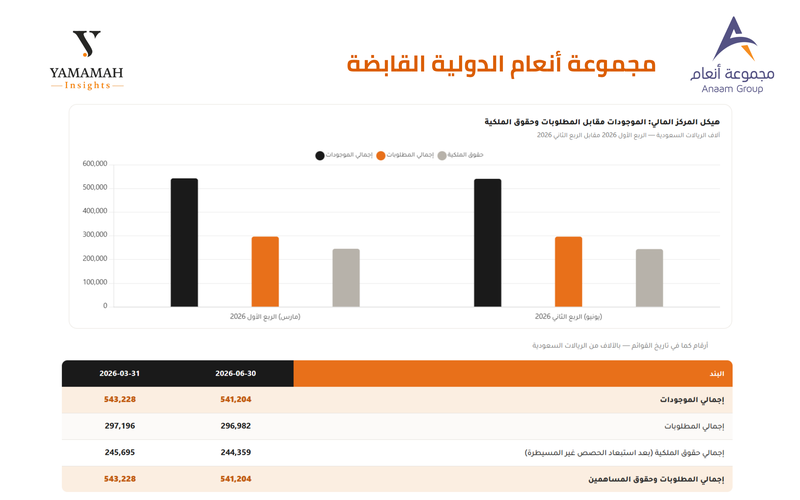
In an analytical reading of the company's performance, financial and economic analyst "Hamad Alsaeed" @Hamad Alsaeed explains: The reduction in Zakat liabilities from Zakat differences totaling SAR 106.93 million and withholding tax of an amount to SAR 51.31 million is a legal and accounting settlement of differences from previous years, not an indicator of operating performance. Its direct impact is limited to reducing current liabilities, which will improve the liabilities-to-assets ratio and financial leverage on paper in the upcoming statements, without addressing the core operational problem.
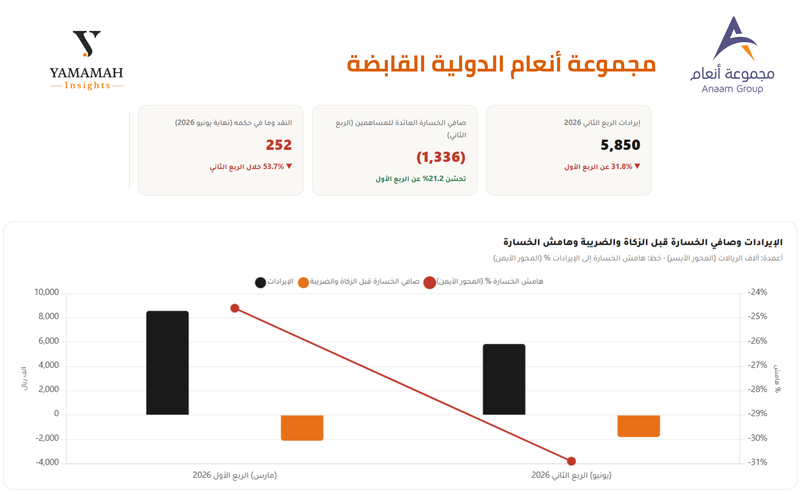
The group has accumulated losses of SAR 70.64 million as of the end of the first half, equivalent to 21.4% of capital, and a working-capital deficit of SAR 138.9 million, followed by quarterly losses of SAR 1.7 million at the end of the first quarter of 2026. With a weak cash balance, the obligation to pay the remaining SAR 51.3 million becomes a genuine liquidity burden that far outweighs the apparent positive impact on liabilities.
Although the accumulated-loss ratio remains well below the statutory threshold at which losses exceed half of capital, their continued quarterly occurrence is gradually bringing the group closer to regulatory procedures. The news therefore improves the appearance of the liabilities figure on the balance sheet, but it does not address the erosion of shareholders' equity or the contraction in revenue affecting the group.

Comments (4)
No comments yet. Be the first to comment!