

Knowledge Economic City Company announced the signing of a strategic memorandum of understanding with Dar Al Majd Real Estate Company (Al Majdiah) and Capital Hill Financial Company, aimed at establishing the general framework for developing a distinctive residential and commercial project within Knowledge Economic City in Medina.
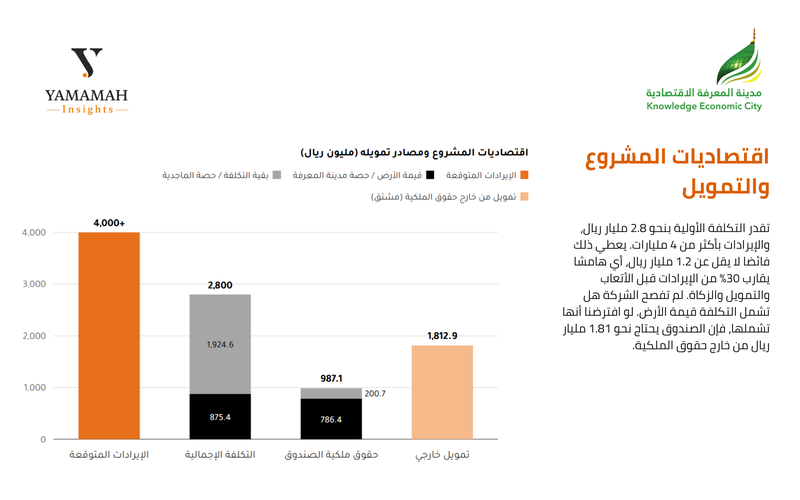
The company explained in its statement that the project will be implemented through the establishment of a closed-ended real estate investment fund. Knowledge Economic City will contribute the project land as an in-kind contribution in exchange for approximately 80% of the fund, while “Al Majdiah” will contribute cash in exchange for 20% and will undertake the role of development manager. “Capital Hill” will establish and manage the fund.
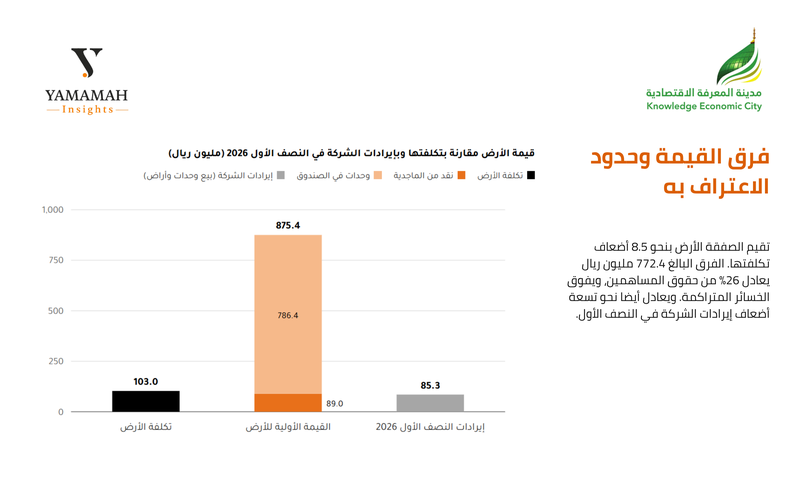
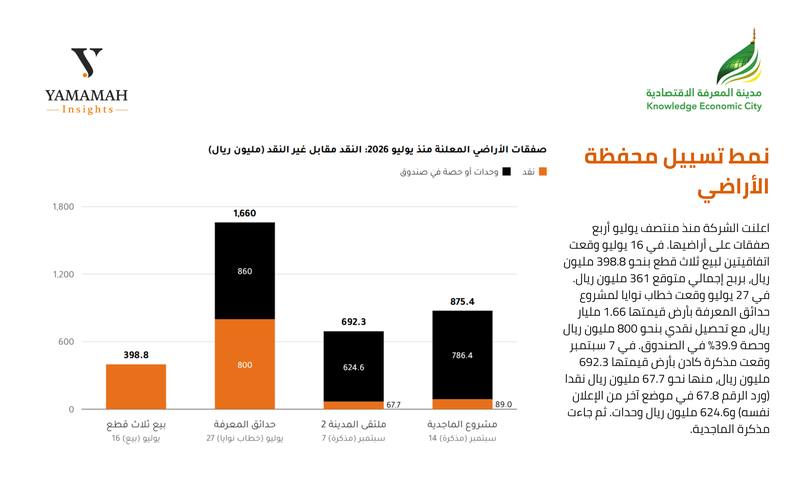
The company outlined the transaction’s financial impact: the initial value of the project land is approximately SAR 875.4 million (while its approximate cost is SAR 103 million). Following the execution of the final agreements, the company will receive SAR 89 million in cash, paid by Al Majdiah, in addition to investment units in the fund valued at SAR 786.4 million.
Knowledge Economic City indicated that the project will be built on an area of 97,000 square meters and will comprise approximately 2,700 residential apartments and a commercial component, with an initial total cost estimated at approximately SAR 2.8 billion and expected revenues exceeding SAR 4 billion. The project primarily targets non-Saudi Muslim customers, in line with the Non-Saudi Real Estate Ownership Law and the objectives of Vision 2030.
Against the backdrop of monetizing real estate assets and building strategic partnerships, students of Al Yamamah University discussed the dimensions of this memorandum and its financial and operational implications for the company’s performance and the future of urban development in Medina, as follows:
The Partnership Model and Supply-Demand Balance
Student “Yazan Al Hamoud” @Yazan Hamoud shared his analysis, saying: “I believe the partnership model is appropriate because it allows the company to benefit from the land’s value without bearing the full cost of development and financing.
The significant difference between the land’s cost and its current value could support the company’s financial statements in the future, but it will not be recorded as an immediate profit; rather, it will depend on the accounting treatment.
Targeting non-Saudis will also increase demand and attract new liquidity to the city, while ensuring that supply growth remains balanced is necessary to prevent price inflation.”
Reducing Financing Burdens and Accounting Gains
Student “Rand Al Khalaf” @Rand Alkhalaf explained: “This partnership helps develop the project without bearing the full financing and development costs.
The substantial difference between the land’s cost and value paves the way for capital gains. However, the final profit will depend on the accounting treatment and completion of the transaction, thereby strengthening real estate investment whenever supply and demand are balanced.”
Optimal Asset Utilization and the Importance of Execution
Student “Mohammad Alghaihab” @Mohammad Alghaihab offered a strategic perspective, saying: “The key point here is not the valuation difference itself, but how the company utilizes its assets. Instead of exiting and selling for a one-time gain, it has taken a stake in the fund to participate in project returns exceeding SAR 4 billion.
The project’s success will maximize the company’s benefit, making execution and actual sales far more important than current valuations.”
The Asset-Light Model and Accounting Recognition Requirements
Student “Fahad Alshaibany” @Fahad Alshaibany said: “The transaction reflects a smart approach to utilizing land through an (Asset-Light) development model. Financially, the notable point is that the accounting difference between the cost (SAR 103 million) and the initial value (SAR 875.4 million) amounts to SAR 772.4 million. However, it should not be considered realized profit immediately, because accounting recognition depends on (IFRS) requirements and completion of the transfer of ownership.”
Accelerating Execution and Cash Flow Flexibility
Colleague “Lujain Al Qurashi” @Lujain Algorashi shared her analysis, saying: “The partnership model provides an opportunity to benefit from the land’s value without bearing the full costs, while bringing in specialized partners will accelerate execution and preserve cash flow flexibility.
The land’s substantial valuation difference draws attention to the expected financial impact once the fund is activated, while targeting non-Saudis will attract new financial inflows that support the construction and services sectors.”
Governance and Legal Structuring for Non-Saudi Ownership
From a legal and regulatory perspective, student “Riouf Al Suwailem” explained: “The memorandum of understanding (MoU) is a non-binding framework until the final contracts are executed and approvals are obtained from the Capital Market Authority.
Since the law prohibits direct ownership by non-Saudis within the city’s boundaries, the targeting strategy relies on usufruct or investment mechanisms through fund units as securities. This requires precise contractual arrangements that protect ownership of the underlying asset and define liquidation and profit-distribution mechanisms.”
Immediate Liquidity and Attracting Foreign Investment
Student “Fay Al-Dosari” @Fay Aldossari highlighted the benefits of the structure, saying: “The (Asset-Light) model provides the company with immediate liquidity while avoiding loans, along with recording strong capital gains once the asset is transferred to the fund.
Economically, supplying 2,700 apartments to non-Saudis will attract direct foreign capital, invigorate the retail sectors throughout the year, and achieve balance through an organized real estate product.”
Supporting Cash Liquidity and Monitoring Profit Margins
Student “Arwa Al-Huwaiti” @Arwa Alhuwaiti affirmed: “Receiving SAR 89 million in cash will support liquidity and reduce the need for direct financing for a project costing SAR 2.8 billion.
But what matters most to me is monitoring profit margins and actual cash flows as execution progresses, because higher expected revenues do not necessarily mean high profitability.”
Capital Gains and Capturing Foreign Demand
Student “Amal Mansi” @Amal Mansi described the transaction, saying: “The transaction is a financial masterstroke. It transforms land that cost SAR 103 million into an asset valued at SAR 875.4 million, generating capital gains of approximately SAR 772 million. Relying on this model ensures accelerated construction without financing burdens and captures inelastic demand that guarantees sustainable foreign financial inflows.”
Valuation Difference and the Timing of Accounting Recognition
Student “Al Batoul Bedairi” @Albatool Bedairi added: “The substantial difference between the cost and initial value reflects a significant increase in the asset’s value, but it does not mean that profit will be recorded immediately. The accounting treatment is linked to the company’s percentage of ownership and control over the fund and the conditions governing the transfer of the land, making the timing of accounting recognition the decisive factor in the impact on profits.”
Expanding the Demand Base and Investment Attractiveness
Student “Rahaf Al-Anazi” @Rahaf Alanazi shared her view, saying: “The partnership represents a good opportunity to generate cash flows from the transaction and reduce development costs. Targeting non-Saudis will expand the demand base and increase the attractiveness of real estate investment, while results will remain tied to the speed of actual execution.”
Cash Return and Real Estate Market Stability
Student “Jumana Al-Shahri” @Jumana Alshehri said in her analysis: “The company benefits from the development without taking on debt burdens and achieves a direct cash return. The valuation difference will have a positive impact once it is recognized in the accounts, while adding 2,700 apartments will meet the expected increase in demand from non-Saudis and help balance supply and demand.”
Strategic Alliances and Reducing Financial Risks
Student “Fahad Al-Ruwaished” @Fahad Alruwaished praised the move, saying: “The company’s adoption of this model is an excellent step. Direct cash collection supports liquidity, while bringing in strong partners such as (Al Majdiah and Capital Hill) accelerates development and spares the company massive debt and financing costs. This enables the company to enhance its assets while retaining an 80% stake from which it can earn excellent returns.”
Retaining a Majority Stake and Integrated Services
Student “Rimas Al-Mashali” @Rimas Almashali said: “The partnership provides an opportunity to develop the land while retaining a large stake (80%) in the fund. Targeting non-Saudis will strongly support demand, particularly given the project’s location and the integration of its accompanying services.”
The Land’s Estimated Value and the Test of Actual Sales
Student “Ghadah Al-Wallan” @Ghadah Alwallan focused on actual outcomes, saying: “The most prominent point is the increase in the estimated value of the land, which will have a positive effect once the accounting requirements are completed and ownership is transferred. However, the actual and ultimate impact depends on successful sales and revenue generation, not merely on the initial valuation.”
The Time Value of Returns and Collection Speed From an efficiency perspective, student “Mohammad Al-Mudbal” analyzed the time factor, saying: “The difference between the cost and revenues appears substantial, but the feasibility assessment depends entirely on the timing of the return. A project of this scale may extend over several years, so sales and collection speed are the real test. Achieving a substantial return over three years is entirely different in financial value from achieving it over eight years.”
Opportunity Cost and Stability of Financing Flows
Student “Ahmed Al-Jadaan” @AHMED ALJADAAN supported this view, adding: “Distributing returns over long periods reduces the time value of money and increases exposure to opportunity cost and inflation rates. The transaction’s strength lies in selecting Al Majdiah to reduce delay risks and having Capital Hill ensure the stability of financing flows. Accurate valuation therefore remains contingent on the cash flow schedule and sales plan.”
Converting Assets into Projects and Balancing Prices
Student “Thanaa Al-Shayib” @Thanaa Alshayib concluded the analytical discussion, saying: “This partnership is a smart step toward converting assets into actual projects with lower financing costs. The valuation difference will have a positive impact once the accounting requirements are fulfilled, while targeting non-Saudis will open a new source of demand that attracts liquidity and investment. Its impact on the balance of real estate prices in the area must nevertheless be monitored.”
Project Dimensions and Its Impact on Financial Performance
In an analytical reading, financial and economic analyst “Hamad Al-Saeed” @Hamad Alsaeed added, saying: “The memorandum of understanding between Knowledge Economic City and Al Majdiah demonstrates a shift in the company’s business model. After relying on unit sales, the company is moving toward monetizing its land portfolio through real estate funds. The land was initially valued at approximately SAR 875 million, compared with a cost of SAR 103 million, although this value remains subject to due diligence. However, direct cash amounts to no more than SAR 89 million, while most of the value is tied to project execution and the sale of its units.
In this context, the accounting treatment remains the decisive factor in assessing the financial impact. Consolidating the fund could add significant liabilities to the company’s balance sheet without recording a profit. The equity method, meanwhile, limits the recognized profit and does not eliminate accumulated losses.
On the other hand, the project is based on demand from a new segment enabled by the Non-Saudi Real Estate Ownership Law, in an area where residential supply and demand are both increasing.
Accordingly, we believe the transaction’s actual value will be determined by the execution of the final agreements and the pace of sales, not by the figures announced at signing.

Comments (5)
No comments yet. Be the first to comment!