
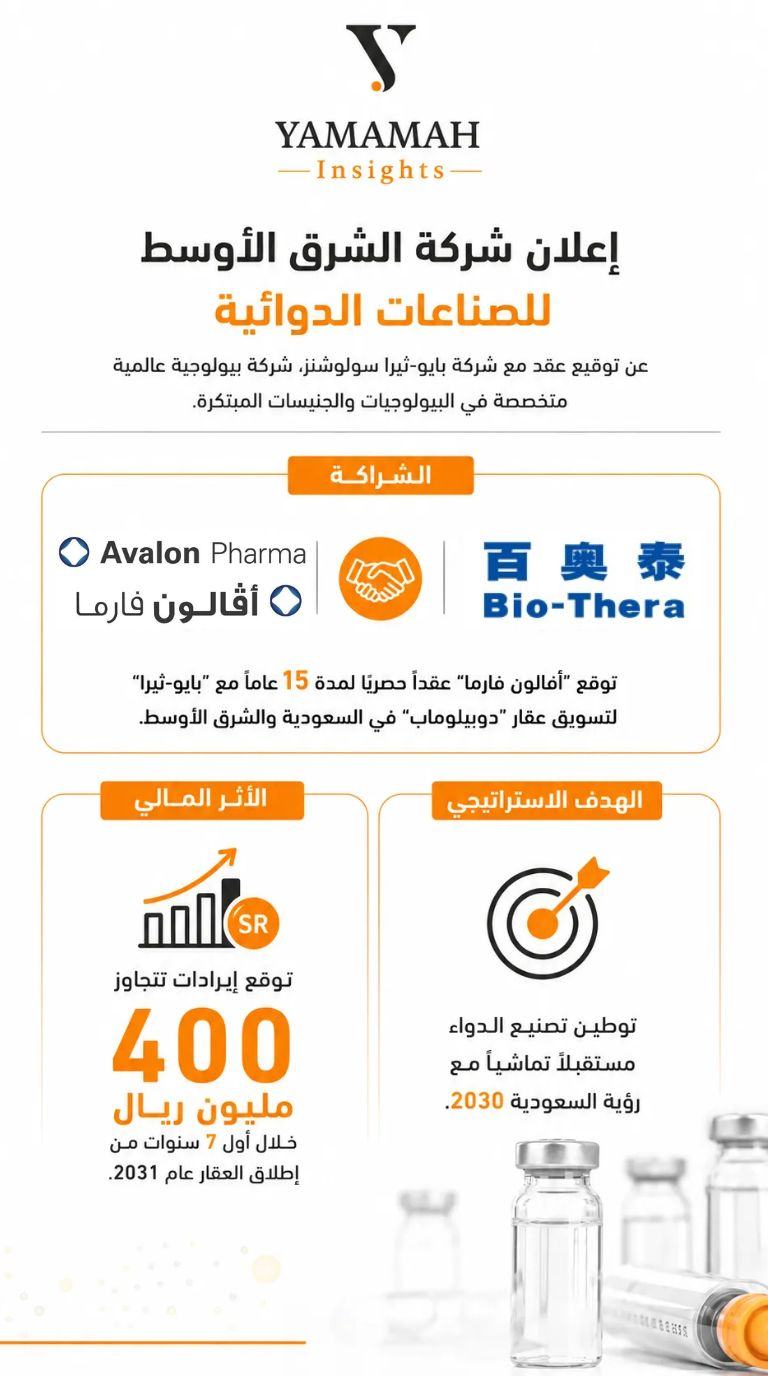
Middle East Pharmaceutical Industries Company (Avalon Pharma) has signed a strategic agreement with global company "Bio-Thera Solutions", under which it secured exclusive rights to register and market "dupilumab" (the biosimilar of "Dupixent") in the Kingdom of Saudi Arabia and the Middle East and North Africa region, under an agreement valid for 15 years, renewable.
This move represents a qualitative shift in Avalon Pharma’s biologics and immunology portfolio, as the agreement includes rights for possible technology transfer aimed at localizing product manufacturing in the future. This supports the national industrial strategy and advances the objectives of the Kingdom’s 2030 Vision to strengthen pharmaceutical security and localize specialized biomanufacturing industries.
Although the current value of the contract represents less than 5% of the company’s total revenues for fiscal year 2025, the financial impact is expected to materialize starting from the planned launch date in 2031, with cumulative sales estimated at no less than SAR 400 million during the first seven years from the start of marketing, provided that there are no pending patents.
Students from Al Yamamah University discussed the strategic partnership’s investment and manufacturing implications for the pharmaceutical sector as follows:
Enhancing competitiveness and diversifying long-term revenue sources
Student "Rimas Almashali" @Rimas Almashali explained her view, saying: "In my opinion, this agreement represents a positive strategic step for Avalon Pharma. It is not limited to future revenues; it also strengthens the company’s presence in the biologics and immunology market.
Although the actual financial impact will not appear before the expected launch in 2031, the possibility of localizing manufacturing in the future will help enhance the company’s competitiveness and diversify its sources of income over the long term."
Supporting localization and pharmaceutical security while enhancing investment appeal
For her part, student "Abeer Altuwaijri" @Abeer Altuwaijri highlighted the partnership’s implications, saying: "I believe this is a positive step for Avalon Pharma, as it supports revenue diversification and long-term growth through expansion into biologics.
Local technology transfer is also aligned with the objectives of Vision 2030 to strengthen pharmaceutical security and localize industry, which could enhance the company’s appeal to investors as its portfolio expands into high-value-added products."
Distinguishing between actual commitments and future aspirations
Student "Rana Alshamrani" @Rana Alshamrani joined the discussion with her financial analysis, saying: "Despite the agreement’s positive aspects, it is important to distinguish between confirmed benefits and potential aspirations.
The contract currently guarantees registration and marketing rights for dupilumab, while technology transfer and local manufacturing remain a future possibility and not a confirmed commitment at this stage.
In addition, the financial impact in 2031 depends on the absence of pending patents, making the timing an estimate.
As for expected revenues of approximately SAR 400 million over 7 years—that is, around SAR 57 million annually—the most important measure of its impact will be assessing their size and profit margins relative to Avalon’s business volume when actual marketing begins."
Delay scenario: a balanced assessment of the risks
Student "Mohammad Alabdullah" @محمد العبدالله added another dimension, saying: "There is no doubt that the agreement presents promising opportunities, but it is also important to consider less-than-ideal scenarios. What if regulatory registration is delayed beyond 2031? Or if obstacles emerge related to patents? What if demand for the product falls short of expectations?.
These possibilities do not mean the deal is weak, but they remind us that the time horizon is long and that the agreement’s actual value will not become fully clear when the contract is signed. Rather, it will become clear once marketing begins, actual revenues are generated, and demand and profit margins are known."
The importance of profitability and converting technology into a sustainable advantage
Meanwhile, student "Ghadah Alwallan" @Ghadah Alwallan shared her perspective, saying: "The agreement is promising because it grants the company exclusive rights for 15 years in a high-value therapeutic market. However, the financial impact is tied to regulatory approvals and a timetable that does not begin before 2031.
Accordingly, one should not focus solely on the cumulative revenue figure; it is also necessary to monitor profit margins and the company’s ability to turn the option of technology transfer into a sustainable competitive advantage."
Technical expertise and technology transfer as pillars of long-term growth
Student "Mohammad Alghaihab" @Mohammad Alghaihab concluded the discussion, saying: "The agreement represents a qualitative transformation that goes beyond merely adding a new product. Entering the biologics and immunology field opens higher-value-added opportunities compared with conventional pharmaceuticals.
Financially, the impact will materialize gradually depending on the speed of registration and demand momentum. However, the long-term contract ensures an additional revenue stream, while future localization will improve margin efficiency and reduce imports once an economically viable production scale is reached.
In my view, the most important aspect is acquiring technology and developing technical capabilities, which will enhance the value of Avalon’s portfolio and allow it to expand into similar products later."
Extended time value and strategic alignment with localization
In an analytical reading of the contract’s dimensions, financial and economic analyst "Hamad Alsaeed" @Hamad Alsaeed explains: Perhaps the most notable aspect of Avalon Pharma’s agreement with Bio-Thera Solutions is that the right is acquired today, while its impact will not appear on the income statement before 2031. The company has obtained exclusive rights to register and market dupilumab (the generic version of Dupixent) in the Kingdom and the Middle East and North Africa region for fifteen years, renewable, with additional rights to localize manufacturing in the future, which will require subsequent capital expenditures.
The disclosed figures indicate that the contract’s value is less than 5% of revenues for the year ending December 2025, which amounted to SAR 460.5 million, compared with cumulative revenues of no less than SAR 400 million during the first seven years—an average of approximately SAR 57 million annually, equivalent to nearly 12% of last year’s revenues—which could have a positive effect on profit margins. These figures gain context from the size of the reference product: Dupixent sales worldwide reached EUR 15.7 billion in 2025, reflecting the scale of the targeted regional market opportunity.
In this context, the technology transfer clause intersects with the biomanufacturing and localization objectives of the National Biotechnology Strategy stemming from Vision 2030.
This impact is expected to remain conditional on the matters disclosed by the company itself: the absence of pending patents and adherence to the launch date.
Disclaimer: This material was prepared under the supervision of a “Yamamah Insights” editor and with the assistance of artificial intelligence tools for financial education purposes. It does not constitute a recommendation to buy, sell, or hold any security, and it expresses the views of its authors, not those of the platform.


Comments (7)
No comments yet. Be the first to comment!