
Referring to the announcement by International Care on May 6, 2026 regarding its annual financial results, which showed that accumulated losses reached approximately 148.4 million SAR, representing 123.70% of its capital; and in compliance with the Companies Law and the regulations for listed companies that have incurred losses of 50% or more, the company announced the recommendations of its board of directors to address this financial situation and ensure its continuity.
The recommendations include adopting a strategic approach to restructuring capital through legal options including capital reduction to extinguish losses and then increasing it later, and starting to appoint a licensed financial advisor to prepare the detailed plan.
The treatment also included transferring the balance of the statutory reserve amounting to approximately 13.5 million SAR, and the entire balance of the share premium amounting to approximately 41.7 million SAR to the accumulated losses for partial extinguishment, a procedure that was previously approved by the extraordinary general assembly in its meeting held on March 26, 2026, and its accounting effect will appear in the preliminary financial statements ending June 30, 2026, while it is difficult to determine the final financial impact at this stage until the financial advisor's studies are completed.
Students from Al-Yamamah University discussed the implications of this announcement and its reflections on the company's financial position as follows:
Feasibility of Accounting Restructuring vs. Operational Efficiency
Student "Rimas Almashali" @Rimas Almashali opened the discussion with a critical analysis of the liquidity structure, stating: "In my opinion, capital restructuring may address losses from an accounting perspective, but it does not address the core issue.
The existence of accumulated losses exceeding 123% of capital, with cash liquidity not exceeding 2.2 million SAR at the end of 2025, and negative operating cash flows, puts the company's ability to continue and grow under real scrutiny.
Therefore, restoring investor confidence will not be achieved through financial decisions alone, but by demonstrating management's ability to improve operational performance, generate sustainable cash flows, and commit to transparency and governance; because the market ultimately evaluates operational results, not future promises".
Decline in Operational Efficiency and Profit Margins
Student "Ghadah Alwallan" @Ghadah Alwallan commented from an operational perspective, saying: "I noticed that the problem is not just in the losses, but also in the decline of operational efficiency; the gross profit margin fell from about 22% in 2024 to 13% in 2025, and the operating profit margin returned to negative territory.
Therefore, I believe that the most important indicator in the coming period is not the implementation of restructuring itself, but the company's ability to improve profit margins and convert revenues into sustainable operating cash flows".
Implications of Delayed Disclosure on Market Confidence and Financial Position
Student @Shahad Almuhaisen added dimensions related to governance and market interaction, stating: "In my opinion, the fundamental problem is not in the drop of the stock itself, but in the accumulation of issues that preceded this drop.
The delay in announcing financial results for more than a year negatively affected investor confidence, and after publishing the statements, the extent of the losses and the weakness of the financial position became clear; thus, the market's reaction was strong.
As for the capital restructuring plan, it is a necessary step, but it is not enough if it is not accompanied by actual improvement in operations and cash flows.
Moreover, the presence of limited cash liquidity and negative operating cash flows raises real questions about the company's ability to execute new projects with the same efficiency or secure large contracts without the need for additional financing.
I believe that the next phase depends more on management's ability to restore market confidence through commitment to disclosures and governance, improving operational performance, and showing tangible results; because any financial restructuring without improvement in core activity may only have a temporary effect".
The Impact of Disclosure Commitment and the Challenge of Real Cash Flows
Student "Thanaa Alshayib" @Thanaa Alshayib continued the analysis by linking governance measures to the operational environment, stating: "From my perspective, the most striking thing about the issue is that the problem was not just losses, but the loss of market confidence after the long delay in announcing financial results.
An investor may accept a company going through tough circumstances if it is clear with them continuously, but when disclosure is delayed and the stock is halted for such a long time, it is natural for the market's reaction to be strong after trading resumes.
As for the capital restructuring plan, I see it as a necessary step in such a situation, but it is not the solution itself; extinguishing losses on paper is one thing, and improving the company's performance in reality is something entirely different.
The real challenge lies in how the company will be able to improve its cash flows, provide the necessary cash liquidity, and continue executing its projects without facing greater financial pressures".
Debt Structure vs. Scarcity of Real Cash Liquidity
Student "Sara Alaqeel" concluded the analysis with a realistic reading of the financial position and obligations, stating: "The company delayed publishing its financial results, which led to the stock being frozen and halted from trading for a year and two full months.
When it resumed trading, the extent of the massive losses that exceeded the company's own capital was revealed; causing the stock to drop sharply, only to slightly rise later after the company announced its plans to address the situation.
However, when questioning the real problem, we find that the company suffers from severe liquidity scarcity, as the available cash does not exceed approximately 2 million SAR in the 2025 report, against massive debts and obligations reaching 321 million SAR.
This means that even if the rescue plan represented by capital restructuring (through reduction and then increase to wipe out losses from the books) succeeds, adjusting the numbers on paper and accounting will not provide the company with sufficient real funds to face this level of debts and obligations in reality".
Stock Performance in the Market and the Dilemma of Mathematical Compensation
Expert Abdulaziz Khrais analyzes the company's financial performance and market interactions, stating: "It is not a happy story for the company's owners; after a trading suspension that lasted a year and two months, the stock of International Care returned to trading, and it would have been better if it hadn't, as the stock lost more than 70% of its price and is now trading at deep price levels, specifically at 1.13 SAR compared to 3.95 SAR before the suspension.
The details of this story go back to the company's failure to publish its financial results for 2024, which led to the suspension of trading in May 2025 at a price of 3.95 SAR, and this suspension continued until the stock resumed trading after publishing its annual results for 2024 and 2025, which revealed that it recorded accumulated losses exceeding 120% of its capital due to additional provisions allocated on its financial statements; resulting in massive accounting losses.
In just 6 trading days, the stock plummeted to a price of 1.13 SAR, losing 71.39% of its market value, making compensation extremely difficult; as the mathematical equation states that every 50% drop requires a 100% rise to compensate, and based on that, the stock now needs a rise of 249.55% to return to the price it was trading at before the suspension.
The company's recent announcement regarding the five items and its main focus on capital restructuring through reduction and increase is an attempt to salvage this situation".
Financial and Economic Analyst "Hamad Alsaeed" @Hamad Alsaeed concluded the discussion with his comment:
The numbers and financial indicators of International Care reflect a fundamental deterioration in the financial structure and operational efficiency of the company, transitioning it to a high-risk phase.
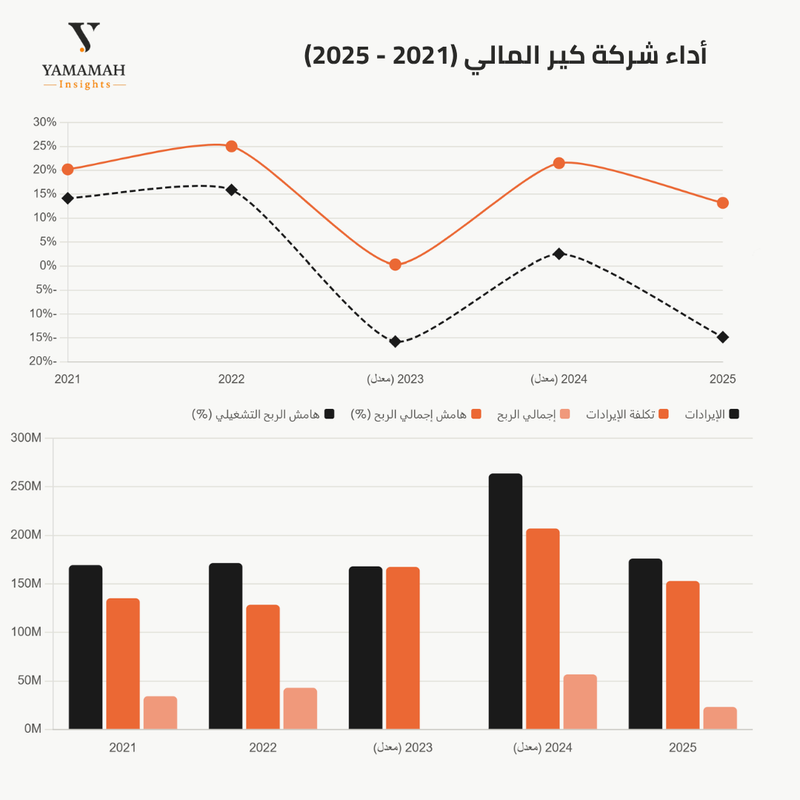
In terms of operational performance and revenues, although the company recorded an increase in revenues during 2024, it quickly declined in 2025 to record 176.1 million SAR. Meanwhile, profit margins faced significant pressure and collapse. The gross profit margin fell from 20.20% in 2021 to 13.18% by the end of 2025. More dangerously, the operating profit margin plunged into negative territory, recording (14.85%) in 2025, compared to a positive and stable margin of 14.15% in 2021, reflecting inflation in revenue costs and an inability to control operating expenses.
In terms of financial position and liquidity, the company is facing a major crisis. Shareholders' equity has nearly eroded, recording a sharp decline of about 90%, dropping from 234.4 million SAR in 2021 to only 26.9 million SAR in 2025. This erosion coincided with a complete collapse in cash liquidity by 95.5%, reaching a critical level of 2.26 million SAR down from 50.3 million SAR.
While liquidity has evaporated, total liabilities (debts) surged alarmingly by 143.8% to reach 321.6 million SAR in 2025 compared to 131.8 million SAR in 2021. This structural imbalance pushed the debt-to-assets ratio to rise by 56.28 percentage points, settling at a dangerous level of 92.28%, placing nearly all of the company's assets under the weight of liabilities and limiting its financial flexibility.
As a result of these accumulated pressures, the company sharply shifted from recording a net profit of 16.9 million SAR in 2021 to incurring massive losses of (45.7 million SAR) by the end of 2025. These consecutive losses have led to a disaster at the capital structure level, with the ratio of accumulated losses to capital reaching 123.70%, exceeding the regulatory red lines, which places the company in front of fundamental challenges threatening the principle of "continuity" and requiring immediate intervention for financial restructuring and injecting new blood into the capital.


Comments (8)
No comments yet. Be the first to comment!