

Acwa Power (ACWA) announced on 7 Rabi' al-Awwal 1448 AH, corresponding to August 20, 2026 CE, that it had signed agreements for battery-based energy storage systems with the Saudi Power Procurement Company. The agreements cover the development, financing, construction, ownership, and operation of three independent battery-based energy storage projects: the "Al-Kahfa," "Hadhn," and "Al-Muwaya" projects, located in the Hail and Makkah regions of the Kingdom of Saudi Arabia.
Each project has a generation capacity of 500 megawatts and storage capacity of 2,000 megawatt-hours.
The agreements were signed between the Saudi Power Procurement Company and the project companies, represented by Bareeq Energy Storage Project Company, New Al-Muwaya Energy Storage Project Company, and Ishaa New Energy Storage Company.
Acwa Power's stake in each project will be 34.9% at financial close, while the contract term will extend for 15 years from the commercial operation date of each project. The financial impact and final value of the projects will be determined upon completion of financial close and fulfillment of the conditions precedent.
Students at Al Yamamah University discussed the implications of this announcement and the strategic partnership in the energy sector as follows:
Grid Flexibility and the Viability of Long-Term Investment
Student @شهد المحيسن offered a strategic perspective, saying: "I believe Acwa Power's entry into energy storage projects is an important strategic step, particularly as the Kingdom expands its renewable energy capacity and electricity demand rises. Batteries give the system greater flexibility by helping store energy when demand is low and use it during peak periods, supporting grid stability and increasing the utilization of renewable energy sources.
For Acwa Power, its presence in projects extending over 15 years and its 34.9% stake provide an opportunity to build a long-term revenue stream and diversify its portfolio. However, the actual financial impact will depend heavily on the details of financial close, the size of the investment, and expected returns. Therefore, I believe that monitoring project costs, the financing mechanism, and the return on investment will be more important than the announced size of the projects alone."
Creating Value for Shareholders and the Financing Structure
Student "Ghadah Alwallan" @Ghadah Alwallan added in the same context: "I believe the importance of these projects for Acwa Power lies not only in entering the energy storage field, but also in its ability to generate an appropriate return on invested capital. As the company continues to expand in long-term projects, the key consideration at financial close will be the size of the investment and the financing structure, as well as whether these projects will help improve capital efficiency and create genuine value for shareholders."
Portfolio Diversification and Building Competitive Expertise
Student "Rimas Almashali" @Rimas Almashali contributed to the analysis, saying: "I believe Acwa Power's entry into energy storage projects adds diversification to its portfolio, especially since storage complements renewable energy projects rather than operating as a separate activity. This could give the company an opportunity to benefit more broadly from the sector's growth. However, the success of the expansion will depend on its ability to build competitive expertise in this field and maintain operational efficiency over the long term."
Balancing Growth Opportunities, Returns, and Risks
Student "Noof Alanazi" @Noof Alanazi addressed the balance between growth opportunities and risks, saying: "In my view, Acwa Power's entry into energy storage projects is a promising strategic step, particularly given the expansion of renewable energy and rising electricity demand. Energy storage also helps stabilize the grid and make greater use of renewable energy sources.
I believe Acwa Power's participation in developing, financing, and operating the projects strengthens its growth prospects in an important and expanding sector. However, financial close remains an important factor in determining the investment size, returns, and risks. Overall, I view the move positively over the long term, provided the company maintains a sound balance between returns and risks."
Cash Flows and the Impact of Financing on Leverage
Student "Mohammad Alghaihab" @Mohammad Alghaihab commented from an investment perspective, saying: "In my view, Acwa Power's entry into energy storage projects is an important strategic step, particularly as renewable energy sources expand and the need for solutions that ensure stable electricity supplies increases. The company's entry into this field also broadens its business portfolio and gives it an opportunity to benefit from the future growth of the energy storage sector.
Financially, the most important consideration for investors is these projects' ability to generate stable, long-term cash flows, while monitoring the impact of financing and investment on leverage and returns. Therefore, the details of financial close and expected returns will be essential in determining the extent to which these projects affect the company's performance."
Project Size and Financial Close Details
Student "Jumana Alshehri" @Jumana Alshehri highlighted the size of the projects and the scope of the company's participation, saying: "I believe the expansion of energy storage is an important step for the Kingdom, particularly with the increase in renewable energy projects and rising electricity demand. It also helps stabilize the grid and make better use of the energy produced.
For Acwa Power, I believe its entry into three projects with a combined total of 1,500 megawatts and 6,000 megawatt-hours strengthens its portfolio and supports its expansion in the energy sector. Its participation in developing, financing, constructing, owning, and operating the projects gives it a greater role in them over the long term.
Regarding the financial impact, the key information I expect to follow at financial close includes the final value of the projects, Acwa Power's investment size, the financing method, returns, and the expected impact on the company's revenue and profits. These factors will give us a clearer picture of how important these projects will be to the company in the future."
Converting Expansion Efficiently into Shareholder Returns
Student "Rana Alshamrani" @Rana Alshamrani concluded the discussion with an analysis of the financial metrics, saying: "In my view, Acwa Power's entry into energy storage projects is an important strategic step, particularly as the Kingdom expands its renewable energy capacity and electricity demand rises. Batteries provide the system with greater flexibility by storing energy when demand is low and using it during peak periods, supporting grid stability and increasing the utilization of renewable energy sources.
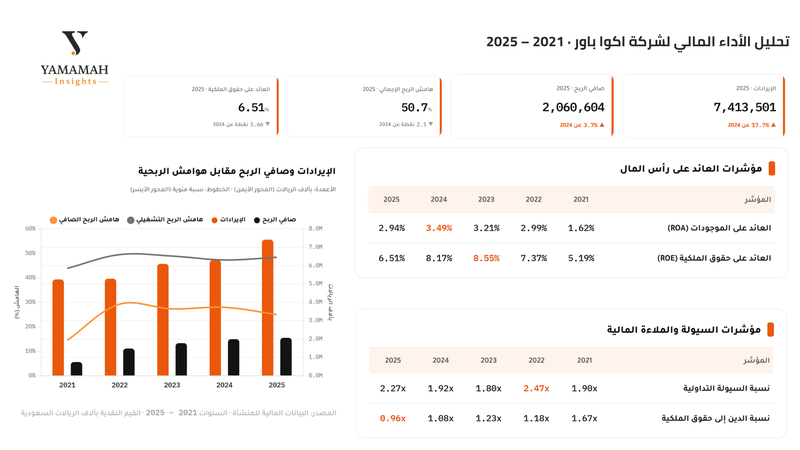
For Acwa Power, its presence in projects extending over 15 years and its 34.9% stake provide an opportunity to diversify its portfolio and build a long-term revenue stream. However, the actual financial impact depends on the details of financial close. Therefore, I believe project costs, the financing structure, and the expected return on investment are more important than the announced project size alone, particularly since return on equity declined from 8.55% in 2023 to 6.51% in 2025, despite revenue growth of 17.7% during 2025. This makes the efficiency with which the expansion is converted into shareholder returns an important point to monitor."
Strategic Enablement of Vision 2030 and the Quality of Future Earnings
In an analytical review of the company's performance, financial and economic analyst "Hamad Alsaeed" @Hamad Alsaeed explains: Energy storage contracts, with a capacity of 1,500 megawatts and storage capacity of 6,000 megawatt-hours, complement Acwa's portfolio. This move supports Vision 2030, which aims to raise the share of renewable energy to 50% of the electricity mix. Since renewable energy is inherently intermittent, storage converts it into reliable, round-the-clock power. It also reduces the need for gas-fired peaking plants, freeing up domestic fuel that can be used to support the Kingdom's ambitions to become a global hub for artificial intelligence data centers, or even directed toward exports.
Financially, the impact unfolds in two contrasting phases. In the first phase, before financial close, Acwa bears its 34.9% share of development expenses without generating revenue. This may temporarily pressure profit margins and return on equity, which has declined from 8.17% to 6.51%. In the second phase, upon commercial operation, the project becomes a 15-year power purchase contract. Revenue depends on available capacity rather than actual consumption, ensuring recurring income that improves earnings quality and offsets the initial pressure.


Comments (4)
No comments yet. Be the first to comment!