

United Electronics Company (Extra) announced on July 8, 2026 its estimated financial results for the first half of 2026, demonstrating operational resilience despite geopolitical developments and their impact on consumer spending, with total revenues increasing by 5.3% to nearly 4,069 million SAR supported by a 4.6% growth in the retail sector and an 11.8% expansion in the financing sector, driving semi-annual net profit to grow by 2.4% to approximately 197.23 million SAR.
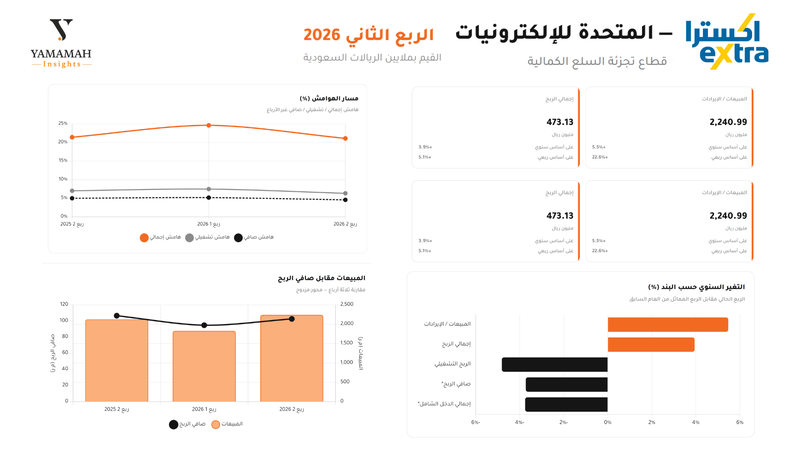
In the second quarter, revenues grew by 5.5% to reach approximately 2,240.99 million SAR, while quarterly net profit declined by 3.7% to 102.57 million SAR due to varying sector performance; the retail sector achieved a profit growth of 7.3% thanks to operational performance and the "Mega Sale" campaign that boosted profits compared to the previous quarter, while net profit in the consumer financing sector fell by 20.3% under pressure from market conditions and long-term operational investments.
The company stated that these results are estimates and have not yet been audited by external auditors, while continuing to apply the cost model to measure investment properties.
Students from Al Yamamah University discussed the implications of these results and the structural impacts of costs as follows:
Quality of Financing Assets and Stock Movement Implications
Student "Rimas Almashali" @Rimas Almashali opened the analysis by evaluating the strategic financial impact, stating: "Extra's results confirm that the retail activity remains strong, but the significant decline in the profitability of the financing sector despite a 13.6% growth in its portfolio deserves attention.
Expansion in lending is not a success in itself if it does not reflect on profitability, so what is more important in the coming periods is the company's ability to improve the return on the financing portfolio while maintaining asset quality.
The decline in the stock since the beginning of the year reflects investor caution regarding the future profitability of the financing sector more than it indicates weakness in the company's operational performance, especially since revenues and profits in the retail sector continue to show good growth."
Market Assessment of the Future and Financing Drivers
Student "Ghadah Alwallan" @Ghadah Alwallan commented by focusing on commercial and pricing aspects, saying: "The decline in the stock since the beginning of the year despite continued revenue growth may indicate that the market is focusing on the future profitability of the financing sector more than the current retail results.
Therefore, I believe that investors will monitor the company's ability to convert financing portfolio growth into actual profits in the coming periods, not just growth in portfolio size."
Management of Expansion Provisions and Regulatory Disclosure Aspects
Student @Thanaa Alshaib continued the discussion by focusing on credit and operational aspects, stating: "Regarding the growth of the financing portfolio alongside declining profits, I see that it does not necessarily mean a decline in asset quality; this may be due to expansion expenses or increased provisions, but the real test that deserves monitoring is the ability to keep default ratios under control.
On the other hand, estimated disclosure is of great importance as it provides investors with early insights to help them make decisions, and if there are significant discrepancies with the final results, it is natural for the company to clarify the reasons, highlighting the regulatory and supervisory importance to ensure the accuracy of information.
I also expect that e-commerce sales and the corporate sector helped raise the average purchase value as their orders are often larger and more stable, while the biggest challenge in the financing sector remains maintaining profitability amid rising costs and competition, not just attracting customers.
It is clear that management is focusing on the long term even if it pressures current profits; if current spending aims to build a stronger financing sector and increase market share, its benefits will show in the future, while campaigns like 'Mega Sale' are excellent for temporarily boosting sales but cannot be relied upon, as the most important thing is to maintain sustainable growth throughout the year."
Balancing Investment Portfolio Building and Risk Management
For her part, student @Shahad Almuhaisen provided an operational analysis balancing different activities, stating: "In my opinion, the results of the retail sector give a good impression, as the company managed to achieve growth in sales and profits despite current conditions.
As for the decline in financing profitability, I see it more related to expansion costs and portfolio building, which may temporarily pressure profits but could positively reflect if the company maintains collection quality and risk management.
Therefore, I believe that the next phase depends on achieving a balance between expansion and maintaining asset quality, not just increasing the financing portfolio."
Balancing Operational Efficiency and Future Growth Opportunities
Student @Tina Azy concluded the analysis by pointing out the dimensions of international expansion and financial balance, saying: "I see that Extra's results are balanced, as the increase in retail sales and net profit indicates continued demand strength, while the decline in financing sector profits despite a 13.6% growth in its portfolio seems related to expansion and future growth investment costs more than a weakness in activity.
If the company succeeds in improving financing efficiency in the coming periods, it may positively reflect on profits and stock price."
Quantitative Growth Meets Qualitative Pressure
In an analytical reading of the company's performance, financial and economic analyst "Hamad Alsaeed" @Hamad Alsaeed stated: The financial results for the second quarter of 2026 for Extra reveal a significant paradox of quantitative growth facing qualitative pressure. Despite a revenue growth of 5.5% reaching 2.24 billion SAR, net profit declined by 3.7% to 102.57 million SAR compared to 106.54 million SAR for the same quarter, reflecting a clear contraction in profit margins.
The main reason for the operational pressure lies in the consumer financing sector (Taseel), as while the financing portfolio recorded strong expansion growth of 13.6%, the sector's net profits faced a sharp decline of 20.3%. This contraction is due to a structural gap, as financing revenues grew by only 6.5% affected by a slowdown in spending due to geopolitical tensions and interest costs, while the company continued to inject high capital expenditures to enhance its operational capabilities and long-term strategy.
On the energy and shipping cost front, the retail sector faced rising logistical pressures resulting from macroeconomic changes, fuel prices, and supply chains. However, the sector demonstrated excellent resilience with a profit growth of 7.3%, supported by a 5.4% revenue growth across the corporate sales sector.
 Ask Yamami
Comments (9)
No comments yet. Be the first to comment!