

Malan Iron Products Company announced that it had received a notice stating that the company’s average closing share price had fallen below the permitted minimum threshold.
This step constitutes a regulatory warning requiring the monitoring of the share’s performance and the company’s compliance with regulatory requirements. It presents management with the challenge of dealing with share-price volatility while maintaining investors’ confidence in the financial market.
Students from Al Yamamah University discussed the financial and regulatory dimensions of this notice and its impact on the share’s future, as follows:
Share consolidation as a regulatory solution and the importance of addressing financial and operational performance
Student @فهد الطيب explained his view, saying: "In my opinion, the core problem is not the decline in the share price itself, but rather the reasons that led the market to price it at this level.
A share consolidation may be an appropriate regulatory solution to avoid a trading suspension and comply with listing requirements, but it does not address the essence of the problem unless it is accompanied by an improvement in financial and operational performance. Investors care about revenue growth, sustainable profits, and cash flows, as well as management’s ability to execute its plan and create value for shareholders.
Therefore, I believe that a share consolidation should be part of a broader plan that includes improving operational efficiency, enhancing results, and increasing transparency with investors. Any rise in the price resulting solely from the consolidation may be temporary if it is not supported by strong company fundamentals."
Deteriorating financial fundamentals and rising accumulated losses as a key underlying cause
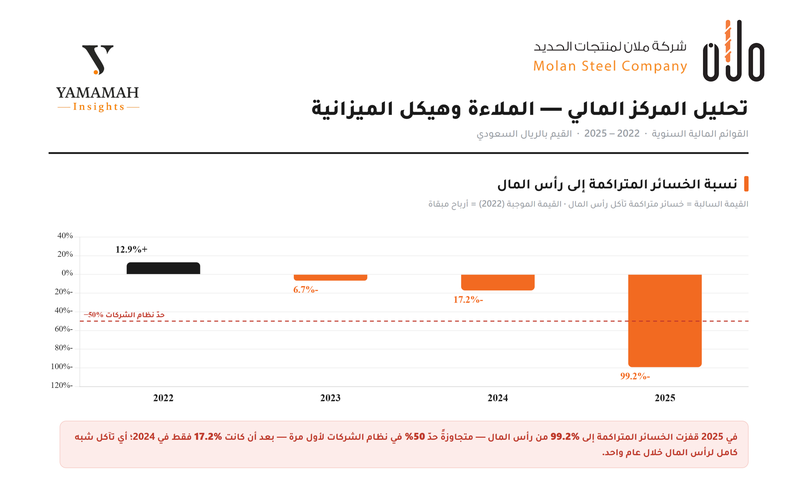
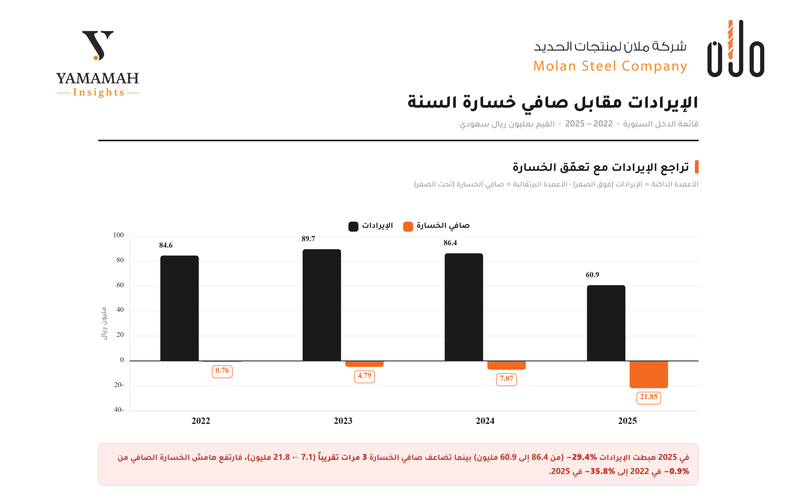
Student اروى الحويطي @Arwa Alhuwaiti shared her view, explaining: "From the financial statements, I can see that the main problem is not the share price itself, but the company’s declining financial performance, particularly in 2025, with accumulated losses rising to 99.2% of capital, revenues declining, and net loss increasing.
Therefore, I believe that the price decline reflects the company’s financial position more than it represents merely a market valuation.
As for the share consolidation, I looked into it and found that it is a regulatory solution that helps the company comply with listing requirements, but it does not resolve the underlying cause.
The most important thing is to have an operating plan that addresses the losses and improves profitability, because that is what will restore investors’ confidence and raise the share’s value over the long term."
Improving the company’s results instead of raising the price through formal measures
Student ريماس المشعلي @Rimas Almashali noted: "A share consolidation helps the company comply with listing requirements, but it does not solve the underlying problem.
If the company’s performance does not improve and investors’ confidence does not increase, the share may decline again.
Therefore, the priority should be improving the company’s results, not merely raising the share price through a regulatory procedure."
The regulatory grace period and the opportunity to rectify the situation before resorting to a consolidation
Student جمانة الشهري @Jumana Alshehri added: "In my view, the situation cannot be judged solely by the share price, because a price decline may reflect weak investor confidence or a low market valuation rather than necessarily indicating weak financial performance. It is therefore necessary to examine the company’s results, cash flows, and profitability before reaching a judgment.
If I were the CEO, I would first focus on improving the company’s performance and disclosing its plans to restore investors’ confidence. I would resort to a share consolidation only if the price did not improve during the grace period, because it addresses a listing requirement but does not resolve the underlying causes of the share’s decline.
From a legal perspective, I believe that granting the company a grace period before taking any action reflects a good balance between protecting investors and giving companies an opportunity to rectify their situations. A share consolidation is a regulatory procedure sufficient for complying with listing requirements, but it remains a cosmetic solution unless it is accompanied by a genuine improvement in the company’s performance."
Doubling losses and declining revenues and their impact on market valuation
Student محمد الغيهب @Mohammad Alghaihab detailed the results’ implications, saying: "In my opinion, the problem at Malan is not merely a decline in the share price; rather, it reflects a clear deterioration in the financial fundamentals.
Revenues fell from SAR 86.4 million in 2024 to SAR 60.9 million in 2025, while losses doubled to SAR 21.8 million. This caused accumulated losses to surge to 99.2% of capital, a very concerning percentage that exceeds the regulatory limit.
It is true that a share consolidation may temporarily resolve the minimum share-price issue, but it does not address the real cause.
If management cannot improve operations, increase revenues, and stop the bleeding from continued losses, pressure on the share will remain even after the share consolidation, because the market ultimately evaluates the company’s financial performance more than any formal measure."
Restructuring the nominal value to mitigate the risks of low-value shares
Expert عبدالعزيز خريص believes that: "In exceptional cases witnessed by the Saudi Exchange (Tadawul), some listed companies may face trading pressures that cause their share prices to fall below one riyal.
Although this scenario is rare, it places the company before an explicit regulatory obligation, as the Saudi Exchange notifies the company of the need to rectify the share’s position, either by naturally returning to trading above one riyal or by adopting a decision to reverse the nominal value in order to raise the share price above 3 riyals."
Kharais explained: "This step falls within a regulatory framework whose implementation began last year to mitigate the risks of low-value shares.
Shams was the first company in the market to apply this mechanism, reversing the nominal value of its share and raising it from half a riyal to 10 riyals per share.
Today, the same situation is recurring with Malan, whose share currently has a nominal value of one riyal and is trading at levels close to 98 halalas.
In light of these regulations, the company is moving toward restructuring the nominal value and raising it to 10 riyals. This will be reflected in the market share price, raising it from its current level to around 9 or 10 riyals in upcoming trading."
Erosion of financial fundamentals and the inevitability of restructuring
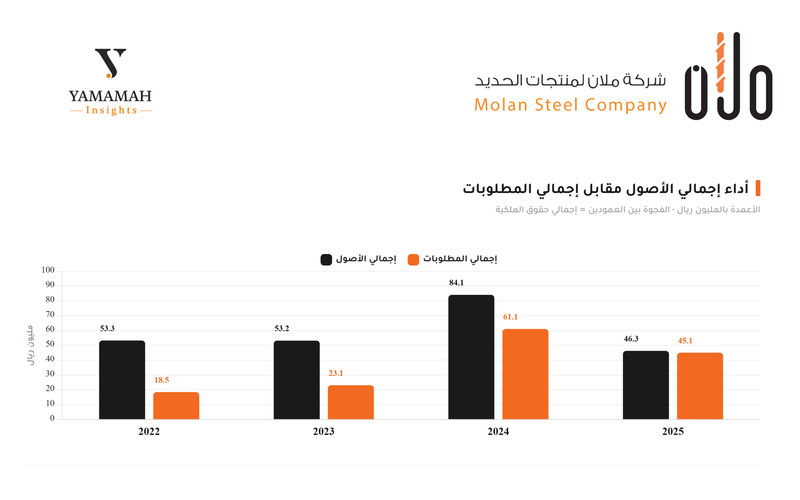
In an analytical review of the company’s performance, financial and economic analyst "حمد السعيد" @Hamad Alsaeed explains: The notice received by Malan regarding the decline in its average closing price below the minimum threshold is not the event itself, but rather a symptom of what the company’s financial statements reveal. A price of SAR 0.97 is a logical reflection of the nearly complete erosion of capital, with accumulated losses reaching approximately 99% of capital in 2025 and shareholders’ equity shrinking from approximately SAR 34.8 million to approximately SAR 1.2 million over four years.
More concerning is that the deterioration affects almost every aspect of financial performance. Revenues fell by 29% in 2025, while net loss doubled to approximately SAR 21.8 million and the loss margin widened to −35.8%. This is not a temporary pricing setback, but rather structural pressure on the operating model itself.
The notice and its corrective grace period are regulatory measures that address the price indicator, not the crisis that produced it. Raising the price through accounting tools such as share consolidation will not address the core problem. The real solution requires restructuring the capital, addressing the requirements of the Companies Law relating to capital erosion, and injecting new liquidity.
We believe that the priority for continuity is to implement a tangible rescue plan while securing liquidity, rather than applying a numerical and accounting-based solution to the minimum-price requirement.

Comments (6)
No comments yet. Be the first to comment!