

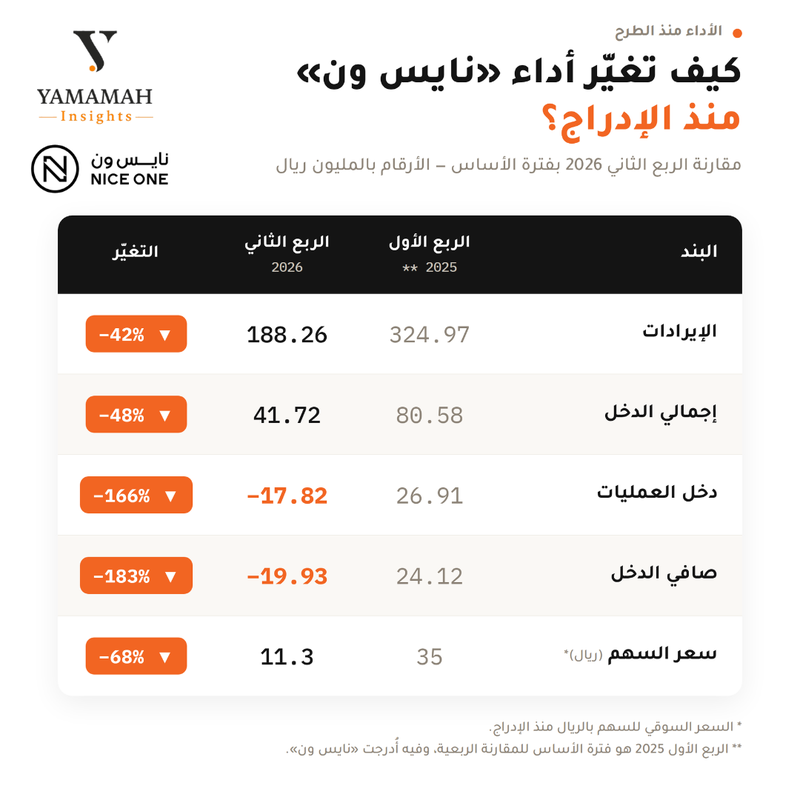
Nice One Beauty E-Marketing Company announced its preliminary financial results for the period ending June 30, 2026 (six months). The company recorded a net loss of SAR 11.28 million in the first half of 2026, compared with a net profit of SAR 22.84 million during the same period of the previous year.
The gap between listing ambitions and operational reality. During the second quarter of 2026, the company recorded a net loss of SAR 19.93 million, compared with a net loss of SAR 1.29 million in the second quarter of 2025.
Revenue declined by 2.12% to SAR 188.26 million, while total customer visits fell by 15.6% to 27.12 million visits. The expansion of retail stores partially offset this decline by increasing their contribution to revenue to 4.70% of total revenue, compared with 0.77% in the corresponding quarter.
The increase in net loss was attributed to lower gross profit and a rise in the provision for slow-moving inventory to SAR 8.8 million in the second quarter (SAR 12 million for the first half). Selling and marketing expenses also increased by 26.11% to SAR 96.16 million in the first half to support market share, while general and administrative expenses rose by 27.24% to SAR 32.80 million as a result of indirect costs associated with supporting the expansion of retail stores.
Yamamah University students discussed the implications of these financial results, the impact of customer visits, inventory provisions, and expansion costs as follows:
Rising costs and spending sustainability amid declining customer visits
Student "Rimas Almashali" @Rimas Almashali shared her view, saying: "In my opinion, the problem does not appear to be only declining revenue, but rather rising costs at a faster pace than the decline in sales.
Although the company has continued spending on marketing and expansion to maintain its market share, this has not prevented visits from declining and profits from turning into losses.
The key question is: When will this investment in expansion and marketing begin to show positive results, and can the company continue spending at this level if competition continues at the same pace?".
Inventory accumulation and stock turnover challenges versus a return to visit growth
For her part, student "Ghadah Alwallan" @Ghadah Alwallan explained the operational assessment, saying: "In my opinion, the real challenge is not the decline in revenue this quarter, as part of it is seasonal, but rather the combination of lower visits and a higher inventory provision. If this trend continues, it could mean that the company is purchasing inventory faster than demand is growing.
Therefore, in the coming results I will focus on improved inventory turnover and a return to visit growth, as these may be the best indicators that the current expansion is moving in the right direction".
A transitional phase between investing in expansion and testing cost controls
Student @فهد الطيب shared his financial analysis, saying: "In my view, the results reflect a transitional phase more than a decline in the company’s activity.
It is true that revenue declined and losses increased, but the stated reasons point to expansion and investment in growth, such as increased marketing spending and the expansion of retail stores. These expenses could have a positive effect over the medium term if they lead to an increase in market share.
It is also notable that the company indicated improved procurement efficiency and higher private-label sales, which could help raise profit margins in the future.
On the other hand, the continued rise in administrative and marketing expenses alongside declining orders will lead investors to focus on management’s ability to control costs and turn this expansion into actual profits, rather than merely growing the scale of activity.
In my opinion, the next two quarters will be very important in assessing the company. If revenue begins to grow alongside improving margins and lower losses, this period will be viewed as an investment in growth. However, if losses continue without a clear improvement in operational efficiency, pressure on the stock and investor confidence may increase".
Shift to an asset-heavy business model and a lower margin ceiling
Student "Rana Alshamrani" @Rana Alshamrani concluded the discussion with her financial analysis, saying: "The prevailing interpretation considers the 33.1% increase in administrative expenses in the second quarter compared with the same quarter of 2025 to be a temporary growth cost that will decline once the expansion stabilizes.
However, this expansion into physical branches is the primary reason for the increase in these expenses. The previous online model relied on an asset-light structure, whereas the branches introduced an asset-heavy component involving rents, operating costs, and salaries, all of which are more costly and generate lower margins.
This explains why the increase in the branches’ contribution, to 4.7% of revenue, did not translate into improved margins. Instead, it coincided with a 48% decline in gross income and a shift in operating income into negative territory.
Accordingly, a return to growth in visits and revenue alone will not be enough to restore profitability to its previous levels, given that the margin ceiling has structurally declined with the inclusion of branches in the business mix.
The true benchmark for the next two quarters will remain an improvement in gross margin, not merely a recovery in revenue growth".
Deteriorating financial performance and consumer behavior amid intensifying competition
Professor Abdulaziz Khrais commented on the stock’s performance and valuation, saying: "Nice One continues to surprise its investors by delivering unexpected results, after recording losses of -SAR 19 million in the second quarter of 2026.
The market has been abuzz over the past two days with extensive discussion of Nice One and the valuation assigned to the company at the beginning of 2025. The company was valued at SAR 35 as a growth company. The stock then rose by 99% after its offering, before the company began reporting losses and the stock plunged vertically until it reached its current trading price of SAR 11, representing a loss of 84% from its all-time high.
The company attributed its losses to intensifying competition, particularly as the consumer has become more discerning when purchasing non-luxury products. There are also many online platforms, allowing consumers to find suitable prices and offers from time to time.
Many people criticized management and attacked more than one aspect, including the high valuation and the way the company manages its expenses, especially since marketing consumes a significant portion of its spending. What can we expect from the company in the coming period?".
The gap between listing ambitions and operational reality
In an analytical assessment of the company’s performance, financial and economic analyst "Hamad Alsaeed"@Hamad Alsaeed explains: Commenting on Nice One’s latest results, the sharp gap between the ambitious listing targets of 26% growth and the current operating reality is becoming clear. Despite the relative improvement in gross profit margin in the first quarter to 27%, this gain was offset by bloated expenses.
Operating pressures were severe, with a net loss of SAR 19.9 million recorded in the second quarter—a fundamental issue requiring management intervention. The surge in marketing spending to approximately SAR 55 million and expansion costs coincided with declining revenue rather than growth, which may indicate that the company is incurring substantial costs defensively to buy time and protect market share, rather than to purchase growth.
Nevertheless, the beauty sector still retains promising growth opportunities in the Kingdom. We believe that some of this spending is investment-oriented and may provide support for revenue later, once operations stabilize and pricing conditions improve.
Accordingly, we believe management faces a narrow window of time either to prove that this cash burn will yield a sustainable operating lever or to acknowledge the loss of its competitive advantage.
Disclaimer: This material was prepared under the supervision of a “Yamamah Insights” editor and with the assistance of artificial intelligence tools for financial education purposes. It does not constitute a recommendation to buy, sell, or hold any security, and it reflects the views of its contributors rather than those of the platform.
 Ask Yamami

Comments (6)
No comments yet. Be the first to comment!